

About Anne Truitt
American · 1921–2004
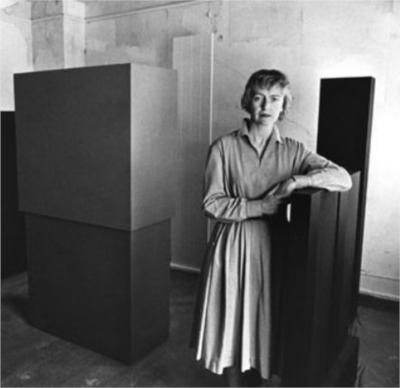
American[2] sculptor whose tall painted wooden columns encoded private memories in colour, working in Washington outside the New York mainstream.
Museums4
Countries1
Largest reported holdingNational Gallery of Art, Washington D.C. · 15 recorded works
Loading map…
Where to see Anne Truitt
Collection holdings are reported here; current display varies. Check with each museum before visiting.
-
15 recorded works
National Gallery of Art
Washington D.C., United States
-
2 recorded works
Smithsonian American Art Museum
Washington D.C., United States


-
2 recorded works
Yale University Art Gallery
New Haven, United States
-
1 recorded work
Metropolitan Museum of Art
New York City, United States


Frequently Asked Questions
Where can I see Anne Truitt's work?
Anne Truitt's artworks are held in numerous public collections. These include institutions within the United States, such as the Smithsonian American[2] Art Museum (Washington, D.C.), the National Gallery of Art (Washington, D.C.), and the Museum of Modern Art (New York). Other American museums holding her work are the Whitney Museum of American Art (New York), the Art Institute of Chicago, the Dallas Museum of Art, and the Los Angeles County Museum of Art. University collections include the Fogg Art Museum at Harvard University. Outside the United States, Truitt's pieces can be viewed at the Tate Gallery in London. It is always advisable to check a museum's website in advance to confirm which specific works are on display, as collection rotations can occur frequently. Major exhibitions of Truitt's work have also been organised periodically; these travelling shows offer another opportunity to view a substantial group of her pieces. Recent examples include the 2017 exhibition at the Baltimore Museum of Art, which then travelled to the Menil Collection in Houston.What should I know about Anne Truitt's prints?
Anne Truitt (1921[2]-2004[2]) is best known for her minimalist sculptures, but she also produced a number of prints. These graphic works offer a different perspective on her artistic concerns, providing an opportunity to explore her ideas in two dimensions. Truitt's prints include lithographs, a technique that involves creating an image on a flat stone or metal plate and then using ink to transfer it to paper. This method allows for a wide range of tonal variations and textures. Other artists who worked extensively in lithography include Henri-Georges Adam, Josef Albers, Alexander Calder, Marc Chagall, Ellsworth Kelly, Roy Lichtenstein, and Joan Miró. Printmaking allowed Truitt to explore colour and form in a more immediate way than sculpture. Her prints often feature simplified geometric shapes and subtle colour relationships, reflecting her interest in the essential elements of visual experience.Who influenced Anne Truitt?
Anne Truitt cited a wide range of artists as formative influences, particularly those she studied during her college years. She mentioned the Analytic Cubist work of Braque and Picasso, including their later periods, as being important. Early Kandinsky and Miró also played a significant role in her artistic development. She also expressed interest in Matisse and Mondrian. Truitt analysed the structure of their paintings in great detail. Specific works she studied include Matisse's *Blue Window* (1913), Miró's *Person Throwing a Stone at a Bird* (1926[2]), Cezanne's *Card Players* (1890-92), and Mondrian's grid paintings. Beyond these, Truitt examined works by Léger, Renaissance and Quattrocento artists, Old Masters, American[2] masters, and African art. She sought to absorb as much art as she could find. Truitt also felt a sense of collegial competition and mutual encouragement with contemporaries such as Hans Hofmann and David Smith.What is Anne Truitt's most famous work?
Anne Truitt is best known for her painted, minimalist sculptures. These works often take the form of simple geometric shapes, particularly columns. Truitt's sculptures explore colour, space, and perception. While it is difficult to identify a single "most famous" work, several pieces are particularly significant. "First Light" (1963[2]) is an early example of her columnar sculptures. It establishes many of the characteristics that would define her later work. Another important piece is "Piths" (1969), which demonstrates her interest in seriality and the subtle variations of colour within a series. "Spoke" (1993) is another well-known sculpture. Truitt's work can be found in major museum collections, including the Museum of Modern Art in New York, the National Gallery of Art in Washington, D.C., and the Tate Modern in London. Her sculptures continue to be exhibited and studied for their contribution to minimalist art.What style or movement did Anne Truitt belong to?
Anne Truitt (1921[2]-2004[2]) is often associated with Minimalism[2], although her relationship to the movement is complex. While her work shares some characteristics with Minimalist art, such as simple geometric forms and an emphasis on colour, Truitt maintained a distinct artistic vision. Truitt began making sculpture in the early 1960s, around the same time that Minimalism was emerging as a dominant force in the art world. Like Minimalist artists, she created sculptures from industrial materials, such as plywood, and she reduced her forms to basic shapes, usually rectangular columns. However, Truitt differed from many Minimalists in her emphasis on colour. She applied multiple layers of paint to her sculptures, creating subtle variations in tone and texture. Truitt also resisted the Minimalist tendency toward anonymity. She saw her sculptures as expressions of personal experience and emotion. In her diaries and writings, she discussed the relationship between her art and her life, particularly her experiences as a woman and a mother. Although her work shares some features with Minimalism, her emphasis on colour and personal expression sets her apart.What is Anne Truitt known for?
Anne Truitt is known for tall vertical columns of painted wood, with surfaces hand-applied in combinations of hue and value that carry private meanings. Each sculpture is described as the residue of a memory or chain of memories.
Sources
Where to See guide aggregates verified holdings of Anne Truitt's works across the following collections.
- [1] wikidata Wikidata: Q565848 Used for: identifiers.
- [2] wikipedia Wikipedia: Anne Truitt Used for: biography.
- [3] book Susie Hodge, Artistic Circles Used for: stylistic analysis.
- [4] book guggenheim-annialbers00webe Used for: biography.
- [5] book guggenheim-carlandre00wald Used for: biography.
- [6] book guggenheim-transfsi00wald Used for: biography.
- [7] book Meyer, James Sampson, 1962-, Minimalism : art and polemics in the sixties Used for: biography, stylistic analysis.
- [8] book Hodge, Susie, 1960- author, The short story of women artists : a pocket guide to movements, works, breakthroughs, & themes Used for: biography.
Editorial overseen by Solis Prints. Sources verified 2026-09-30. Click a source for details, or hover over [N] in the page above to preview.
Editorial standardsMethodologyCorrectionsAI disclosureAbout the editorial team