



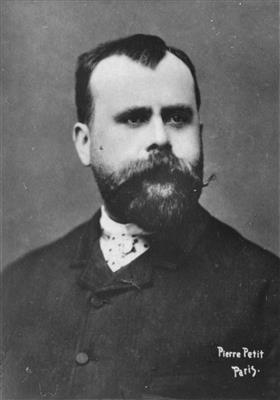
About Albert Maignan
Museums6
Countries2
Largest reported holdingMusée des Beaux-Arts de la ville de Paris, Paris · 4 recorded works
Loading map…
Where to see Albert Maignan
Collection holdings are reported here; current display varies. Check with each museum before visiting.
-
4 recorded works
Musée des Beaux-Arts de la ville de Paris
Paris, France
-
3 recorded works
Musée d'Orsay
Paris, France


-
1 recorded work
Museum of Fine Arts of Reims
Reims, France
-
1 recorded work
Palais des Beaux-Arts de Lille
Lille, France
-
1 recorded work
National Gallery of Victoria
Melbourne, Australia
-
1 recorded work
Musée Carnavalet
Paris, France


Frequently Asked Questions
Where can I see Albert Maignan's work?
Paintings by Albert Maignan can be viewed in several museums and galleries. In France, these include the Musée des Arts Décoratifs, Musée du Louvre, Musée Gustave Moreau, Musée National d’Art Moderne (Centre Georges Pompidou), Musée d’Orsay, and Musée du Petit Palais; all are located in Paris. Outside of Paris, Maignan's work can be seen at the Musée des Beaux-Arts in Nantes, and the Musée des Augustins in Toulouse. Other museums that hold his works are the Musée des Beaux-Arts in Nancy, and the Musée de l’Ecole de Nancy. Outside of France, museums with Maignan's paintings include the Musées Royaux des Beaux-Arts de Belgique in Brussels, and the Koninklijk Museum voor Schone Kunsten in Antwerp.Why are Albert Maignan's works important today?
Albert Maignan (1845[2]-1908[2]) was a French[2] painter known for historical and allegorical scenes. Assessing an artist's importance involves understanding how artistic value is assigned, and how reputations evolve. Judgements applied to artists, both living and dead, influence their position in a hierarchy, separating major painters from minor ones. The art world is subject to re-evaluation, where past figures can be reassessed by later generations. Conflicts around classification and hierarchical position serve to establish legitimacy and recognition. Nationality also plays a role. Despite globalisation, national concentration remains strong in the art world. Analysis of major international institutions reveals a high proportion of national artists, with American, German, British, French, and Italian artists often dominating. The "Kunstkompass" ranks artists based on institutional recognition and coverage in publications. While globalisation has led to some diversification in the geographical origins of recognised artists, Western Europe and North America still dominate.What techniques or materials did Albert Maignan use?
Information about Albert Maignan's specific techniques is scarce. However, some context about artists' materials and techniques of the period may be helpful. During the 19th century, a growing number of commercial artists' suppliers appeared. Before this, materials were often the domain of grocers and apothecaries. The rise of specialist colour merchants meant artists could purchase ready-made materials; however, some worried that the pursuit of profit might take precedence over the durability of the materials. Some artists of the time tried to recapture the techniques of earlier masters. Some believed the secrets of the Renaissance had been lost. Painters such as Louis Anquetin and Émile Bernard abandoned their own work to try to rediscover these methods. While study of earlier methods could be helpful, the materials available to modern painters differed from those used in the past.Who did Albert Maignan influence?
It is difficult to identify specific artists who were directly influenced by Albert Maignan. Some art historians have examined the broader question of artistic influence during Maignan's period. They note that artists of the time were grappling with how to develop individual styles, while also acknowledging the impact of earlier masters. One approach was to blend multiple influences, creating originality through a unique combination of sources. For example, Paul Cézanne directly quoted from Gustave Courbet's compositions. Other artists working in different styles and media also made connections to Courbet. The hunt for iconographic sources can sometimes yield surprising results. The lineage of Jeff Wall's photograph *The Drain* (1989) has been traced back to Courbet, via Cézanne. Wall makes it clear that he is making art from art, and that his practice has been informed by a variety of pictorial sources.Who influenced Albert Maignan?
Albert Maignan initially followed the Barbizon School style, displaying two paintings in that manner at the 1867[2] Salon. However, he abandoned this approach in 1868. He then embarked on a successful career as a history painter. Maignan, along with artists like Besnard, Aman-Jean, and Martin, aimed to combine topicality, naturalistic detail, and philosophical messages in their work. This was especially relevant given the decline in history painting[2] around 1891. A painting of the sculptor Carpeaux was well received at the Salon des Champs-Élysées of 1892. In terms of specific influences, his painting *The Passage of Fortune* shows similarities to Camille Pissarro’s drawing *The Temple of the Golden Calf* (1889-90), though there is no evidence Maignan intended a socialist critique like Pissarro.What is Albert Maignan's most famous work?
Albert Maignan (1845[2]-1908[2]) was a French[2] history painter. He is best known for large-scale historical and allegorical compositions. One of Maignan's most recognised pieces is "The Departure of the Vikings" (1888[2]). This painting depicts a Viking longship setting sail. It is a dramatic representation of Norse seafarers. The artwork is in the town hall at Saint-Cloud. Another important painting by Maignan is "Saint Louis Cares for the Plague Victims" (1897). It portrays Louis IX, the 13th-century king of France, tending to those afflicted by plague during the Eighth Crusade. This work is located in the Panthéon in Paris. It demonstrates Maignan's ability to handle complex historical narratives. Maignan also produced paintings for the ceiling of the Paris Opéra Comique. These paintings, finished in 1898, feature allegorical figures representing music and poetry. They are less frequently discussed than his large canvases, but they are still significant examples of his academic style.What style or movement did Albert Maignan belong to?
Albert Maignan (1845[2]-1908[2]) was a French[2] history painter and portraitist. He is usually associated with the academic art of the late nineteenth century. This style valued historical accuracy, idealised forms, and technical skill. Maignan studied with Joseph Blanc and Jules Noël. He won the Prix du Salon in 1867[2]. Maignan's paintings often depicted scenes from French history and mythology. Examples include "The Departure of the Norman Fleet for the Conquest of England" (1874) and "Saint Louis Visiting the Plague Victims" (1881). These works demonstrate his ability to create large-scale, detailed compositions. Academic art was dominant in France during Maignan's career. The Académie des Beaux-Arts controlled artistic training and exhibitions. Artists like Maignan achieved success by following its guidelines. However, academic art later faced challenges from modern movements like Impressionism and Post-Impressionism. These movements rejected academic conventions. They favoured subjective expression and experimentation. Maignan's style remained rooted in academic traditions despite these changes. He continued to produce paintings that reflected its values.What was Albert Maignan known for?
Albert Maignan (1845[2]-1908[2]) trained with Noel and Luminais. He debuted at the 1867[2] Salon with two paintings in the style of the Barbizon School. Although these were well received, he abandoned that approach in 1868. Maignan then embarked on a successful career as a history painter. He received prizes throughout the 1870s and 1880s. In 1892, he was awarded the Salon's medal of honour for *Carpeaux*, which was purchased by the State for the Musée du Luxembourg. This painting marked the beginning of his interest in finding a balance in history painting[2]. He sought to reconcile the specificity of contemporary subject matter with the generalisation of the Ideal. This problem occupied him until his death. Maignan, along with Besnard, Aman-Jean and Martin, belonged to the generation of Salon artists of the 1890s who sought to express the Eternal through a combination of topicality, naturalistic detail and philosophical message.
Sources
Where to See guide aggregates verified holdings of Albert Maignan's works across the following collections.
- [1] museum Museum of Fine Arts of Reims Used for: museum holdings.
- [2] wikipedia Wikipedia: Albert Maignan Used for: biography.
- [3] book Harding, James, Artistes pompiers : French academic art in the 19th century Used for: biography.
- [4] book Post-impressionism : cross-currents in European painting Used for: biography.
- [5] book Post-impressionism : cross-currents in European painting Used for: biography.
Editorial overseen by Solis Prints. Sources verified 2026-09-30. Click a source for details, or hover over [N] in the page above to preview.
Editorial standardsMethodologyCorrectionsAI disclosureAbout the editorial team