



Andrea Solario
When the French Cardinal d'Amboise failed to lure Leonardo da Vinci to his chateau in Normandy, he settled for Leonardo's closest Milanese follower. In 1507[1], Andrea Solario travelled to France and spent two years painting frescoes in the chapel at the Château de Gaillon, one of the first significant introductions of Italian[1] Renaissance[1] painting to French soil. He was, in the Cardinal's estimation, the best available substitute for the unavailable original.
Biography
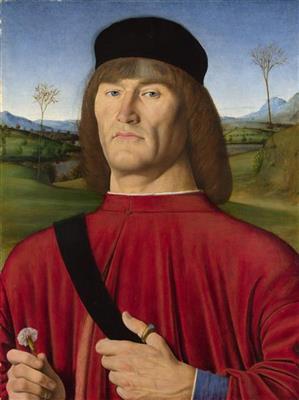
Solario's formation was broader than the Leonardo connection suggests. He was born in Milan around 1460[1] and trained initially with his brother Cristoforo, a sculptor working at Milan Cathedral and the Certosa di Pavia. A visit to Venice around 1490 exposed him to Antonello da Messina, whose northern technique of building up glazed layers to achieve optical depth left a clear mark on his portrait work. His Portrait of a Venetian Senator (c. 1492, National Gallery, London) belongs to this phase: precise, cool, and constructed in the Flemish-Venetian manner.
After returning to Milan in 1493, he entered the orbit of Leonardo, absorbing the master's way of modelling form through shadow and his preference for the three-quarter view in portraiture. The Portrait of Charles d'Amboise (c. 1507[1], Louvre), painted shortly before Solario's French journey, shows this inheritance at its clearest: a sitter turned slightly from the viewer, face emerging from a dark ground. The Madonna with the Green Cushion (1507, Louvre) carries the sfumato haze of the Leonaresque circle without being a copy of it.
He returned to Milan and continued working until his death around 1524[1], completing work connected to the Certosa di Pavia altarpiece cycle his brother had been involved with decades earlier. Later paintings show Flemish touches, suggesting a possible visit to the Low Countries.
Timeline
- 1460Born in Milan. He trained with his brother Cristoforo, a sculptor.
- 1490Visited Venice, where he was exposed to the work of Antonello da Messina.
- 1492Painted "Portrait of a Venetian Senator".
- 1493Returned to Milan and began absorbing Leonardo da Vinci's techniques.
- 1507Travelled to France to paint frescoes in the chapel at the Château de Gaillon.
- 1507Painted "Portrait of Charles d'Amboise".
- 1507Painted "The Madonna with the Green Cushion".
- 1509Returned to Milan after two years in France.
- 1524Died in Milan, aged around 64. He had been working on the Certosa di Pavia altarpiece cycle.
Notable Works
Tap to view larger.
Next stop
Renaissance →
Explore the artists and ideas of Renaissance.
Related Artists




Frequently Asked Questions
What is Andrea Solario's most famous work?
It is difficult to identify a single "most famous" work by Andrea Solario. Several paintings are recognised as significant examples of his output. These include "Adoration of the Magi" (1462), which is held in the Galleria degli Uffizi, Florence. Another is "Camera degli Sposi" (1473), located in the Palazzo Ducale, Mantua. "The Lamentation over the Dead Christ", circa 1480, can be found in the Pinacoteca di Brera, Milan. Also of note is "St. Sebastian" (1480), which resides in the Musée du Louvre, Paris. Finally, there is the "Madonna with the Cherubim" (1485), also in the Pinacoteca di Brera, Milan. The relative notability of these works can vary depending on the specific focus of art-historical study or popular interest.What should I know about Andrea Solario's prints?
Andrea Solario, an Italian[1] painter of the High Renaissance[1], was active primarily in Milan, but also Venice and France. While he is best known for his paintings, it is useful to consider the wider context of printmaking during his time. Printmaking in the Renaissance was a growing industry. Woodcuts and engravings allowed for the wider distribution of images and ideas. These prints were not only artworks in themselves, but also served as sources of inspiration for other artists. Northern European engravings, for example, found their way into Florentine workshops and influenced Italian art. Prints had various functions. They were used as models for sculptors, and examples appear in decorative arts. They were also pasted into manuscripts, and collected as part of personal collections. The circulation of prints facilitated the exchange of artistic ideas across Europe. Printmaking was a means of marketing and distributing images to a broad audience.What style or movement did Andrea Solario belong to?
Andrea Solario was an Italian[1] painter of the High Renaissance[1]. The Renaissance was a period of artistic and cultural flourishing that began in Italy in the 14th century, reaching its peak in the High Renaissance (about 1490 to 1527). Renaissance artists sought to revive the artistic ideals of classical antiquity, placing emphasis on human form and naturalistic representation. Developments in painting during the early Renaissance included the use of perspective, proportion, and attention to detail. The High Renaissance fused the large-scale vision of the early 15th century with the realistic detail of the later 15th century. Renaissance Humanism also affected the art of the period. Humanism considered man the centre of the universe, and promoted study of classical literature and philosophy.What techniques or materials did Andrea Solario use?
Andrea Solario, an Italian[1] Renaissance[1] artist, employed a range of techniques and materials typical of his time. He is known for his oil paintings, a medium that allowed for detailed work and the creation of luminous effects. Venetian artists had access to a wide array of high-grade pigments, due to Venice's status as a commercial centre and port. Pigments such as azurite blue came from Germany and Hungary, carmine red from Poland, and verdigris green from the Netherlands. Natural ultramarine blue was imported from present-day Afghanistan. Solario, like other Venetian painters, mixed colour by applying separate layers of distinct colours, rather than mixing paint on the palette. This "broken colour" technique created variations in colour, texture, and focus. He also painted frescoes, a technique of mural painting on fresh lime plaster, allowing the pigment to bind into the plaster as it dried. This method required a rapid and resolute hand, as alterations were difficult once the plaster was applied.What was Andrea Solario known for?
Andrea Solario, an Italian[1] Renaissance[1] painter of the Milanese school, is noted for his portraits and religious works, often displaying a Leonardesque influence. Active primarily in the late 15th and early 16th centuries, Solario's style combined elements of Venetian colourism with the more formal approach typical of Lombardy. He spent time in Venice; this exposure to Venetian art is evident in his use of light and colour. Some of his important commissions include work for the church of San Giorgio Maggiore in Venice. He also travelled to France around 1507[1], where he worked on decorations for the Château de Gaillon. His paintings often feature a sense of realism and attention to detail, particularly in his portraits. Solario's ability to blend different regional styles contributed to his recognition during the High Renaissance.When did Andrea Solario live and work?
Andrea Solario was active as an artist during the late 15th and early 16th centuries. While precise dates for his birth and death are not available here, a general timeline of the artistic and historical events of the period can be established. In the 1440s, developments in art included Fra Angelico's frescoes in Florence and Donatello's sculptures in Padua. The 1450s saw Alberti designing buildings in Florence and Rimini, and Mantegna working on frescoes in Padua. By the 1470s, Botticelli was painting in Florence, and Perugino was contributing to the Sistine Chapel in Rome. Leonardo da Vinci's *Last Supper* in Milan dates to the 1490s. During the early 1500s, Michelangelo was sculpting in Florence and designing tombs. Raphael was painting frescoes in the Vatican. These events provide a sense of the artistic milieu in which Solario lived and worked.Where can I see Andrea Solario's work?
Andrea Solario's paintings and drawings can be found in numerous public collections. In Italy, his works are held by the Galleria degli Uffizi (Florence), the Pinacoteca Civica (Piacenza), and the Pinacoteca di Brera (Milan). Elsewhere in Europe, you can find Solario at the Musée du Louvre (Paris), the Staatliche Museen zu Berlin, the Kunsthistorisches Museum (Vienna), the National Gallery (London), and the National Gallery of Scotland (Edinburgh). Outside Europe, look for Solario's pieces at the Metropolitan Museum of Art (New York) and the National Gallery of Art (Washington, D.C.). Other museums that hold his works include the Ashmolean Museum (Oxford), the J. Paul Getty Museum (Los Angeles), and the Royal Cabinet of Paintings Mauritshuis (The Hague).Where was Andrea Solario from?
Andrea Solario was an Italian[1] artist. Many Italian artists were not from the city where they performed most of their work. Leonardo Bruni, a humanist known for his praise of Florence, was from Arezzo. Ficino, a philosopher, came from Figline in the Valdarno. Leonardo da Vinci was from Vinci, a village in Tuscany. Three non-Venetian humanists, Giorgio Merula, Giorgio Valla, and Marcantonio Sabellico, spent considerable time in Venice. The most well-known Venetian painters were not from Venice. Giorgione was born in Castelfranco, a small town, and Titian was born in Pieve di Cadore. Being outsiders may have given them more freedom from local cultural traditions, making it easier for them to innovate.Who did Andrea Solario influence?
Andrea Solario was part of the Milanese school that had formed before Leonardo da Vinci's arrival in the city. This school was influenced by Mantegna and the Venetians. From Mantegna, the Milanese artists adopted a taste for foreshortening and perspective. The Venetians revealed the delights of colour to some Milanese painters, including Solario, in tones that were alternately brilliant and deep. Leonardo's presence in Milan affected a number of artists. These included his immediate pupils and imitators, such as Salai, Boltraffio, Marco d’Oggione, Cesare da Sesto, Melzi, Bernardino Luini, il Sodoma, and Gaudenzio Ferrari. Even artists outside this direct circle felt Leonardo's influence. Girolamo Aliprandi of Messina (1470-1524[1]) studied Leonardo with such dedication for his Presentation in the Temple in the Duomo at Messina that the picture was long attributed to Leonardo himself. In the seventeenth century, Peter Paul Rubens studied Leonardo's work with passion. Rembrandt also drew inspiration from da Vinci.Who influenced Andrea Solario?
Andrea Solario, an Italian[1] painter of the High Renaissance[1], was born around 1465 and died in 1524[1]. Leonardo da Vinci (1452-1519[1]) appears to have been a significant influence. Other artists who were active during similar periods include: Agostino da Lodi (flourished 1467-1524[1]), Altdorfer, Baldovinetti (circa 1425-1499), Bartolomeo (1473-1517), Giovanni Bellini (1430-1516), Jacopo Bellini (1400-1470), Boltraffio (1467-1516), Botticelli (1445-1510), Brunelleschi (1377-1446), Castagno (1446-1497), Cimabue (1240-1302), Cosimo (di) (1462-1521), Costa (1460[1]-1535), Credi (di) (circa 1458-1537), Donatello (1386-1524), Fra Angelico (1378-1455), Piero della Francesca (circa 1416-1492), Ghiberti (1378-1455), Ghirlandaio (1449-1494), Giotto di Bondone (circa 1267-1337), Ingres (1780-1867), Filippino Lippi (1457-1504), Fra Filippo Lippi (circa 1406-1469), Lotto (1480-1556), Luini (1530-1593), Mantegna (1431-1506), Master of the Pala Sforzesca (flourished 1480-1520), Messina (da), (1430-1479), Michelangelo (1475-1564), Nelli (1661-1725), Piero Pollaiuolo (1441-1496), Pinturicchio (1454-1513), Porta (della) (circa 1490-1545), Predis (de) (circa 1455-1522), Raphael (1483-1520), Romano (circa 1470-1512), Andrea del Sarto (1486-1530), Tintoretto (1518-1594), Titian (1490-1576), Uccello (1397-1475), Vasari (1512-1574), and Verrocchio (del) (circa 1435-1488).Who was Andrea Solario?
Andrea Solario (c.1465-1524[1]) was an Italian[1] painter of the Milanese school. He was one of many artists whose work was influenced by Leonardo da Vinci. Others include Salai, Boltraffio, Marco d’Oggione, Cesare da Sesto, Melzi, Bernardino Luini, il Sodoma, and Gaudenzio Ferrari. The Milanese school had existed before Leonardo's arrival; artists such as Michelino, Vincenzo Foppa, Bernardo Zenale, Buttinone, and Ambrogio Borgognone were active at that time. The school was influenced by Mantegna and the Venetians, adopting Mantegna's taste for perspective and the Venetian subtleties of colour. However, the Milanese artists sought harmony rather than splendour, using amber tones that were distinct from the Florentine style. Solario, like other Milanese painters, employed rich and luminous colours. His work, along with that of Francesco Napoletano and Girolamo Aliprandi, demonstrates the impact of Leonardo's style on artists in the region.
Sources
Editorial draws on the following primary and tertiary references for Andrea Solario.
- [1] wikipedia Wikipedia: Andrea Solario Used for: biography, birth dates, death dates, identifiers, movement attribution, nationality.
- [2] book Beard, Lee, 1973- author, Butler, Adam, author; Van Cleave, Claire, author; Fortenberry, Diane, author; Stirling, Susan, author, Beard, Lee, 1973- author, Butler, Adam, author; Van Cleave, Claire, author; Fortenberry, Diane, author; Stirling, Susan, author - The Art Book_ New Edition, Mini Format Used for: biography.
- [3] book Franois Quiviger;, Leonardo Da Vinci Used for: stylistic analysis.
- [4] book da Vinci Leonardo; Müntz, Eugène; da Vinci Leonardo, Leonardo da Vinci _ artist, thinker, and man of science volume 1 Used for: biography.
- [5] book da Vinci Leonardo; Müntz, Eugène; da Vinci Leonardo, Leonardo da Vinci _ artist, thinker, and man of science volume 1 Used for: biography.
- [6] book Metropolitan Museum of Art (New York, N.Y.), The Age of Caravaggio Used for: biography.
- [7] book Catherine Fletcher, The Beauty and the Terror Used for: biography.
Editorial overseen by Solis Prints. Sources verified 2026-09-18. Click a source for details, or hover over [N] in the page above to preview.
Editorial standardsMethodologyCorrectionsAI disclosureAbout the editorial team