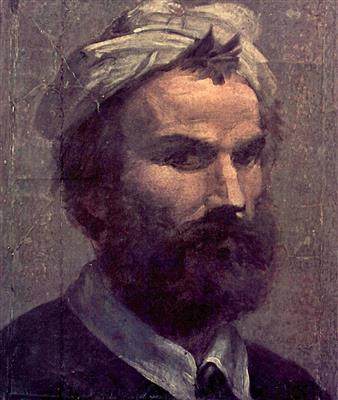
Crossing of the Red Sea by Agnolo Bronzino
Saint Martin and the Beggar by El Greco
Portrait of the Dwarf Nano Morgante by Agnolo Bronzino
Christ Driving the Money Changers from the Temple by El Greco
Summer (from The Four Seasons) by Giuseppe Arcimboldo
Autumn by Giuseppe Arcimboldo
Self-portrait by Sofonisba Anguissola
Portrait Group with the Artist’s Father, Brother and Sister by Sofonisba Anguissola
Plato’s Cave by Cornelis van Haarlem
The Dragon Devouring the Companions of Cadmus by Cornelis van Haarlem
Battle of Salvore by Domenico Tintoretto
Allegory of Vigilance by Domenico Tintoretto

Mannerism

17 artists · 1520–1600

Mannerism[4] emerged in Italy around 1520, in the generation after Leonardo, Raphael and Michelangelo had seemingly brought painting to perfection. Younger artists faced an impossible challenge: how to advance beyond masters who had already achieved ideal harmony. Their answer was to break the rules deliberately. Figures were elongated, twisted into spiralling poses, and set in compressed or ambiguous spaces. Colour shifted from naturalistic tones to sharp, acidic combinations. Compositions avoided the stable symmetry of the High Renaissance in favour of tension, complexity and visual wit. The movement spread from Florence and Rome to courts across Europe, finding receptive patrons in Prague, Fontainebleau and Toledo. Critics long dismissed Mannerism as decadent or affected. Twentieth-century scholars rehabilitated it, recognising in its self-conscious sophistication a forerunner of modern anxieties about originality and artistic exhaustion.

Key Ideas

  • Crossing of the Red Sea — Mannerism

    The Anxiety of Influence

    Mannerism was the first European art movement defined by its relationship to a predecessor. Artists such as Pontormo, Rosso Fiorentino and Parmigianino grew up studying the achievements of Leonardo, Raphael and Michelangelo. Rather than simply imitate, they exaggerated, distorted and recombined elements from these masters. The result was an art that was overtly referential, quoting earlier works while subverting their balance. This dynamic anticipated the modern condition in which every artist must position themselves in relation to an existing tradition.

  • Saint Martin and the Beggar — Mannerism

    The Elegant Distortion

    Mannerist figures are immediately recognisable by their elongated proportions, small heads and serpentine poses. Parmigianino's Madonna of the Long Neck pushes the Virgin's body to impossible proportions. El Greco's saints appear to stretch upward as if pulled by spiritual gravity. These distortions were not errors of draughtsmanship; they were deliberate departures from nature in pursuit of an ideal gracefulness that transcended realism. The Italian term maniera, meaning style or stylishness, gives the movement its name and signals its priorities.

  • Portrait of the Dwarf Nano Morgante — Mannerism

    Courtly Sophistication

    Mannerism thrived in court settings. Bronzino served the Medici in Florence, producing portraits of glacial elegance and complex allegorical paintings for private viewing. Arcimboldo amused the Habsburg court in Prague with composite heads made of fruit, flowers and objects. The movement's intellectual puzzles, coded references and virtuosic technique suited an aristocratic audience that valued wit, learning and surprise. Court Mannerism spread through diplomatic gift-giving and the movement of artists between royal households.

  • Christ Driving the Money Changers from the Temple — Mannerism

    Colour as Expressive Force

    High Renaissance colouring aimed at harmony and naturalism. Mannerist painters abandoned this restraint. Pontormo used pinks, pale greens and lavenders that have no atmospheric source. El Greco applied whites and blues with an intensity that dissolves solid form into flickering light. Rosso Fiorentino combined harsh oranges with cold blues. This liberated use of colour detached painting from representation and pushed it toward purely emotional effect, anticipating developments that would not fully emerge until Expressionism four centuries later.

Origins

After Perfection: The Crisis of 1520

Raphael died in 1520 at the age of thirty-seven. His death coincided with the Sack of Rome in 1527 and a broader cultural crisis in Italy. The three great masters of the High Renaissance had set standards of harmony, proportion and idealised beauty that seemed unsurpassable. Younger painters in Florence and Rome responded by turning away from balance toward complexity. Pontormo and Rosso Fiorentino began producing works of startling emotional intensity and spatial ambiguity as early as the mid-1520s. The term Mannerism derives from maniera, the Italian word for stylishness, and reflects the movement's emphasis on personal artistic manner over adherence to nature.

The Medici Court and Bronzino's Florence

Duke Cosimo I de' Medici made Florence a centre of Mannerist culture during the 1540s and 1550s. Bronzino served as court painter, producing state portraits of icy perfection and complex allegorical paintings for the duke's private apartments. Giorgio Vasari, who wrote the first art-historical survey (Lives of the Most Excellent Painters, Sculptors, and Architects, 1550), was also a practising Mannerist painter and architect. The Medici court valued artistic virtuosity as a projection of political power, and Mannerist art's difficulty and exclusivity suited this purpose.

International Mannerism

By the 1550s, Mannerism had spread beyond Italy through travelling artists and printed reproductions. The School of Fontainebleau brought Italian Mannerist ideas to France under Francis I. Rudolf II's court in Prague attracted Arcimboldo, Bartholomaeus Spranger and other artists who created a refined, sometimes bizarre court style. El Greco carried the movement to Spain, where his intensely personal interpretation survived long after Mannerism had faded elsewhere. In the Low Countries, artists like Joachim Wtewael adopted Mannerist figure types for mythological scenes. The movement's international spread demonstrated that artistic ideas could travel across political boundaries through prints, diplomacy and personal ambition.

In Their Words

“I hold the imitation of colour to be the greatest difficulty of art.”
El Greco, Annotations on Vasari's Lives, c. 1568
“An artist must study the masters but guard the original style that beats within his soul.”
El Greco, Attributed, widely cited in art-historical literature
“The judgment of the eye is the most important.”
Giorgio Vasari, Lives of the Most Excellent Painters, Sculptors, and Architects, 1550

All Mannerism Artists

15 artists.

Recommended Reading

  • Mannerism: The Crisis of the Renaissance and the Origin of Modern Art

    Mannerism: The Crisis of the Renaissance and the Origin of Modern Art

    Arnold Hauser · 1965

    Influential study linking Mannerist anxiety to the political and religious upheavals of sixteenth-century Europe.

  • Pontormo, Bronzino, and the Medici: The Transformation of the Renaissance Portrait in Florence

    Carl Brandon Strehlke · 2004

    Examination of Florentine Mannerist portraiture within the context of Medici court culture and patronage.

  • El Greco

    El Greco

    Michael Scholz-Hansel · 2004

    Concise monograph covering El Greco's formation in Crete, Venice and Rome, and his mature work in Toledo.

Frequently Asked Questions

  • What is Mannerism?
    Mannerism[4] was a late Renaissance style, running from about 1520 to 1600, that deliberately departed from the balanced clarity of Raphael and Michelangelo in favour of elongated figures, compressed or illogical space, acid colour and compositional strain. The name comes from the Italian maniera, meaning 'style' or 'manner'. Early practitioners took Michelangelo's late work as a starting point rather than a summit.
  • When did Mannerism start?
    The movement emerged in Florence and Rome immediately after Raphael's death in 1520, with Pontormo's Deposition from the Cross (1525 to 1528) and Rosso Fiorentino's Deposition (1521) as foundational canvases. The 1527 Sack of Rome scattered its practitioners across Italy and into France, where Rosso decorated the Château de Fontainebleau. The style lasted until Caravaggio opened the Baroque[4] around 1600.
  • Who are the most famous Mannerist artists?
    Jacopo Pontormo, Rosso Fiorentino and Parmigianino are the Italian founders. Agnolo Bronzino served the Medici court as a polished portraitist in the mature Mannerist mode. El Greco, trained in Venice and Rome, carried the style to Toledo, where his elongated figures reached new emotional intensity. Sculptors included Benvenuto Cellini[12] and Giambologna, whose Rape of the Sabine Women (1583) is a Mannerist tour de force.
  • What defines the Mannerist style?
    Mannerist paintings feature bodies with exaggeratedly long necks, small heads and serpentine poses (the so-called figura serpentinata), compositions that crowd the picture surface or stretch into unstable deep space, colour schemes of acid pinks, lemon yellows and icy blues, and subject matter that treats familiar biblical scenes with deliberate strangeness. Parmigianino's Madonna with the Long Neck (1535) is the canonical example.
  • What is the difference between Mannerism and High Renaissance art?
    High Renaissance art (c. 1495 to 1520) pursued balanced composition, naturalistic proportion, clear spatial logic and measured colour, exemplified by Raphael's School of Athens. Mannerism[4] (c. 1520 to 1600) took these resolved elements and deliberately unsettled them, as if their solutions were a starting point to be complicated. Where Raphael sought resolution, Pontormo and Parmigianino sought productive tension.
  • Why was Mannerism important?
    Mannerism[4] represents the first self-conscious departure from the classical ideal in Western painting, establishing that style itself could be a subject rather than a neutral vehicle for content. Its decorative elaboration shaped European court painting for eighty years. The movement also produced the first modern art theory, in Giorgio Vasari's Lives of the Most Excellent Painters (1550), which codified the painter's biography as a literary genre.
  • Where can I see the best Mannerist paintings?
    The Uffizi Gallery in Florence holds Pontormo, Bronzino and Parmigianino. The Prado in Madrid has the densest El Greco collection outside Toledo. The Louvre holds Rosso's Fontainebleau frescoes and paintings from the School of Fontainebleau. The Palazzo del Te in Mantua preserves Giulio Romano's decorative scheme. Santa Felicita in Florence still displays Pontormo's Deposition in the chapel it was painted for.

Sources

Mannerism editorial draws on the following published scholarship.

  1. [1] book Arnold Hauser, Mannerism: The Crisis of the Renaissance and the Origin of Modern Art, 1965 Used for: political views, stylistic analysis.
  2. [2] book Carl Brandon Strehlke, Pontormo, Bronzino, and the Medici: The Transformation of the Renaissance Portrait in Florence, 2004 Used for: biography, exhibition history, influences, stylistic analysis.
  3. [3] book Michael Scholz-Hansel, El Greco, 2004 Used for: biography, exhibition history, stylistic analysis.
  4. [4] wikipedia Wikipedia: Mannerism Used for: biography.
  5. [5] book Gardner, Helen, 1878-1946, Gardner's art through the ages Used for: biography.
  6. [6] book Hodge, Susie, 1960- author, The short story of women artists : a pocket guide to movements, works, breakthroughs, & themes Used for: biography.
  7. [7] book Beckett, Wendy, The story of painting Used for: biography.
  8. [8] wikipedia Wikipedia: Cristofano dell'Altissimo Used for: biography.
  9. [9] wikipedia Wikipedia: Bartolomeo Passerotti Used for: biography.
  10. [10] wikipedia Wikipedia: Domenico Beccafumi Used for: biography.
  11. [11] wikipedia Wikipedia: Alessandro Allori Used for: biography.
  12. [12] wikipedia Wikipedia: Benvenuto Cellini Used for: biography.
  13. [13] wikipedia Wikipedia: Claude Deruet Used for: biography.

Editorial overseen by Solis Prints. Sources verified 2026-06-19. Click a source for details, or hover over [N] in the page above to preview.

See Mannerism art in person.

Plan your visit to see Mannerism art →

Take Mannerism home.

See all Mannerism prints →
Back to Discover