



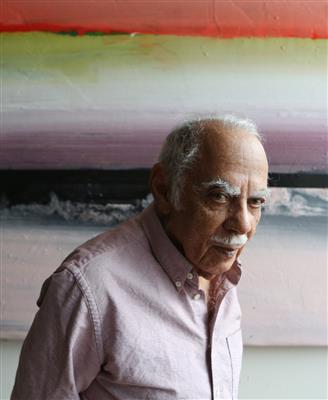
About Ed Clark
American · 1926–2019
New Orleans-born Abstract Expressionist who pioneered shaped canvases and broom-swept paint in the 1950s New York scene.
Museums5
Countries1
Largest reported holdingBuffalo AKG Art Museum, Buffalo · 1 recorded work
Loading map…
Where to see Ed Clark
Collection holdings are reported here; current display varies. Check with each museum before visiting.
-
1 recorded work
Buffalo AKG Art Museum
Buffalo, United States
-
1 recorded work
Museum of Modern Art
New York City, United States


-
1 recorded work
Art Institute of Chicago
Chicago, United States
-
1 recorded work
Detroit Institute of Arts
Detroit, United States
-
1 recorded work
Metropolitan Museum of Art
New York City, United States


Frequently Asked Questions
Where can I see Ed Clark's work?
Ed Clark's work can be viewed in several museums. In the United States, these include the Metropolitan Museum of Art (New York), the Museum of Modern Art (New York), the Los Angeles County Museum of Art, the Minneapolis Institute of Arts, the Virginia Museum of Fine Arts (Richmond), the Wolfsonian at Florida International University (Miami Beach), and the Charles Hosmer Morse Museum of American[1] Art (Winter Park, Florida). Outside the United States, museums that hold works by Ed Clark include the Royal Ontario Museum (Toronto). Other museums that hold fine art, textiles, and design may also hold work by Ed Clark, such as the National Museums of Scotland (Royal Museum, Edinburgh), the Victoria & Albert Museum (London), the Brighton Museum & Art Gallery, and the Manchester Art Gallery.What should I know about Ed Clark's prints?
When assessing Ed Clark's prints, bear in mind some basic facts about the medium. Printmaking is an unregulated activity, but some conventions have developed around editioning, signing, and numbering; these add value to the work. The edition claim is written as a pair of numbers on the left bottom margin of the print. The print number is written above, and the edition size is below. The title of the print is in the middle of the bottom margin. The signature is on the right of the bottom margin of the print. Edition descriptions are always signed in pencil. The largest number is the total number of prints in the edition; the smaller number is the sequential number of the actual print (for example, 35/100). Some artists hold out ten percent as artist’s proofs and number them separately with AP after the number (e.g., 5/100 AP). An 'original print' is conceived by the artist as a print and executed solely as a print, usually in a numbered edition, and signed by the artist.Why are Ed Clark's works important today?
Ed Clark's art is important because it contributes to a broader understanding of modernism and abstraction. His work challenges conventional narratives within art history by incorporating his identity as a Black artist. Clark's practice aligns with a movement that recognises cross-cultural exchange as fundamental to modernity. Black artists have historically been underrepresented; current scholarship seeks to address this by acknowledging their contributions. This involves re-evaluating established notions of influence and originality. Hale Woodruff, for example, integrated his ancestry into his abstract work, countering the idea that African art was simply an "irrational" source of inspiration. Clark's art invites a re-examination of the past, prompting viewers to consider the complexities of cultural exchange and the delayed recognition of Black artists' impact. This perspective acknowledges that Black culture has always been integral to American[1] culture, challenging previous interpretations that may have overlooked or dismissed this reality.What techniques or materials did Ed Clark use?
Ed Clark is best known for his shaped canvases and the use of a push broom to apply paint. He experimented with materials and methods throughout his career. Early in his career, Clark worked with traditional brushes and paint application. However, he soon sought ways to move beyond these conventional approaches. In the 1950s, he began diluting his paints, allowing them to stain the canvas. This technique created luminous effects and blurred boundaries between colours. Clark's innovation with the push broom came later. He would pour paint onto the canvas and then use the broom to spread it across the surface. This method allowed him to create broad, sweeping strokes and a sense of movement within his compositions. The broom also enabled him to work on a larger scale, producing expansive fields of colour. His shaped canvases further challenged traditional painting formats. Rather than adhering to the conventional rectangle, Clark created canvases with curved or irregular edges. This approach integrated the painting with its surrounding space.Who did Ed Clark influence?
Ed Clark's influence is evident in the work of William T. Williams, an African American[1] artist born around 1940[1]. Williams belongs to a generation that brought Black painting and sculpture to artistic maturity, following the civil rights movement. Williams developed a sophisticated technique comparable to jazz improvisation, interweaving colour and brushwork within a clear structure. This approach allows for variations on a central theme. Williams is concerned with formal issues, but the play of colour and abstract shapes evokes patterns, light, and space. His work seemingly captures an evanescent memory of the artist's past. Clark's work also had an impact on the broader artistic community. He explored the expressive possibilities of form and colour, maintaining a belief in their value. His work resonates with a range of emotional responses.Who influenced Ed Clark?
Ed Clark found inspiration in a range of artists and movements. Jackson Pollock had a particular impact; Clark said that Pollock's paintings resonated with him and opened the way for him to make his own contribution. Clark also expressed interest in older artists such as Rembrandt and Manet, wanting to understand their methods. He created his own abstract response to their works; for example, his painting *For E. M.* (1981[1]) is a version of Manet's *Fish (Still Life)* (1864). Through this process, Clark came to appreciate Manet's use of space and his ability to create both three-dimensional and flat effects in his paintings. Clark also admired Cubists, as well as Miró and Gorky. These influences helped shape Clark's understanding of painting and his own artistic approach.What is Ed Clark's most famous work?
Ed Clark is best known for his shaped canvases and his use of the push broom to apply paint. Although he produced a large body of work, it is difficult to identify one single piece as his "most famous". Clark began experimenting with shaped canvases in 1964[1], moving away from the traditional rectangle. These works include curves and angles, altering the viewing experience. Examples include Untitled from 1968, an oval canvas, and the 1972 shaped canvas in the collection of the Smithsonian American[1] Art Museum. His technique of using a push broom to spread paint across the canvas also became a signature element of his style. This method allowed him to create broad, sweeping strokes and a sense of movement in his paintings. He adopted this technique in the late 1950s. Clark's work defies easy categorisation. While associated with abstract expressionism, he also incorporated elements of colour field painting. His innovative approach to both form and technique has secured his place in the history of American art.What style or movement did Ed Clark belong to?
Ed Clark (1926[1]-2019[1]) is associated with abstract expressionism; however, he resisted easy categorisation. Clark began his studies at the Art Institute of Chicago in 1947[1], later moving to Paris in 1952. There, he was exposed to European modernism and met artists like Joan Mitchell. Although Clark's early work had affinities with second-generation abstract expressionism, he developed a distinctive approach. In 1956, he created his first shaped canvas, moving away from the traditional rectangular format. He poured paint onto the canvas, manipulating the flow to create dynamic compositions. This technique aligned him with the broader concerns of colour field painting, which prioritised colour and form over representation. Clark's work also connects to the Black Arts Movement. He was a member of the Spiral Group, a collective of African-American[1] artists who addressed issues of racial equality in their work. Although Clark's abstraction was not overtly political, his participation in Spiral reflects his engagement with social issues. Throughout his career, Clark explored different modes of abstraction, defying simple classification.
Sources
Where to See guide aggregates verified holdings of Ed Clark's works across the following collections.
- [1] wikipedia Wikipedia: Ed Clark Used for: biography.
- [2] book guggenheim-guggenheimintern00frye Used for: biography.
- [3] book guggenheim-onehundredpainti00thom Used for: biography.
- [4] book guggenheim-transfsi00wald Used for: biography.
Editorial overseen by Solis Prints. Sources verified 2026-10-14. Click a source for details, or hover over [N] in the page above to preview.
Editorial standardsMethodologyCorrectionsAI disclosureAbout the editorial team