



Bernardo Marques
A self-taught artist from Silves in the Algarve, Bernardo Marques became one of Portugal's most distinctive graphic voices in the 1920s through caricature and illustration, working in a wiry, satirical line before a visit to Berlin in 1929[1] changed the register of his work entirely.
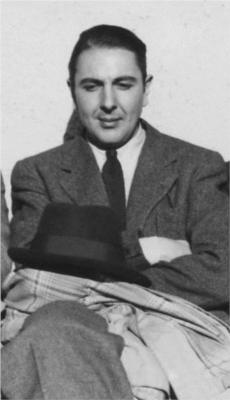
Biography
Born in 1898[1], Marques had no formal training but found his metier in Lisbon's illustrated press, where political caricature and graphic design were the most immediate routes into public visual culture. His early style was people-focused: acute physiognomies, sardonic observation, a draughtsman's eye for character. He married the painter Ofelia Marques, and the couple moved in Lisbon's small but committed modernist circle.
The Berlin visit was the turning point. Encountering German Expressionism at first hand, particularly the corrosive social satire of Georg Grosz, Marques returned with a harder formal sensibility. The encounter strengthened both his compositional rigour and his willingness to use distortion expressively rather than merely for comic effect.
In his later career he turned from figures towards landscape: Lisbon, Sintra, and the Algarve became his subjects, painted with a poetic restraint far removed from the graphic sharpness of his early work. He died in Lisbon in 1962[1], leaving behind a body of work that spans caricature, book illustration, and painting without settling comfortably into any one category.
Timeline
- 1898Born in Silves, Algarve.
- 1920Began working in Lisbon's illustrated press, focusing on political caricature and graphic design.
- 1929Visited Berlin and encountered German Expressionism, particularly the work of Georg Grosz.
- 1929Returned from Berlin with a harder formal sensibility, influencing his compositional rigour.
- 1962Died in Lisbon at 64. He produced caricatures, book illustrations and paintings.
Notable Works
Tap to view larger.
Next stop
Browse the movements →
Every movement in the collection, from the Renaissance to Pop art.
Related Artists

Frequently Asked Questions
What is Bernardo Marques known for?
Bernardo Marques is known for his graphic work, including caricature and illustration. His work spanned caricature, book illustration, and painting.What should I know about Bernardo Marques's prints?
When considering Bernardo Marques's prints, bear in mind some key aspects of printmaking as a medium. An "original print" is conceived as a print, and executed solely as a print. Each impression in the edition is an original, made from a plate or screen created for that purpose. The artist inks and pulls each print individually. The number of prints in an edition is decided by the artist, and they are numbered sequentially (e.g., 12/25, meaning the twelfth print in an edition of twenty-five). This numbering has only recently become standard; earlier prints were often unsigned or unnumbered. The artist usually signs the print in pencil, typically on the bottom margin. A reproduction, on the other hand, is a copy of a work originally created in another medium, such as painting. Numbering and signing a reproduction does not make it an original print. The intent behind creating the image distinguishes an original print from a reproduction. If the aim is to replicate an existing image, the result is a reproduction, regardless of the technique used.What style or movement did Bernardo Marques belong to?
It is difficult to assign Bernardo Marques to a single artistic movement. The early 20th century saw many artists drawing from multiple styles. Marques's work incorporates elements of both Art Deco and modernism, evident in his graphic design and illustration. Art Deco, which peaked in the 1920s and 1930s, embraced geometric shapes, stylised forms, and industrial materials. Modernism, a broader movement, sought to break from traditional artistic conventions, favouring abstraction and experimentation. Marques's bold use of line and simplified forms aligns with both aesthetics. His posters and advertising art often feature streamlined designs and a sense of dynamism, characteristic of Art Deco, while his rejection of realism places him within the modernist sphere. Marques created his own synthesis of both tendencies.What techniques or materials did Bernardo Marques use?
Information on Bernardo Marques's specific methods is limited; however, we can discuss painting techniques and materials generally. Oil paint is made by mixing dry pigment with linseed or another oil. The oil acts as a binder. Many artists apply paint to canvas, often prepared with gesso. Some artists prefer hog hair brushes for their stiffness. Others favour synthetic brushes. Some artists begin with a toned ground, or imprimatura, to establish a base colour. Underpainting, a monochrome version of the final image, can define forms before colour is added. Colour is often applied in thin, transparent layers called glazes. This allows the underpainting to influence the final appearance. Alternatively, artists may use direct surface blending, mixing colours on the palette and applying them to the canvas in smooth, continuous gradations. The choice of materials and techniques is a personal one, with artists often developing their own unique approaches.When did Bernardo Marques live and work?
Bernardo Marques (1898[1]-1962[1]) was a Portuguese[1] artist, best known for his work as a painter, illustrator, and graphic designer. He was born in Lisbon, where he spent most of his life. Marques began his artistic training at the Escola de Belas-Artes de Lisboa. He then worked as a caricaturist and contributed to several publications, including the satirical magazine *ABC*. His early work displays the influence of Art Deco and Cubism. In the 1930s and 1940s, Marques developed his distinctive style, characterised by bold lines, flat planes of colour, and a sense of humour. He produced posters, advertisements, book illustrations, and murals. His work often depicted scenes of Portuguese life, such as fishing villages, markets, and festivals. Marques participated in numerous exhibitions, both in Portugal and abroad. He received several awards for his work, including the National Prize for Illustration in 1957[1]. After his death in 1962, Marques's reputation as one of Portugal's leading modern artists has continued to grow. His work is now held in major public and private collections.Where can I see Bernardo Marques's work?
Bernardo Marques's work can be viewed in several museums. In Portugal, the Museu Calouste Gulbenkian (Lisbon) holds pieces. In Spain, visit the Museo Art Nouveau y Art Deco (Salamanca), Museu d’Art Modern (Barcelona), Museo de Bellas Artes (Bilbao), Fundacién Coleccion Thyssen-Bornemisza and Museo Nacional del Prado (Madrid). In the United Kingdom, collections are held at the Victoria & Albert Museum (London), the National Museums of Scotland (Edinburgh), Manchester Art Gallery, Brighton Museum & Art Gallery, the Geffrye Museum (London), and the Bakelite Museum. Other museums include the National Museum of Wales (Cardiff), the Scottish National Gallery of Modern Art (Edinburgh), the Burrell Collection (Glasgow), and the Jersey Museum and Art Gallery (St Helier). In the United States, see Marques's work at the Metropolitan Museum of Art (New York), the Museum of Modern Art (New York), the Los Angeles County Museum of Art, the Minneapolis Institute of Arts, the Charles Hosmer Morse Museum of American Art, the Wolfsonian at Florida International University (Miami Beach), and the Virginia Museum of Fine Arts (Richmond). Also, the Royal Ontario Museum (Toronto) has pieces.Where was Bernardo Marques from?
Bernardo Marques was Portuguese[1]. Portugal, during the mid-20th century, was under the Estado Novo regime. This regime maintained official neutrality during the Second World War. It supported both the Allies and the Axis powers, depending on what was most advantageous at any given moment. This strategy helped Portugal avoid attack during the war. In the 1950s, Portugal still controlled many colonies in Asia, Africa, and South America, with the exception of Bombay and Brazil. These territories included Macao, East Timor, Goa, Daman, Diu, Cape Verde, São Tomé e Príncipe, Guinea Bissau, Angola, and Mozambique. The promotion of Portugal as a pioneer of globalisation, through the union of different countries and peoples, was evident at events such as the Brussels World Fair. Objects related to the 'period of the Discoveries' were prominently featured.Who did Bernardo Marques influence?
Bernardo Marques (1898[1]-1962[1]) was a Portuguese[1] artist known for his work in illustration, advertising, and set design. While direct lines of influence are difficult to trace, we can consider his impact through the lens of his style and career. Marques's bold, graphic style, incorporating elements of Art Deco and modernism, certainly had an impact on subsequent generations of Portuguese designers and illustrators. His work in advertising, particularly his posters and promotional materials, helped to shape the visual culture of Portugal during the mid-20th century. This would have affected how commercial artists approached their work. His work in theatre design also exposed his aesthetic to a wider audience. Marques designed sets and costumes for numerous productions, contributing to the development of stagecraft in Portugal. Although it is difficult to name specific individuals who were directly influenced by Marques, his contribution to Portuguese visual culture is clear. He helped modernise design and illustration in the country.Who influenced Bernardo Marques?
Bernardo Marques (1898[1]-1962[1]) was a Portuguese[1] artist known for his work in illustration, drawing, and painting. He began his artistic training at the Superior School of Fine Arts of Lisbon. Marques's early work shows the influence of Art Deco, a style popular in the 1920s and 1930s. This can be seen in his use of geometric shapes, stylised figures, and bold colours. His travels in Europe exposed him to various artistic movements. Later in his career, Marques developed a more personal style, characterised by its focus on Portuguese themes and subjects. He was influenced by popular culture, and his illustrations often depicted scenes from everyday life. Marques also drew inspiration from Portuguese folk art, incorporating elements of traditional design into his work. He was part of a generation of artists who sought to create a distinctly Portuguese modern art. His work is a combination of international trends and local inspirations.Who was Bernardo Marques?
Bernardo Marques (birth and death dates unavailable) was a Portuguese[1] artist active during a period when Portugal still maintained its colonial territories in Asia, Africa, and South America. In the 1950s, Portugal controlled areas such as Macao, East Timor, Goa, Angola, and Mozambique. During this time, Portuguese art was promoted as a forerunner in a globalised world. This was achieved by uniting different countries and peoples. Portugal remained officially neutral during the Second World War. It supported the Allies by providing a military base in the Azores, and the Axis powers by providing vessels. Marques’s work fits within a period of Portuguese art that consciously developed a Portuguese modernity with an Atlantic lyricism that had universal appeal.Why are Bernardo Marques's works important today?
Bernardo Marques (1898[1]-1962[1]) was a Portuguese[1] artist known for his work as a modernist illustrator, painter, and graphic designer. Marques's art is important because it reflects the social and political circumstances of Portugal during his lifetime. His illustrations and designs often engaged with contemporary issues. Marques did not fully incorporate international aesthetic inquiries; instead, he portrayed specific historical and political circumstances. His work provides insight into Portuguese culture and society during a period of significant change. Marques's work is also significant within the history of Portuguese modernism. His contributions to graphic design and illustration helped to shape the visual culture of his time. The modernist movement of the 1910s included an authorial creativity based on conceptual understanding and subjective interpretation. Marques's art offers a valuable perspective on the development of modern art in Portugal, as well as its relationship to international artistic movements.What was Bernardo Marques's art style?
Bernardo Marques's early style was people-focused with acute observation. After visiting Berlin, his style shifted, and he developed a harder formal sensibility, strengthening his compositional rigour and expressive distortion.
Sources
Editorial draws on the following primary and tertiary references for Bernardo Marques.
- [1] wikipedia Wikipedia: Bernardo Marques Used for: biography, birth dates, death dates, identifiers, movement attribution, nationality.
- [2] book guggenheim-guggenheimintern1964allo Used for: biography.
- [3] book Jennifer D. Milam, Historical Dictionary of Rococo Art Used for: biography.
- [4] book Masterpieces of western art : a history of art in 900 individual studies from the Gothic to the present day Used for: biography.
- [5] book Nathalia Brodskaya, The Fauves Used for: biography.
Editorial overseen by Solis Prints. Sources verified 2026-09-30. Click a source for details, or hover over [N] in the page above to preview.
Editorial standardsMethodologyCorrectionsAI disclosureAbout the editorial team