

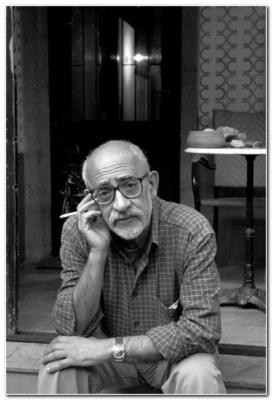
Angelo de Sousa
When Ângelo de Sousa graduated from Porto's School of Fine Arts in the early 1960s, he scored a perfect 20, the top mark possible, joining three fellow students to form an unofficial cohort known as "Os Quatro Vintes" (The Four Twenties). That group, which included Armando Alves, Jorge Pinheiro, and José Rodrigues, went on to reshape Portuguese[1] contemporary art, and de Sousa remained at its centre for five decades.
Biography
Born in Lourenço Marques (now Maputo), Mozambique in 1938[1], de Sousa relocated to Porto aged 17 and never left the city's cultural orbit. He taught at the School of Fine Arts from 1962[1] and eventually retired as a full professor in 2000, after nearly four decades of shaping generations of Portuguese[1] artists.
His practice was grounded in a sustained investigation of light and colour, approached with the rigour of a researcher rather than the spontaneity of an expressionist. Working across painting, sculpture, and drawing, he explored minimalist reduction as a means of intensifying perceptual experience. The work resists easy categorisation: neither pure abstraction nor representation, but a kind of attentive looking made physical.
International recognition came through exhibition and award. He won the International Prize at the 13th São Paulo Art Biennial in 1975[1] and the Calouste Gulbenkian Prize in 2007. He also collaborated with some of Portugal's leading poets, providing illustrations for books by Eugénio de Andrade and Fiama Hasse Pais Brandão. De Sousa died in Porto in March 2011[1], aged 73.
Timeline
- 1938Born in Lourenço Marques (now Maputo), Mozambique.
- 1955Relocated to Porto at 17.
- 1960Graduated from Porto's School of Fine Arts with the highest possible mark.
- 1962Began teaching at the School of Fine Arts in Porto.
- 1975Won the International Prize at the 13th São Paulo Art Biennial.
- 2000Retired as a full professor from the School of Fine Arts after nearly four decades.
- 2007Won the Calouste Gulbenkian Prize.
- 2011Died in Porto at 73.
Notable Works
Tap to view larger.
Next stop
Browse the movements →
Every movement in the collection, from the Renaissance to Pop art.
Related Artists

Frequently Asked Questions
What is Angelo de Sousa known for?
Ângelo de Sousa is known for his sustained investigation of light and colour across painting, sculpture, and drawing. He won the International Prize at the 13th São Paulo Art Biennial in 1975[1] and the Calouste Gulbenkian Prize in 2007.What is Angelo de Sousa's most famous work?
It is difficult to name one single work as Angelo de Sousa's "most famous". He produced a varied body of work, and his notability rests on his contribution to Portuguese[1] art more generally. De Sousa (1869-1918[1]) is regarded as a significant figure in the introduction of modern artistic ideas into Portugal. He studied in Paris, and his work shows the influence of French Impressionism and Post-Impressionism. He is known for his portraits, genre scenes, and depictions of Portuguese life. Some better-known examples include paintings such as "Joaquina" (1892), and "The Artist's Sister" (1890). These paintings display his skill in capturing light and atmosphere, and his interest in portraying everyday subjects. His wider output is catalogued in the Gulbenkian Museum archive. De Sousa's importance lies not only in individual works, but in his role as an educator and his impact on the development of modern Portuguese painting.What should I know about Angelo de Sousa's prints?
Angelo de Sousa's prints, like those of many artists, exist in a marketplace with specific conventions. Understanding these conventions is key to appreciating and evaluating the work. Original prints are conceived as prints from the start, executed solely as prints. They are usually in numbered editions and signed by the artist. Each print in the edition is an original, printed from a plate, stone, screen, or block created for that purpose. The artist decides the number of prints in the edition. The numbering of prints is a relatively recent convention. Reproductions are copies of artworks conceived in another medium, such as painting or watercolour. They are usually made by photomechanical means. Numbering and signing a reproduction does not change its essence; it remains a reproduction, not an original print. When buying prints, look for documentation sheets and consider the intent behind the work. Is it meant to be a print, or a copy of something else? Also, be aware that the market plays a role in determining the worth of art. The context of a print is important, as is the artist's integrity and intent.What style or movement did Angelo de Sousa belong to?
Angelo de Sousa (1869-1938[1]) was a Portuguese[1] artist who moved between several styles during his career. He is often associated with Naturalism and Impressionism, though his work also shows Realist and Post-Impressionist influences. Born in Porto, Portugal, Sousa studied at the Superior School of Fine Arts in Porto. Later, he travelled to Paris, where he encountered Impressionism. His early paintings often depicted everyday life and the natural world, using a muted palette and loose brushstrokes characteristic of Naturalism. However, Sousa did not adhere strictly to any single artistic doctrine. His travels throughout Europe exposed him to a range of approaches, which he synthesised in his own way. Some of his later pieces display a brighter colour range and a concern with capturing light effects, aligning them more closely with Impressionism. Other works show the influence of Post-Impressionism in their simplified forms and expressive use of colour. He remained open to different influences, making it difficult to place him neatly within one category.What was Angelo de Sousa known for?
Angelo de Sousa (1869-1938[1]) was a Portuguese[1] Realist painter. He is known for naturalistic depictions of the Portuguese countryside and its people. Born in Porto, Portugal, Sousa studied at the Superior School of Fine Arts of Porto. There, he was a student of João António Gonçalves. Sousa later studied in Paris, where he absorbed Impressionist and Post-Impressionist influences. Sousa's work includes portraits, genre scenes, and depictions of rural life. His paintings often feature peasants, fishermen, and other working-class people. He captured their daily activities and the beauty of the Portuguese landscape. His style is characterised by loose brushwork, natural light, and a muted colour palette. Sousa exhibited his work widely, both in Portugal and abroad. He received several awards and honours during his lifetime. Today, his paintings are held in major Portuguese museums, such as the National Museum Soares dos Reis in Porto and the Chiado Museum in Lisbon. Sousa's art offers a view into Portuguese society at the turn of the 20th century.When did Angelo de Sousa live and work?
Angelo de Sousa was born in Porto, Portugal, in 1859. He is known as one of the key figures in Portuguese[1] art of his period. Sousa began his artistic training at the Academy of Fine Arts in Porto. Later, he continued his studies in Paris, where he absorbed influences from the prevailing artistic movements. He exhibited at the Salon in Paris, gaining recognition for his work. Sousa's paintings often depicted scenes from everyday life, portraits, and also some historical subjects. His style evolved over time, reflecting both academic training and an engagement with impressionism. He returned to Portugal and continued to produce art, teach, and exhibit. Angelo de Sousa died in 1918.Where can I see Angelo de Sousa's work?
Angelo de Sousa's paintings are primarily held in Portuguese[1] collections. The Soares dos Reis National Museum, in Porto, possesses a significant collection of his works. This museum provides an opportunity to view a range of de Sousa's artistic output. Other museums with his paintings include the Chiado Museum (officially the National Museum of Contemporary Art), in Lisbon. The Chiado's collection offers another avenue for experiencing de Sousa's contribution to Portuguese art. Smaller galleries and regional museums throughout Portugal sometimes feature de Sousa's work in temporary exhibitions. These shows provide focused views of particular periods or themes within his career. Auction houses, such as Sotheby's and Christie's, occasionally offer his paintings for sale; these sales are less predictable, but offer another way to see his art. Catalogues from these auctions can also be useful resources.Who was Angelo de Sousa?
Ângelo de Sousa was a Portuguese[1] artist who graduated from Porto's School of Fine Arts and became a central figure in contemporary art for five decades. He was part of a group known as "Os Quatro Vintes" and later taught at the School of Fine Arts, shaping generations of artists.Why are Angelo de Sousa's works important today?
Angelo de Sousa (1868-1918[1]) was a Portuguese[1] modernist painter. He is important because he represents a point of divergence from mainstream Portuguese art of his time. In 1953[1], one critic writing about Portuguese participation in the São Paulo Biennial observed that most Portuguese painters were not tempted by "the novelties of Paris", with Sousa-Cardoso an exception. This critic felt that Portuguese artists had begun to lead their own lives, inheriting a national soul and aesthetic sensibility. They supposedly emancipated themselves from cubism and other schools, expressing themselves within lyrical tendencies. However, Ernesto de Sousa, an art critic and film-maker, sought to revise this perspective after the 1974 revolution. He identified past and present breaks from cultural and political isolation, censorship, and repression. His 1977 exhibition, "Alternative Zero", presented artists experimenting with new artistic expressions and indicated that Portuguese art was aligning with international contemporary trends. Angelo de Sousa's earlier work can be seen as a precursor to this later embrace of internationalism.How did Angelo de Sousa die?
Angelo de Sousa died in 2011[1] at the age of 73.
Sources
Editorial draws on the following primary and tertiary references for Angelo de Sousa.
- [1] wikipedia Wikipedia: Angelo de Sousa Used for: biography, birth dates, death dates, identifiers, movement attribution, nationality.
- [2] book Beard, Lee, 1973- author, Butler, Adam, author; Van Cleave, Claire, author; Fortenberry, Diane, author; Stirling, Susan, author, Beard, Lee, 1973- author, Butler, Adam, author; Van Cleave, Claire, author; Fortenberry, Diane, author; Stirling, Susan, author - The Art Book_ New Edition, Mini Format Used for: biography.
- [3] book guggenheim-anglesofvisionfr00denn Used for: biography.
- [4] book guggenheim-emergingartists100wald Used for: biography.
Editorial overseen by Solis Prints. Sources verified 2026-09-30. Click a source for details, or hover over [N] in the page above to preview.
Editorial standardsMethodologyCorrectionsAI disclosureAbout the editorial team