



Álvaro Pires de Évora
The first documented appearance of Álvaro Pires de Évora in any archive places him in Tuscany, not Portugal. On 4 November 1410, he was recorded alongside Niccolò di Pietro Gerini and several other Florentine painters working on frescoes for the facade of the Palazzo del Ceppo in Prato. How a Portuguese[1] painter born in Évora came to be working in a Florentine workshop on that date is not known: training in Valencia has been suggested, but nothing is confirmed.
Biography
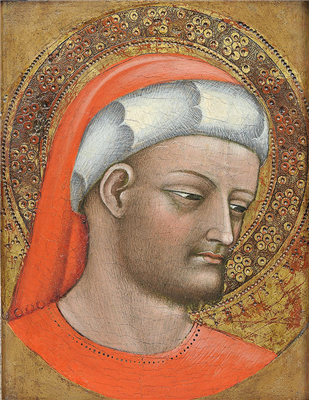
He signed his work in both languages, identifying himself as either "Alvarvs Petri de Portogallo" or "Álvaro Pirez Devora." Giorgio Vasari, writing in 1568, noted that he worked in Volterra and Pisa, making many panels in Volterra and one in S. Antonio in Pisa, and observed that compared to his contemporary Taddeo Bartoli, Pires de Évora "made the colouring more brilliant and the figures lower." The comparison places him within the Florentine Primo Quattrocento tradition, though his surviving Annunciation panels also show direct debts to Sienese precedent: the Madonna figure follows Lorenzo Monaco, while the angel's wings quote Simone Martini's celebrated Annunciation in the Uffizi.
Activity is documented through 1434 at the latest; birth and death dates remain unknown. He has been tentatively identified as the Master of Lourinhã, attributed with the Políptico do Convento de Santiago de Palmela and other Iberian altarpieces. A Sotheby's lot in 2018, catalogued as "Álvaro Pires de Évora, called Alvaro Portoghese," confirmed that his panels still surface at major auction. For a painter whose career was apparently spent entirely abroad, the Évora name endured.
Timeline
- 1390Born in Évora, Portugal. Little is known about his early life.
- 1410Documented in Tuscany, working on frescoes for the facade of the Palazzo del Ceppo in Prato with Niccolò di Pietro Gerini and other Florentine painters.
- 1410Signed his works in both Portuguese and Italian, as "Alvarvs Petri de Portogallo" or "Álvaro Pirez Devora."
- 1450Died. The location and cause of death are unknown.
Notable Works
Tap to view larger.
Next stop
Browse the movements →
Every movement in the collection, from the Renaissance to Pop art.
Related Artists


Frequently Asked Questions
What is Álvaro Pires de Évora known for?
Álvaro Pires de Évora is known for his panel paintings. Giorgio Vasari observed that, in comparison to Taddeo Bartoli, he "made the colouring more brilliant and the figures lower."What is Álvaro Pires de Évora's most famous work?
Álvaro Pires de Évora was a 15th-century Portuguese[1] painter. He is best known for his altarpiece panels. His most celebrated work is generally considered to be the "Pentecost Altarpiece". This piece is a large-scale polyptych. It was created circa 1430-1435[1] for the main chapel of the Convent of Ferreirim, near Lamego. The altarpiece comprises several panels depicting religious scenes. These include the Pentecost, the Virgin Mary, and various saints. The panels are characterised by their delicate detail, use of colour, and the artist's attention to realistic representation. The "Pentecost Altarpiece" demonstrates Pires de Évora's skill in combining International Gothic stylistic elements with early Renaissance influences. Today, the panels are dispersed. Some are held by the National Museum of Ancient Art (Museu Nacional de Arte Antiga) in Lisbon. Others are in different collections. The altarpiece remains a significant example of early Portuguese painting. It offers insights into the artistic developments of the period.What should I know about Álvaro Pires de Évora's prints?
Álvaro Pires de Évora was a 16th-century Portuguese[1] artist. He is known for his work as a painter and printmaker during the Renaissance. When considering prints by any artist, there are several terms that define when the print was made. A vintage print is made around the time the negative was taken. A period print is one made within 10 to 15 years after. Modern or contemporary prints are recent photographs made from the original negative. An original print is one made by the artist, or under their supervision. A facsimile is a print made by re-photographing a print, or by using the original negative, with the print base and processing as close as possible to the reference print. Prints are often signed and numbered to show authenticity and to indicate the edition size. For example, a print numbered 35/100 means it is the 35th print out of a total edition of 100. Artists sometimes create artist's proofs, marked "A/P", which are identical to the edition prints. "Hors de Commerce" prints are identical to the edition, but are not for sale.What style or movement did Álvaro Pires de Évora belong to?
Álvaro Pires de Évora was active during a transitional period. In Portugal, the Romanesque style persisted well into the thirteenth century, even as the Gothic style was emerging. Évora's career began around 1415, placing him in the late Gothic. By the early fifteenth century, the Dominican convent at Batalha, begun in 1388, became a model for church building. Its design influenced architectural projects throughout the country. The cathedral of Lisbon suffered earthquake damage several times; its Romanesque choir was replaced in the High Gothic style after a quake in 1340. However, another earthquake in 1755 devastated it. These reconstructions and continued building projects demonstrate the stylistic shifts of the period.What techniques or materials did Álvaro Pires de Évora use?
Álvaro Pires de Évora's practice occurred before the standardisation of painting materials. Artists had a range of painting materials available; these included natural and, later, chemical pigment in fresco, egg tempera, watercolour, and oil. Sculptors traditionally used materials such as wood, marble, and bronze. Techniques included applying oil thickly in impasto or thinly in glazes. Brushwork could be fine and disguised or thickly applied with a palette knife. Panel paintings involved an understanding of supports, pigment, and binding media. The support affected the colour of the pigments used. Light penetrated the translucent paint and was reflected back from the vellum, giving a purity of colour. Clarity of detail was essential, and artists used a minimum of shading and modelling, as if their subjects were illuminated in full sunlight. Sandblasting was also used; the glass to be sandblasted had to be covered with an especially prepared stencil paper or rubber pasted air-tight upon the pane.What was Álvaro Pires de Évora known for?
Álvaro Pires de Évora was a Portuguese[1] painter active during the first half of the 16th century. He is best known for his contributions to the early Renaissance style in Portuguese art. Pires de Évora's paintings often feature religious themes, reflecting the dominant artistic trends of his time. His work displays a blend of influences, combining elements of both Flemish and Italian Renaissance styles. This synthesis is apparent in his use of perspective, attention to detail, and the realistic depiction of figures. He is documented as working on several important commissions, including altarpieces and panels for churches and chapels. Although many of his works are no longer extant, those that remain offer insight into the artistic climate of Portugal during the period of exploration and expansion. His paintings can be found in museum collections, providing valuable examples of early Renaissance painting in Portugal.When did Álvaro Pires de Évora live and work?
Álvaro Pires de Évora was active as a painter in Portugal during the 15th century. Specific dates for his birth and death are not readily available; however, his known works and artistic activity can be placed within the first half of the 1400s. During this period, Portugal saw significant developments in Gothic art and architecture, particularly under the patronage of King João I (1385-1433[1]) and subsequent rulers of the Aviz dynasty. Évora's career unfolded during a time when Portuguese[1] art was absorbing influences from various European styles, blending them with local traditions. Évora's contribution is part of this artistic moment. Notably, the monastery at Batalha, begun in 1388, became a central project, influencing church building commissions across the country. Similarly, the Hieronymite monastery at Belem, founded by Manuel I after Vasco da Gama's return from India in 1499, further demonstrates Portugal's artistic ambition during this era.Where can I see Álvaro Pires de Évora's work?
Álvaro Pires de Évora's work can be viewed in several museum collections. These include the Museu Calouste Gulbenkian, located in Lisbon, Portugal; the Museo Art Nouveau y Art Deco, in Salamanca, Spain; and the Museu d’Art Modern (MNAC) in Barcelona, Spain. Please contact these museums for opening times and specific gallery information. Other museums that hold work by artists of this period include the M. H. de Young Memorial Museum; the Museu de Arte in São Paulo; the John and Mable Ringling Museum of Art in Sarasota; and the Nationalmuseum in Stockholm. Other locations include the National Trust in Stour Head; the Galleria Sabauda in Turin; the Graf Harrach’sche Gemäldegalerie and the Kunsthistorisches Museum in Vienna; the National Gallery of Art in Washington, D.C.; and the Sammlung Oskar Reinhart in Winterthur, Switzerland.Where was Álvaro Pires de Évora from?
Álvaro Pires de Évora was a 15th-century Portuguese[1] painter. He is thought to have been active between 1410 and 1434. His origins are somewhat mysterious; Évora is a city in Portugal, suggesting a possible place of birth or artistic training. Documents mention him in Pisa, Italy, in 1411. These records describe him as a Portuguese painter. He received payment for work done in the Pisan Baptistery. This early presence in Italy indicates that he may have travelled there for artistic opportunities or training. Later, Pires de Évora is documented in Portugal. He worked on commissions for the Portuguese royal family. His royal patronage suggests that he became an established artist in his native country. The combination of his early activity in Italy and later work in Portugal paints a picture of an artist who likely moved between different artistic centres during his career. The "de Évora" part of his name probably refers to his origins.Who did Álvaro Pires de Évora influence?
Álvaro Pires de Évora's artistic influence is not well documented, but some inferences can be drawn from the period in which he worked. Royal and aristocratic patronage often determined the direction of influence. For example, Juan Pacheco may have been inspired by Álvaro de Luna's attempt to be buried in the same church as his master, Juan II, in Toledo Cathedral. Pacheco may also have drawn inspiration from his ancestor Lopo Fernandes Pacheco, who, as a member of Alfonso IV of Portugal's circle, was buried next to the king in Lisbon Cathedral after its refurbishment in 1334. Additionally, Hieronymite monks frequently replicated artistic elements from their main houses in new monasteries. The monks of El Parral, for instance, imitated the cloister of Guadalupe when constructing their own in Segovia. Diego López Pacheco may have sought to emulate Enrique IV’s tomb in Guadalupe, given his close ties with the ruler. The main chapel of Guadalupe and Enrique IV’s tomb were well known, suggesting intentional imitation by artists of the time.Who influenced Álvaro Pires de Évora?
Álvaro Pires de Évora, active during the first half of the 15th century, painted in Portugal. His precise influences are debated, but several possibilities have been proposed. Some scholars suggest he was mainly influenced by Italian painting. Specifically, the Sienese School is often cited as a source for his style. This influence likely came via imported artworks or travelling artists. His refined figures and use of gold leaf are features shared with Sienese painters such as Duccio and Simone Martini. Others argue for a stronger influence from Early Netherlandish painting. This is based on the observation that his work shares certain characteristics with artists like Jan van Eyck. Details such as realistic textures and close observation of light may point to this connection. Netherlandish art was circulating in Europe at the time, so it is plausible that Pires de Évora encountered it. It is also possible that Pires de Évora synthesised both Italian and Netherlandish elements, creating a unique style. He may have combined the elegance of Sienese art with the realism of the Northern Renaissance. Without more documentary evidence, the precise nature of his artistic influences remains open to interpretation.Who was Álvaro Pires de Évora?
Álvaro Pires de Évora was a 15th-century Portuguese[1] painter. Active between 1410 and 1434, he is known for his contributions to early Portuguese art. Évora's artistic output shows a blending of influences. These include the Italian Gothic style and the emerging techniques of the Early Renaissance. His most celebrated work is the altarpiece in the Chapel of Saint John the Baptist at Viseu Cathedral. This piece, created around 1430, demonstrates his skill in depicting religious scenes with a sense of drama and emotion. The altarpiece features several panels, each illustrating episodes from the life of Saint John the Baptist. Évora's style is characterised by its attention to detail and use of colour. His figures are often depicted with elongated proportions and expressive faces, typical of the Gothic aesthetic. However, there is also an attempt to create a sense of depth and realism in his compositions, which points towards Renaissance developments. Although relatively few of his works survive today, Álvaro Pires de Évora is considered an important figure in the development of Portuguese painting.
Sources
Editorial draws on the following primary and tertiary references for Álvaro Pires de Évora.
- [1] wikipedia Wikipedia: Álvaro Pires de Évora Used for: biography, birth dates, death dates, identifiers, movement attribution, nationality.
- [2] book Maria Teresa Chicote Pompanin;, Art Patronage and Conflicting Memories in Early Modern Iberia Used for: biography.
- [3] book Rolf Toman and Achim Bednorz, Gothic: Architecture, Sculpture, Painting Used for: biography.
- [4] book Mark Lamster, Master of shadows Used for: biography.
- [5] book Cuttler, Charles D, Northern painting from Pucelle to Bruegel: fourteenth, fifteenth, and sixteenth centuries Used for: biography.
- [6] book Charles D. Cuttler, Northern Painting From Pucelle to Bruegel Fourteenth, Fifteenth, and Sixteenth Centuries Used for: biography.
- [7] book 1892-1968, Panofsky, Erwin,, Tomb sculpture: four lectures on its changing aspects from ancient Egypt to Bernini Used for: stylistic analysis.
Editorial overseen by Solis Prints. Sources verified 2026-09-23. Click a source for details, or hover over [N] in the page above to preview.
Editorial standardsMethodologyCorrectionsAI disclosureAbout the editorial team