



Eduardo Nery
Eduardo Nery spent part of his training in Saint-Céré in southern France, learning tapestry under Jean Lurçat, the artist who had almost single-handedly revived that medieval craft in the twentieth century. It was an unusual detour for a painter trained at the Lisbon Academy of Fine Arts, but it speaks to Nery's lifelong interest in the boundaries between disciplines and between flat surface and perceived depth.
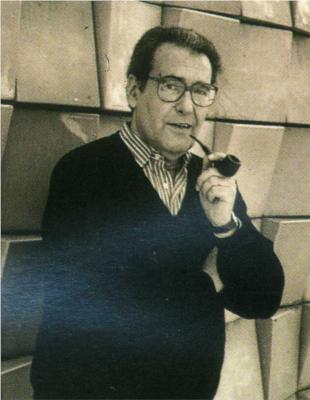
Biography
His paintings and public installations belong broadly to the tradition of geometric abstraction, inflected by Op Art's interest in perceptual instability: grids and curves that seem to advance or recede, that make the eye work. Where many Op artists confined themselves to studio canvases, Nery applied the same logic at architectural scale. His azulejo tile panels, stained glass commissions, and public murals became fixtures across Lisbon and Portugal through the 1970s and 1980s, putting his visual language into train stations, public squares, and institutional buildings.
Over four decades he staged more than forty solo exhibitions in Lisbon and participated in upwards of three hundred group shows internationally, including representing Portugal at the Lausanne International Biennale in 1965[1]. The Portuguese[1] Art Critics' Prize came in 1969, the Press Prize in 1996. Born in Figueira da Foz in 1938[1] and based in Lisbon until his death in 2013[1], Nery belonged to a generation of Portuguese artists who brought rigorous European currents into a country that had been culturally isolated for much of the mid-century.
Timeline
- 1938Born in Figueira da Foz, Portugal.
- 1965Represented Portugal at the Lausanne International Biennale.
- 1969Received the Portuguese Art Critics' Prize.
- 1970Began creating azulejo tile panels, stained glass, and murals for public spaces in Lisbon and Portugal throughout the 1970s and 1980s.
- 1996Received the Press Prize.
- 2013Died in Lisbon, Portugal at the age of 75.
Notable Works
Tap to view larger.
Next stop
op art →
Explore the artists and ideas of op art.
Eduardo Nery prints
Hand-finished archival prints from Eduardo Nery's body of work.


Related Artists




Take Eduardo Nery home.
See all Eduardo Nery prints →Frequently Asked Questions
What is Eduardo Nery known for?
Eduardo Nery is known for his paintings and public installations in the tradition of geometric abstraction, influenced by Op Art. He applied his visual language to architectural scales, creating azulejo tile panels, stained glass, and public murals, many of which became fixtures across Lisbon and Portugal.What is Eduardo Nery's most famous work?
It is difficult to name one single work as Eduardo Nery's most famous. He was a prolific artist who worked across several media, including painting, sculpture, and architecture. Nery is well known for his work with *azulejos* (ceramic tiles), often creating large-scale public art installations. These tile works frequently incorporate geometric patterns and explore themes of colour and light. Some of his most recognisable pieces include the installations at the Campo Grande metro station in Lisbon. He also produced notable work in other areas. These include his explorations of Op Art and kinetic art during the 1960s. While it is hard to isolate one piece, Nery's consistent innovation and his integration of art with public spaces have solidified his position in Portuguese[1] art history. His diverse output makes him a significant figure, rather than any single creation.What should I know about Eduardo Nery's prints?
Eduardo Nery (1938[1]-2013[1]) was a Portuguese[1] artist known for his geometric abstraction, often working in a variety of media. When considering Nery's prints, it is helpful to understand some basic principles of printmaking. An original print is conceived as a print, made solely as a print, and usually produced in a numbered edition, with each print signed by the artist. The prints are created from a plate, stone, screen, or block made for that purpose. Each print is individually inked and pulled, making it a "multi-original" medium. The artist decides the number of prints in the edition. The numbering (for example, 12/25) accounts for the number of prints; in this case, print number 12 of an edition of 25. A reproduction is a copy of a work of art initially created in another medium, such as painting or watercolour. Reproductions are usually made using photo-mechanical methods. Numbering and signing a reproduction does not make it an original print. The artist's intent is what distinguishes an original print from a reproduction. The standard method of signing and numbering editions involves writing the edition number on the bottom left margin of the print, the title in the centre, and the signature on the right.What style or movement did Eduardo Nery belong to?
Eduardo Nery is associated with Op Art, also known as Optical or Retinal art. This movement, which developed partly from De Stijl and Concrete Art, involves creating illusions and optical effects. Op artists employ geometric shapes, often using strong colours or black and white. The precise arrangement of lines and repetitive forms produces optical effects, making static images appear to move. Op Art gained momentum in 1955[1] with the exhibition *Le Mouvement* at Galerie Denise René in Paris. A decade later, *The Responsive Eye* at the Museum of Modern Art in New York further popularised the style. Some critics, however, dismissed it as superficial. Op Art is sometimes seen as an extreme form of art, subjugating art to the power of science, and exchanging emotional expression for scientific impersonality.What techniques or materials did Eduardo Nery use?
Eduardo Nery (1938[1]-2013[1]) explored diverse artistic techniques and materials throughout his career. He is particularly known for his work with ceramics, creating tile panels that integrated art with architecture. These panels often featured geometric patterns and explored the interplay of light and shadow. Nery also experimented with photography, using it as a medium for both documentation and artistic expression. His photographic work sometimes incorporated collage elements, blurring the lines between photography and other art forms. In addition to ceramics and photography, Nery produced paintings and drawings. His paintings often display an interest in colour theory and optical effects. He also created sculptures, often using materials such as glass and metal. Nery's multidisciplinary approach reflects a desire to push the boundaries of artistic conventions and explore new possibilities in art making. His varied output resists easy categorisation, but demonstrates a consistent interest in geometry, light, and the relationship between art and its environment.What was Eduardo Nery known for?
Eduardo Nery (1938[1]-2013[1]) was a Portuguese[1] artist known for his work in Op Art and Kinetic Art. These styles involve creating optical illusions and the impression of movement. Op Art uses geometric shapes and strong colours, or black and white, in precise arrangements. This causes the static image to appear to move, expand, or contract. Nery explored these concepts through various media, including painting, sculpture, and installation art. He often incorporated mathematical systems into his work, creating pieces that invite the viewer to actively engage with their perception of space and form. His art shares some features with that of Victor Vasarely and Bridget Riley, who were early artists in the Op Art movement.When did Eduardo Nery live and work?
Eduardo Nery was born in Lisbon, Portugal, in 1938[1]. He is known for his work in a variety of media, including painting, sculpture, and architecture. Nery began his artistic career in the 1950s, and he quickly gained recognition for his innovative approach to geometric abstraction. His early work often incorporated elements of Pop Art and Op Art, and he was interested in exploring the relationship between art and technology. In the 1960s, Nery began to experiment with new materials and techniques, including the use of neon lighting and mirrored surfaces. He also started to create large-scale public art installations, often in collaboration with architects and designers. Nery continued to work and exhibit his art until his death in 2013[1].Where can I see Eduardo Nery's work?
Eduardo Nery's work can be viewed in several museums. In his home country of Portugal, the Museu Calouste Gulbenkian (Lisbon) holds pieces by Nery. Other European museums include the Museo Art Nouveau y Art Deco (Salamanca, Spain), the Museu d’Art Modern (Barcelona, Spain), the Musée d’Art et d’Industrie (Roubaix, France), the Musée de l’Ecole de Nancy (Nancy, France), and the Musée des Arts Décoratifs (Paris, France). In Belgium, his art can be seen at the Brangwyn Museum (Brugge) and the Clockarium Museum (Brussels). In the UK, museums include the Bakelite Museum (Williton), the Brighton Museum & Art Gallery (Brighton), the Geffrye Museum (London), the Manchester Art Gallery (Manchester), the National Museums of Scotland (Edinburgh), the Victoria & Albert Museum (London), the Towneley Hall Art Gallery (Burnley), the Fitzwilliam Museum (Cambridge), the National Museum of Wales (Cardiff), the National Gallery of Scotland (Edinburgh), the Scottish National Gallery of Modern Art (Edinburgh), the Burrell Collection (Glasgow), the Jersey Museum and Art Gallery (St Helier), and the Leeds City Art Gallery (Leeds).Where was Eduardo Nery from?
Eduardo Nery was born in Figueira da Foz, Portugal, in 1938[1]. He is known as a Portuguese[1] artist, although his work reached international audiences. Nery studied at the Escola Superior de Belas Artes in Lisbon. There, he completed courses in painting between 1957[1] and 1961. He also studied set design. Nery then spent time in Paris as a Gulbenkian Foundation fellow from 1961 to 1963. His artistic output includes painting, sculpture, and architecture. Nery explored geometric abstraction. He worked in ceramic tile, creating large-scale public art installations. These can be seen in various locations around Portugal, such as the Campo Grande metro station in Lisbon. Nery died in Lisbon in 2013[1]. His career spanned several decades, and his pieces are held in public and private collections.Who did Eduardo Nery influence?
It is difficult to name specific artists who were directly influenced by Eduardo Nery (1938[1]-2013[1]). The literature available does not discuss his influence on other artists. One source notes that David Hockney's embrace of still life made him a maverick during the 1970s. During this period, most California artists pursued new art practices that allowed little room for still life. The years from roughly 1968[1] to 1981 have been called the “pluralist era” because artists had many options, such as minimalism, pattern painting, systemic abstraction, fiber art, light art, earth art, process art, conceptual art, performance art, installation art, video and political art. Another source notes that the fictional strategies that some artists invented have proven highly influential for many younger French artists who have chosen to further explore the distinction between art and reality by creating composite images of actual events that, in their finished form, read as fiction.Who influenced Eduardo Nery?
Eduardo Nery, as a student, drew influence from Surrealism, Francis Bacon, and Hieronymus Bosch. He also admired Michelangelo and Baroque artists. Pablo Picasso was his idol. Nery appreciated Picasso's capacity to assimilate other artists' work, capturing and personalising it. Nery also cited Robert Rauschenberg, Jasper Johns, Cy Twombly, and Joseph Beuys as contemporary influences. Rauschenberg, in particular, affected Nery through his handling of objects in relation to painting, illusion, and reality, along with his spontaneous use of materials. Later, Nery examined earlier abstract European art, such as Cubism, Piet Mondrian, and Paul Klee. He valued Klee's work for not being purely formalistic, dealing with art, reality, and symbolism on different levels. Nery aimed for his art to be a broad statement, encompassing more than just the painting itself. He sought to maintain a connection with the past while creating a personal art, free to reference past art on his own terms.Who was Eduardo Nery?
Eduardo Nery (1938[1]-2013[1]) was a Portuguese[1] artist, best known for his work in geometric abstraction and public art installations. He worked across several media, including painting, sculpture, ceramics, and printmaking. Nery studied at the Escola Superior de Belas Artes in Lisbon. There, he was influenced by the European avant-garde movements of the mid-20th century. He became associated with a group of Portuguese artists who sought to integrate art into everyday life. This led to his interest in creating art for public spaces. His public art projects often involved the use of azulejos (ceramic tiles), a traditional Portuguese art form. Nery incorporated this medium into modern, abstract designs. These tile installations can be seen in various locations in Portugal, including the Campo Grande metro station in Lisbon. Nery's work often explores themes of space, light, and movement, reflecting his interest in perception and optical effects. He exhibited widely both in Portugal and internationally.
Sources
Editorial draws on the following primary and tertiary references for Eduardo Nery.
- [1] wikipedia Wikipedia: Eduardo Nery Used for: biography, birth dates, death dates, identifiers, movement attribution, nationality.
- [2] book guggenheim-latinamericanpai00catl Used for: biography.
- [3] book guggenheim-masterp00solo Used for: biography.
- [4] book guggenheim-twopri00weis Used for: biography.
- [5] book Rolando Pérez, Severo Sarduy and the Neo-Baroque Image of Thought in the Visual Arts (Purdue Studies in Romance Literatures, 53) Used for: biography.
- [6] book Rolando Pérez, Severo Sarduy and the Neo-Baroque Image of Thought in the Visual Arts (Purdue Studies in Romance Literatures, 53) Used for: biography.
Editorial overseen by Solis Prints. Sources verified 2026-10-07. Click a source for details, or hover over [N] in the page above to preview.
Editorial standardsMethodologyCorrectionsAI disclosureAbout the editorial team