



About Domenico Veneziano
Italian · 1410–1461
Venetian-born Early Renaissance painter who pioneered unified light in Florentine art and taught Piero della Francesca.
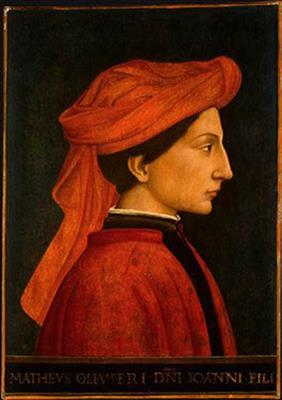
Museums5
Countries4
Most worksNational Gallery, London · 4 works
Loading map…
Where to see Domenico Veneziano
Ranked by works you can see in person.
-
4 works
National Gallery
London, United Kingdom
-
3 works
National Gallery of Art
Washington D.C., United States


-
2 works
Gemäldegalerie Berlin
Berlin, Germany
-
2 works
Fitzwilliam Museum
Cambridge, United Kingdom
-
1 works
Thyssen-Bornemisza Museum
Madrid, Spain


Frequently Asked Questions
Where can I see Domenico Veneziano's work?
Domenico Veneziano's paintings can be found in several European and North American museums and churches. In Florence, Italy, his works reside in the Galleria dell’ Accademia (which holds *Saint Francis*, *Saint Catherine*, and *Annunciation*), the Museo Nazionale del Bargello (home to *Madonna of Humility*), and the Museo dell’Ospedale degli Innocenti (which possesses *Coronation of the Virgin*). Other works originally in Florence are now held in storage at Santo Stefano al Ponte. Elsewhere in Italy, his art can be seen in the Keresztény Muzeum in Esztergom, the parish church in Greti, the Church of the Holy Family in Sagginale, and the church of San Romolo in Valiana (Stia). Outside of Italy, examples are held at the Musée du Petit Palais in Avignon, the Muzeum Narodowe in Warsaw, the Seattle Art Museum, the Christ Church Gallery in Oxford, the Art Gallery of Canada in Toronto, and the Museum of Fine Arts in Houston, which possesses *Madonna and Child*.What should I know about Domenico Veneziano's prints?
Domenico Veneziano was active during the Early Renaissance. He is known for his frescoes and panel paintings; however, there is little evidence connecting him directly to printmaking. Some paintings, such as the Houston Museum of Fine Arts's tondo depicting the encounter of Solomon and the Queen of Sheba, have been misattributed. This tondo, a fine example of a ceremonial salver (desco da parto) commissioned to commemorate a birth, was at one time attributed to Veneziano. Prints, particularly engravings from the north of Europe, circulated in Florence during the second half of the fifteenth century. These prints influenced Florentine artists. However, there is no firm evidence that Veneziano created prints himself, or that his paintings were widely copied as prints during his lifetime. It is more likely that any prints associated with Veneziano's name are either later copies of his paintings or misattributed works.Why are Domenico Veneziano's works important today?
Domenico Veneziano, active around 1438 to 1461[1], was a Venetian artist of great importance in early Renaissance Florence. His influence is seen in the work of his student, Piero della Francesca. Domenico's paintings display a mastery of light. Light appears to emanate from a single source, unifying forms and creating a sense of space. This gives an early indication of a Venetian style, which is characterised by a silvery quality. One example is his "St John in the Desert", where light pours with clarity over a barren scene. His "St Lucy Altarpiece", circa 1445-7, demonstrates an understanding of linear perspective. The artist manipulates the technique, setting figures within a tripartite architectural structure, an arcade with pointed arches reminiscent of earlier triptychs. The floor tiles are foreshortened, receding from the panel's lower edge toward the Madonna's throne. The arched arcade and shell niches are constructed along mathematical principles. In his "Madonna and Child with Saints", circa 1455, Domenico combines the brightness of Gothic panel painting with perspective space and natural light. The scene is set in a loggia flooded with sunlight from the right. The architecture reflects the light, so even shadowed areas glow with colour. The influence of its tonality can be felt throughout Florentine painting later in the century.What techniques or materials did Domenico Veneziano use?
Domenico Veneziano, active around 1438 to 1461[1], worked primarily in Florence. Fresco was a typical medium for the period; artists would paint frescoes during the summer, completing one section, or giornata, each day. The lines between giornate are often visible. Artists sometimes painted on top of the dried mural (a secco) to add details or figures or to use pigments with binders other than water. Oil-based media were in use in Italy by around 1428. Venice was a centre for dyestuffs and pigments in the first half of the sixteenth century. The city produced, imported, and exported pigments to serve a wide-ranging clientele. Domenico's importance is less in his personal achievement and more in his influence, as he was the teacher of Piero della Francesca. Domenico employed a splendour of light emanating from a single source, unifying forms within it. He gave the first indication of the water-born silveriness that is one of the Venetian gifts to the visual world.Who did Domenico Veneziano influence?
Domenico Veneziano (active circa 1438-1461[1]) was an important figure in the early Florentine Renaissance. Although his own output was relatively small, his impact on other artists was considerable. His most significant student was Piero della Francesca (circa 1420-1492). Domenico's influence on Piero is evident in the latter's mastery of perspective and use of light. Domenico's work displays a careful understanding of linear perspective. His *St Lucy Altarpiece*, dating from around 1445-1447, shows his manipulation of the technique. The floor tiles are foreshortened, and the background arcade is constructed along mathematical principles. Domenico's skill with colour and light also had a wider effect. His ability to integrate natural light within a perspective space influenced Florentine painting in the latter half of the 15th century. His *Madonna and Child with Saints* (circa 1455) uses light to make even shadowed areas glow with colour.Who influenced Domenico Veneziano?
Domenico Veneziano (active c. 1438-1461[1]) was an important painter in early Renaissance Florence. Although few works survive, he called himself a Venetian. It is assumed that his background promoted an artistic talent, making him a unique figure in the development of colour in early 15th-century Florentine painting. In 1438, he wrote to Piero de' Medici, seeking commissions in Florence. He expressed his intention to produce work comparable to Fra Angelico and Filippo Lippi. This choice of names is significant; Domenico was primarily interested in colour, not space and figure treatment. He studied Masaccio, Uccello, and Castagno with regard to the representation of space and figure. Masaccio achieved a similar quality of light in one of his paintings, which Domenico surely knew. When Domenico settled in Florence, Piero della Francesca became his most important pupil.What is Domenico Veneziano's most famous work?
Domenico Veneziano, who died in 1461[1], was an important painter in Florence during the early Renaissance. His importance is due to his influence; he taught Piero della Francesca. Veneziano's style is marked by its use of light, which seems to emanate from a single source. This gives his paintings a sense of spaciousness, unifying the forms within. Among Domenico Veneziano's well-regarded works is the St Lucy Altarpiece, now at the Uffizi Gallery in Florence. Another is St John in the Desert. Also notable is The Adoration of the Magi; and The Meeting of Solomon and the Queen of Sheba, a ceremonial salver now held at the Museum of Fine Arts, Houston. This work depicts the Queen of Sheba's visit to Solomon's temple, where she tested his wisdom with hard questions.What style or movement did Domenico Veneziano belong to?
Domenico Veneziano, active around 1438 to 1461[1], was associated with the Early Renaissance. Although Venetian by birth (Domenico di Bartolomeo di Venezia), he is considered an important painter who worked in Florence. His Santa Lucia dei Magnoli altarpiece, painted around 1445, is an early example of the sacra conversazione, a scheme that became popular from the mid-15th century. This type of panel includes an enthroned Madonna, framed by architecture and flanked by saints. It is not a narrative scene; instead, it offers a glimpse of a heavenly court. Domenico's work displays an understanding of linear perspective. The architecture and the space it defines are clear, yet elevated above the everyday. His perspective setting has been compared to Masaccio's Holy Trinity fresco. The figures are balanced and dignified, and their bodies show the influence of Donatello. Domenico's use of colour is also remarkable, with a harmony of pink, light green, and white, set off by spots of red, blue, and yellow.
Sources
Where to See guide aggregates verified holdings of Domenico Veneziano's works across the following collections.
- [1] wikipedia Wikipedia: Domenico Veneziano Used for: biography.
- [2] book Masterpieces of western art : a history of art in 900 individual studies from the Gothic to the present day Used for: biography.
- [3] book Johnson, Geraldine A, Renaissance Art: A Very Short Introduction (Very Short Introductions) Used for: biography, stylistic analysis.
- [4] book Beckett, Wendy, The story of painting Used for: biography, stylistic analysis.
Editorial overseen by Solis Prints. Sources verified 2026-08-31. Click a source for details, or hover over [N] in the page above to preview.
Editorial standardsMethodologyCorrectionsAI disclosureAbout the editorial team