



About Blinky Palermo
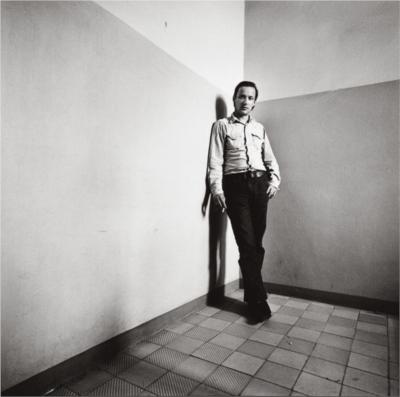
Museums7
Countries4
Largest reported holdingMuseum Ludwig, Cologne · 4 recorded works
Loading map…
Where to see Blinky Palermo
Collection holdings are reported here; current display varies. Check with each museum before visiting.
-
4 recorded works
Museum Ludwig
Cologne, Germany
-
3 recorded works
Museum of Modern Art
New York City, United States


-
3 recorded works
Mu.ZEE - Kunstmuseum aan Zee
Ostend, Belgium
-
1 recorded work
Städel Museum
Frankfurt, Germany
-
1 recorded work
Wallraf–Richartz Museum
Cologne, Germany
-
1 recorded work
Museo Nacional Centro de Arte Reina Sofía
Madrid, Spain
-
1 recorded work
Stedelijk Museum voor Actuele Kunst
Ghent, Belgium


Frequently Asked Questions
Where can I see Blinky Palermo's work?
Blinky Palermo's artworks have been featured in many exhibitions. In the late 1990s, his pieces were included in group shows such as 'De Klein & Warhol Face-a-Face, France Etats-Unis' at the Musée d'Art Moderne et d'Art Contemporain, Nice (1997-98), and 'Pop Impressions U.S.A.' at The Museum of Modern Art, New York (1999). In 2000, his work was part of 'Open Ends' at The Museum of Modern Art, New York, and 'An American Focus: The Anderson Graphic Arts Collection' at the Fine Arts Museum of San Francisco, California Palace of the Legion of Honor. More recently, Palermo's art could be seen in 'Made in USA 1940-1970[1]' at the Centre Cultural de la Fundacio "la Caixa," Barcelona (1999), which then travelled to Schim Kunsthalle, Frankfurt. His pieces also appeared in 'Pop Art: U.S./U.K. Connections 1956[1]-1966' at The Menil Collection, Houston (2001), and 'Les Années Pop 1956-1968' at the Centre Georges Pompidou, Paris (2001).What should I know about Blinky Palermo's prints?
Blinky Palermo, born Peter Schwarze, adopted his pseudonym at the suggestion of Joseph Beuys; Beuys likened him to a boxing promoter of that name. Palermo enrolled at the Dusseldorf Academy in 1962[1]. Palermo is known for his abstract works that explore the intersection of painting, object, and architecture. In 1966, he began making Stoffbilder, or cloth paintings. These works consist of sections of commercially produced fabric mechanically sewn together. The designs come from arrangements of coloured fabric, with no paint applied after stretching. Palermo's practice involved mass-produced source material. In 1966, Gerhard Richter, a friend and fellow student at the Dusseldorf Academy, also began working with commercial colour charts. Palermo produced Himmelsrichtungen, using baked enamel on glass panels, for the Ambiente Arte exhibition at the 1976 Venice Biennale. Richter confirmed that Palermo's Himmelsrichtungen made a major impression on him.Why are Blinky Palermo's works important today?
Blinky Palermo, born Peter Schwarze, adopted his pseudonym at the suggestion of Joseph Beuys, his teacher at the Dusseldorf Academy. Beuys likened Schwarze's appearance to a small-time mobster and boxing promoter of the same name. Palermo's works are important because they represent a new attitude toward painting, particularly abstraction. His pieces reference contexts beyond artistic formalism. In 1966[1], he began creating Stoffbilder, or cloth paintings, using commercially produced fabric. These sections of fabric were sewn together, with no paint applied. This method aligned with a broader movement among artists using mass-produced materials. Palermo's work occupies a space where painting, object, and architecture intersect. He and Gerhard Richter were friends, both enrolling at the Dusseldorf Academy in 1962. Richter also used commercial colour charts in his work from Dusseldorf outlets. Palermo's fabric paintings moved away from Modernist claims of autonomy, while maintaining a connection to post-painterly abstractionists, such as Kenneth Noland, and object-paintings by Ellsworth Kelly and others. In 1976, Palermo produced Himmelsrichtungen, a work using baked enamel on glass panels, for the Venice Biennale.What techniques or materials did Blinky Palermo use?
Blinky Palermo, also known as Peter Heisterkamp, worked with a variety of materials and methods. He is known for his use of simple geometric forms and a limited colour palette. Palermo often employed commercially produced materials, such as fabric and metal, in his work. "Boneless method" involved adding water to paper, priming the support, so brush actions diffuse and lose direction. The application of ink or pigment within the saturated surface of the paper investigates the absorptivity of the wetted areas in contrast with the unsaturated areas. He explored the properties of paint itself, sometimes applying it in thin washes or layers to create subtle tonal variations. His interest lay in the interplay between colour, form, and space, rather than in traditional artistic techniques.Who did Blinky Palermo influence?
Blinky Palermo, born Peter Schwarze (1943[1]-1977[1]), was a German[1] abstract painter. He is associated with a number of later artists. Although Palermo's career was short, his minimalist approach and use of colour had an impact on the art world. His influence can be seen in the work of subsequent generations of artists who explored similar themes of abstraction and spatial relationships. Some artists who have been associated with Palermo include Imi Knoebel, who was a close friend and colleague; Liam Gillick, known for his installations and wall paintings; and Tomma Abts, a Turner Prize-winning painter. These artists, among others, have acknowledged Palermo's importance to their own artistic development. His emphasis on simple forms, geometric compositions, and the interplay of colour continues to resonate with artists interested in pushing the boundaries of abstract art[1].Who influenced Blinky Palermo?
Blinky Palermo, born Peter Schwarze, was influenced by several artists and movements. Joseph Beuys, his teacher at the Dusseldorf Academy, had a significant impact; he gave Schwarze the pseudonym "Blinky Palermo". Palermo's *Stoffbilder* (cloth paintings), begun in 1966[1], evidence an engagement with abstraction, while also referencing a broader range of object-paintings. His work has connections with post-painterly abstractionists such as Kenneth Noland, and with object-painters including Ellsworth Kelly, Richard Tuttle, and Karen Carson. Palermo's fusion of support and colour within a single surface in his fabric paintings prefigures some of Gerhard Richter's experiments with monochrome. Palermo and Richter were friends, having both enrolled at the Dusseldorf Academy in 1962. Both artists' monochrome work around 1965 shifted from industrial design to social spaces. In 1976, Palermo produced *Himmelsrichtungen*, using baked enamel on glass panels. Richter confirmed that Palermo's *Himmelsrichtungen* made a major impression on him.What is Blinky Palermo's most famous work?
It is difficult to name one single 'most famous' work by Blinky Palermo, as his output varied considerably. He is best known for his abstract works from the 1960s and 1970s. Palermo's early work included paintings on canvas, such as Religious Area with Equal Unreligious Area (1961[1]). Later, he moved toward shaped canvases and installations. His series of Metal Pictures (Metallbilder) involved arrangements of aluminium bars. Wall Paintings (Wandmalereien) were site-specific installations directly on the wall. Palermo also produced graphic works and drawings. He explored colour theory and geometric forms, often in a minimalist style. His work is held in museum collections, including the Museum of Modern Art, New York; the Moderna Museet, Stockholm; and the Staatsgalerie, Stuttgart.What style or movement did Blinky Palermo belong to?
Blinky Palermo's work has connections with several movements, including Abstract Expressionism and Action Painting. These styles moved away from traditional representation. Instead, they focused on the physical act of painting and the artist's direct expression. Action Painting, in particular, involved the artist's physical movement as part of the artwork itself. A stroke of pigment, for example, 'works' within us in the same way as a bridge across the Hudson. For the unseen universe that inhibits us an accidental blot or splash of paint may thus assume an equivalence to the profoundest happening. Jackson Pollock is closely associated with this technique. He placed unprimed canvas on the floor. Moving around it, he poured paint, creating an all-over image that captured his method. The layers of paint suggested depth, while the complex forms implied movement. Similarly, Willem de Kooning conveyed movement by splicing figures and repositioning limbs, activating surfaces with textured paint and colours.
Sources
Where to See guide aggregates verified holdings of Blinky Palermo's works across the following collections.
- [1] wikipedia Wikipedia: Blinky Palermo Used for: biography.
- [2] book Staff, Craig, After Modernist Painting_ The History of a Contemporary Practice (International Library of Modern and Contemporary Art Book 3) Used for: biography, stylistic analysis.
- [3] book Staff, Craig, After Modernist Painting_ The History of a Contemporary Practice (International Library of Modern and Contemporary Art Book 3) Used for: biography, stylistic analysis.
- [4] book guggenheim-richterei00rich Used for: biography, stylistic analysis.
Editorial overseen by Solis Prints. Sources verified 2026-09-30. Click a source for details, or hover over [N] in the page above to preview.
Editorial standardsMethodologyCorrectionsAI disclosureAbout the editorial team