



About Andre Cadere
Museums3
Countries2
Largest reported holdingMusée d'art moderne de Paris, Paris · 1 recorded work
Loading map…
Where to see Andre Cadere
Collection holdings are reported here; current display varies. Check with each museum before visiting.
-
1 recorded work
Musée d'art moderne de Paris
Paris, France
Also here (6)
-
1 recorded work
National Gallery of Art
Washington D.C., United States


-
1 recorded work
Musée National d'Art Moderne
Paris, France

Frequently Asked Questions
Where can I see Andre Cadere's work?
Andre Cadere's work has been exhibited in major museums and galleries around the world. In Paris, his art can be seen at the Musée National d’Art Moderne, located within the Centre National d’Art et de Culture Georges Pompidou. Other museums in France that have exhibited Cadere's work include the Musée d’Art Moderne de la Ville de Paris and the Centre National des Arts Plastiques. Outside of France, museums such as the Neue Nationalgalerie in Berlin and the Kunsthalle Tübingen in Germany have also displayed his pieces. Additionally, the Art Gallery of New South Wales in Sydney, Australia, has featured Cadere's art within its collections. These institutions provide opportunities to view and study Cadere's artistic output.What should I know about Andre Cadere's prints?
André Cadere is best known for his conceptual installations and performances using painted wooden bars; however, he also produced prints. Printmaking, with its capacity for repetition, has allowed many artists to explore their ideas. Some artists use printmaking to explore concepts first developed in other media, while others find the medium itself opens new possibilities. Experimentation in printmaking has often led artists to new discoveries. S. W. Hayter, a twentieth-century innovator in etching and engraving, greatly influenced artists in Europe and America. He encouraged experimentation and automatism. Printmaking has also served artists who wish to explore the relationship between visual and written forms; some created prints to accompany their own writings. Prints have allowed artists to reach a wider audience, because they can be produced in greater quantities and distributed at a lower cost than unique works.What techniques or materials did Andre Cadere use?
Andre Cadere worked with a range of materials and techniques throughout his career. Early on, he created small sculptures from plexiglas and wood, drilling and incising them while keeping the original block-like surfaces intact. These shapes were geometric: cubes, spheres, cylinders, or pyramids. By 1958[1], Cadere made larger wood sculptures, described as man-sized "negative sculptures", hand-cut from building timbers. He realised that the wood was better before he cut it, leading him to use the material as the cut in space, rather than cutting into the material. In later works, Andre used standard commercial units, identical modules determined by arithmetic combinations. Examples include sand-lime bricks, concrete bricks, plastic blocks, styrofoam slabs, and metal plates composed of aluminium, copper, steel, magnesium, lead, and zinc. These materials were often arranged directly on the floor, sometimes in specific patterns or geometric configurations.What is Andre Cadere's most famous work?
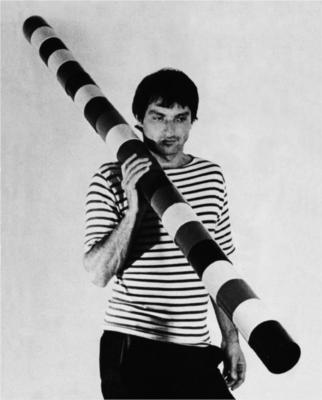
André Cadere is best known for his wooden sculptures called *Barres de bois rond* (Round Wooden Bars). These works consist of cylindrical wooden batons, painted in various colours and arranged in a specific sequence. Cadere began creating these sculptures in the early 1970s. Each *Barre de bois rond* is unique, with the colour order determined by a mathematical system, although Cadere sometimes disrupted the system by introducing an error. The sculptures were portable; Cadere often carried them around, displaying them in different environments, both inside galleries and in public spaces. The *Barres de bois rond* challenged conventional notions of sculpture, authorship, and the art market. Cadere aimed to democratise art by taking it outside traditional gallery settings and engaging directly with the public. The sculptures became a symbol of his nomadic artistic practice and his critique of the art establishment.What style or movement did Andre Cadere belong to?
Andre Cadere, born in 1935[1], is most often associated with Minimalism. However, some critics have drawn comparisons between his work and Constructivism, although these comparisons are often considered superficial. Cadere's artistic practice involved using materials in their basic form and arranging them in direct relation to the surrounding space. His sculptures often lay directly on the floor, which made viewers aware of gravity as a condition of sculpture. One of his exhibitions involved laying sand-lime bricks directly on the floor in different permutations. Cadere's early work was influenced by Constantin Brancusi, particularly in the absence of differentiation between sculpture and base. He also spent time in Frank Stella's studio, and Stella's ideas about materials influenced him. Cadere's work is resolutely abstract, but it also identifies with nature by recognising the floor as a zone for existence.What was Andre Cadere known for?
Andre Cadere (1934[1]-1978[1]) was a Romanian[1]-French conceptual artist known for his "Barres de bois rond," or wooden bars. These sculptures consisted of cylindrical wooden segments, painted in different colours and arranged in a specific sequence. Cadere began creating these works in the early 1970s. The bars were intended to challenge conventional notions of sculpture and art presentation. He often carried the bars with him, placing them in galleries, museums, and public spaces without permission. This was a deliberate act of intervention, questioning the established art world and its institutions. His practice involved a system of calculated disruption. The colour sequences of the wooden segments, while seemingly random, followed a specific logic, with one element always intentionally out of place. This "error" was a deliberate feature, introducing an element of imperfection and challenging the viewer's perception of order. Cadere's nomadic approach and use of simple, portable forms allowed him to bypass traditional gallery settings, engaging directly with the public and redefining the boundaries of art.What is Andre Cadere known for?
André Cadere is known for his carved and painted wooden bars, which he called Barres de bois rond. From 1970[1] until his death, he made these by hand, each divided into colour segments in a mathematical sequence, but with one deliberate error. He would take them uninvited into other artists' exhibitions, openings, and institutions across Europe as a form of institutional critique.
Sources
Where to See guide aggregates verified holdings of Andre Cadere's works across the following collections.
- [1] wikipedia Wikipedia: Andre Cadere Used for: biography.
- [2] book guggenheim-guggenheimintern1964allo Used for: biography.
- [3] book guggenheim-masterp00solo Used for: biography.
- [4] book guggenheim-twopri00weis Used for: biography.
- [5] book 1892-1968, Panofsky, Erwin,, Tomb sculpture: four lectures on its changing aspects from ancient Egypt to Bernini Used for: stylistic analysis.
Editorial overseen by Solis Prints. Sources verified 2026-10-15. Click a source for details, or hover over [N] in the page above to preview.
Editorial standardsMethodologyCorrectionsAI disclosureAbout the editorial team