



About Adja Yunkers
- abstract art
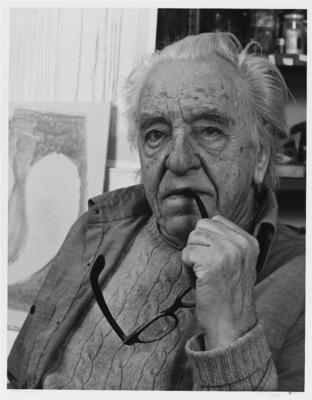
Latvian-American abstract printmaker whose innovative colour woodcuts from the 1950s are held by MoMA, the Whitney, and the Guggenheim.
Where to see Adja Yunkers
Collection holdings are reported here; current display varies. Check with each museum before visiting.
-
84 recorded works
National Gallery of Art
Washington D.C., United States
-
2 recorded works
Smithsonian American Art Museum
Washington D.C., United States


-
1 recorded work
Museum Boijmans Van Beuningen
Rotterdam, Netherlands
-
1 recorded work
Cleveland Museum of Art
Cleveland, United States
-
1 recorded work
Princeton Art Museum
Princeton, United States
-
1 recorded work
Whitney Museum of American Art
New York City, United States
-
1 recorded work
Georgia Museum of Art
Athens, United States
-
1 recorded work
Harvard Art Museums
Cambridge, United States


Frequently Asked Questions
Where can I see Adja Yunkers's work?
Adja Yunkers's works can be viewed in a number of museums internationally. These include the Musée des Arts Décoratifs in Paris, and the Los Angeles County Museum of Art (LACMA). Other locations in the United States that hold his works are the Metropolitan Museum of Art in New York, the Minneapolis Institute of Arts, the Museum of Modern Art in New York, the Art Institute of Chicago, the Field Museum in Chicago, the High Museum in Atlanta, the J. Paul Getty Museum in Los Angeles, and the Wolfsonian at Florida International University in Miami Beach. In Canada, Yunkers's art can be seen at the Royal Ontario Museum in Toronto. European locations include the Beaux-Arts Museum of Arras, the Deutsches Historisches Museum in Berlin, the Kunsthaus Zurich, the MAK (Vienna), the Museo Egizio in Turin, the National Museum of Ireland (Decorative Arts and History) in Dublin, the Rijksmuseum in Amsterdam, the St Gallen Textilmuseum, the Victoria & Albert Museum in London, the Manchester Art Gallery, and the National Museums of Scotland (Royal Museum) in Edinburgh.Who did Adja Yunkers influence?
It is difficult to identify specific individuals who were directly influenced by Adja Yunkers. However, the Dada movement, of which Yunkers was a part, had a broad effect on later artists and cultural practices. Dada's cut-up methods and repurposing strategies influenced culture at large. Rapid cutting in visual media, sampling in hip-hop, and mash-up aesthetics all show Dada's influence in new media. Surfing the Internet is similar to Dadaist creative practices. The poetry movement Flarf trawls the Internet for vocabulary, echoing Dada's methods. Photomontage, a Dada innovation, became a tool in advertising. Modern advertising reflects Dada's nonlinear organisation, asymmetry, incongruity, and use of evocation. Dada's influence can be seen in advertising's visual disruption, no longer addressing the rational mind. Dada dispensed with the logic of the frame and the privileged perspective.What is Adja Yunkers's most famous work?
It is difficult to name one single work as Adja Yunkers's "most famous". He was a prolific artist who worked in several styles and media. Born in Riga, Latvia, in 1900[1], Yunkers emigrated to the United States in 1947[1]. He is often associated with the Abstract Expressionist movement, although his work also incorporates elements of Surrealism and Constructivism. Yunkers is perhaps best known for his large-scale abstract prints, particularly his colour lithographs. These works often feature bold colours and geometric shapes, and they demonstrate his mastery of the printmaking process. His prints from the 1960s and 1970s are particularly well regarded. However, he also produced paintings, watercolours, and collages throughout his career. These pieces show a similar interest in abstraction and experimentation with form. Without a specific title dominating his output, it is more accurate to appreciate the breadth and depth of his abstract explorations across different media.What style or movement did Adja Yunkers belong to?
Adja Yunkers is associated with abstract expressionism, a movement that gained momentum in the United States during the 1940s. However, the term encompasses a range of styles and approaches. Some preferred the term "non-objective" to describe a type of art that rejected recognisable subject matter. Instead, these artists aimed to create compositions based on the intrinsic qualities of form, colour, and rhythm. They believed that non-objective art could offer a direct, intuitive experience, free from the constraints of earthly representation. This approach sought to express spirituality and cosmic order through abstract means. While abstract expressionism is often linked to intuitive creation, some theorists argued that true mastery involved conscious control and the elimination of accidental effects. The goal was to achieve a sense of balance and harmony, where every element contributed to the overall unity of the work. This focus on formal relationships and spiritual expression places Yunkers within the broader context of abstract art[1]'s development during the mid-20th century.What was Adja Yunkers known for?
Adja Yunkers (1900[1]-1983[1]) was a Latvian-American abstract expressionist painter, printmaker, and publisher. Born in Riga, he studied at the State Art Academy. He travelled in Europe during the late 1920s and early 1930s, settling in Paris, where he encountered work by artists associated with Cubism. After moving to the United States in 1947[1], Yunkers became known for his contributions to abstract expressionism, particularly his large-scale, colourful woodcuts and monotypes. Yunkers experimented with printing techniques, creating textures and effects. He taught at the New School for Social Research and was involved with several artists' groups. His work is held in the collections of the Museum of Modern Art and the Whitney Museum of American Art, both in New York.What is Adja Yunkers known for?
Adja Yunkers is known for producing large-scale colour woodcuts in the early 1950s. He departed from convention by applying paint directly with a brush, giving his prints the gestural quality of painting while retaining the physical directness of wood.What was Adja Yunkers's art style?
Yunkers's work shifted to lithography later in his career. He produced two notable series at the Tamarind Lithography Workshop in Los Angeles: Salt (five prints) and Skies of Venice (ten prints).
Sources
Where to See guide aggregates verified holdings of Adja Yunkers's works across the following collections.
- [1] wikipedia Wikipedia: Adja Yunkers Used for: biography.
- [2] book guggenheim-onehundredpainti00thom Used for: biography.
- [3] book guggenheim-thirdenlargedcat1938reba Used for: biography.
- [4] book Masterpieces of western art : a history of art in 900 individual studies from the Gothic to the present day Used for: biography.
Editorial overseen by Solis Prints. Sources verified 2026-09-30. Click a source for details, or hover over [N] in the page above to preview.
Editorial standardsMethodologyCorrectionsAI disclosureAbout the editorial team