



Albert Tucker
- Angry Penguins
Albert Tucker spent most of the 1940s painting in a state of controlled rage against the society around him. His Images of Modern Evil series, begun in 1943[1], fixed on wartime Melbourne with an unflattering eye: soldiers on leave, prostitutes in the Cross, the intersection of violence and commercial sex that wartime inevitably produced. The images were expressionist in technique and accusatory in tone, painted in red and ochre on hardboard with a deliberate rawness.
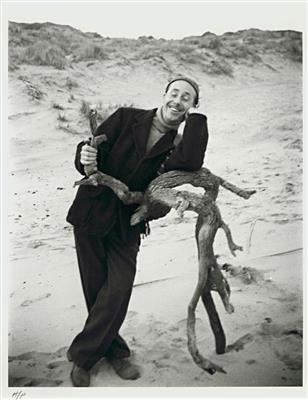
Biography
Tucker was largely self-taught, filling the gaps with evening classes at the Victorian Artists' Society. He moved through Melbourne's most electrically charged intellectual circle, the Heide group around John and Sunday Reed, alongside Sidney Nolan, Arthur Boyd, and Joy Hester, whom he married in 1941[1]. It was a small and contentious world, and Tucker quarrelled with most of it at various points.
He left Australia in 1947[1], spending time in Japan before settling for extended periods in Germany, Italy, and Britain. The Thames Series came from the London years; the Manhattan Series from time spent in New York. Through it all the sensibility remained confrontational: his Apocalyptic Horse (1954) and the Antipodean Heads pursued a vision of Australia as mythic, damaged, and irreducibly strange.
He returned to Australia in 1960[1]. A major retrospective at the National Gallery of Australia in 1990 confirmed his standing as one of the country's defining postwar painters. Works entered the Guggenheim in New York and the Museum of Modern Art.
Timeline
- 1914Born in Australia
- 1941Married Joy Hester
- 1943Began 'Images of Modern Evil' series
- 1947Left Australia, traveled to Japan, Germany, Italy, and Britain
- 1954Painted 'Apocalyptic Horse'
- 1960Returned to Australia
- 1990Major retrospective at National Gallery of Australia
- 1999Died
Notable Works
Tap to view larger.
Next stop
Browse the movements →
Every movement in the collection, from the Renaissance to Pop art.
Related Artists
Frequently Asked Questions
What is Albert Tucker known for?
Albert Tucker is known for his confrontational sensibility in painting. His Images of Modern Evil series focused on wartime Melbourne, and his Apocalyptic Horse and Antipodean Heads pursued a vision of Australia as mythic and damaged.What should I know about Albert Tucker's prints?
Prints offer artists the opportunity to explore concepts first developed in other media, due to the capacity for repetition. The numbering and signing of prints distinguishes original graphics, possessing aesthetic value, from reproductions. A signature testifies to the print's authenticity and the artist's approval. The practice of limiting print editions controls quality; artists can prevent prints from being produced after the plate or stone has degraded from excessive use. The edition claim is written as a pair of numbers on the left bottom margin of the print, indicating the print number and the edition number. The title of the print is written in the middle of the bottom margin, and the signature is on the right. However, the distinction between an original print and a reproduction can be confusing. An original print is conceived and executed solely as a print, usually in a numbered edition, and signed by the artist. Each print is individually inked and pulled, making it a "multi-original". A reproduction is a copy of artwork from another medium, often made photomechanically.What style or movement did Albert Tucker belong to?
Albert Tucker is associated with Expressionism, and he is also linked to figurative painting. Expressionism, which originated in the early 20th century, is characterised by the use of strong colours and dynamic brushwork to evoke heightened emotion. Tucker, along with other Australian[1] artists such as Arthur Boyd, Sidney Nolan, and John Perceval, created expressionistic works. Tucker's art moved away from social realism, focusing instead on individual inner feelings. His paintings were deeply personal, while also reflecting the state of art in Australia. Some critics suggest that Australian art confronts our consciousness directly, rather than drawing upon popular imagery. This is distinct from humanist painting that evolved since the Renaissance. Tucker's work, along with that of his contemporaries, contributed to a unique and powerful pictorial style in Australia.What techniques or materials did Albert Tucker use?
Albert Tucker employed a range of techniques and materials in his art. He primed cotton duck canvas with two coats of turps-thinned Flake White, sanding the surface when dry. When applying colour, Tucker mixed standard artist's oil colour with a medium of wax and turpentine. This medium was kept warm on a hot plate and mixed with the paint by brush just before application. The mixture was then applied to the canvas with a brush and worked over with a large painting spatula and a small painting knife. Tucker aimed for constant and total surfaces in his paintings, though variables existed. Extensive heating of the medium could lead to evaporation, making the paint gummy and softer. Leftover paint, with wax added, was often used in mixing subsequent colours. While he added wax to the oil paint, oil remained the primary binder.What was Albert Tucker known for?
Information on Albert Tucker is not present in the provided documents. Instead, the texts discuss Albert Gleizes, and the writings of Mark Rothko. Gleizes (1881-1953[1]) was the subject of a retrospective exhibition organised by Daniel Robbins. The show was a collaboration between the Solomon R Guggenheim Museum in New York, the Musée National d'Art Moderne in Paris, and the Museum am Ostwall in Dortmund. Rothko's writings reveal an artist frustrated by a lack of recognition. He sought to capture his notion of reality and truth in his paintings, yet struggled to gain attention. Rothko criticised artists he viewed as derivative and soulless, particularly those who achieved popularity despite, in his view, lacking artistic merit. He had little patience for anything that did not aspire to the highest ideals.When did Albert Tucker live and work?
Albert Tucker was an Australian[1] artist who lived from 1914[1] to 1999[1]. He is associated with the Angry Penguins[1] movement, a group of avant-garde artists and writers active in Melbourne during the 1940s. Tucker's early work often dealt with social and political themes, reflecting the anxieties of the Second World War era. His images explored alienation and the darker aspects of urban life. In the late 1940s, Tucker travelled to Europe and later lived in New York for some years. During this time, his style evolved, and he became interested in abstract expressionism. He returned to Australia in the 1960s and continued to paint, developing new series of works. These later paintings often drew on Australian mythology and history, as well as personal experiences. Tucker remained a prominent figure in the Australian art world until his death.Where can I see Albert Tucker's work?
To view works by Albert Tucker, you might begin your search with major art galleries in Australia. The Art Gallery of New South Wales, located in Sydney, is one possibility. Many museums throughout Europe hold collections of modern art, any of which may include pieces by Tucker. Some potential locations include the Musées Royaux des Beaux-Arts de Belgique in Brussels; the Kunsthistorisches Museum and the Osterreichische Galerie, both in Vienna; the Narodni Galerie in Prague; the Musée National Fernand Léger in Biot, France; and several museums in Paris (Musée d’Art Moderne de la Ville de Paris, Musée de l’Orangerie, Musée d’Orsay, and Musée du Louvre). Other European museums with significant collections include the Rijksmuseum Kréller-Miller in Otterlo, Netherlands; the Museum Boymans-van Beuningen in Rotterdam; the Nasjonalgalleriet in Oslo; the Museu Nacional de Arte Antiga in Lisbon; the Tretyakov Gallery and the Hermitage Museum, in Moscow and St Petersburg respectively; the Museo Nacional del Prado in Madrid; the Musée d’Art et d’Histoire in Geneva; the National Gallery of Scotland and the Scottish National Gallery of Modern Art in Edinburgh; and the Leeds City Art Gallery.Where was Albert Tucker from?
Albert Tucker was an Australian[1] artist. Although sources do not specify his precise place of birth, it is known that he worked in Melbourne, Victoria, during the 1940s. Tucker is associated with the Angry Penguins[1], a group of avant-garde artists and writers who challenged conservative artistic norms in Australia. This group included artists such as Sidney Nolan, Arthur Boyd, and Joy Hester. His art often explored themes of social alienation, psychological distress, and the impact of war on the Australian psyche. Tucker's images frequently depicted the dark underbelly of urban life. During the Second World War, Tucker served in the army, and this experience had a significant impact on his artistic vision. After the war, he travelled extensively, spending time in Europe and the United States before returning to Australia later in life.Who did Albert Tucker influence?
Albert Tucker, along with Sidney Nolan, Arthur Boyd, and John Perceval, rose to prominence in the 1940s. These figures later inspired younger artists. This influence occurred during a resurgence of figurative painting in Australia. This resurgence was caused by a new awareness of, and pride in, native tradition. It was not due to the influence of Neo-Expressionism from abroad. Prior to this resurgence, Australian[1] art in the 1970s was similar to art in major centres throughout Europe and the United States. Conceptual art, video, and performance predominated where painting and sculpture had previously held sway. However, Australian art of those years already had special qualities that set it apart and lent it credibility. There was a brooding, introspective mood, a sense of urgency and drama, and an intense, hothouse palette. These qualities became hallmarks of much of the very different art of the 1980s in Australia.Who influenced Albert Tucker?
Albert Tucker's artistic development involved a range of influences. Analytic Cubism, particularly the work of Braque and Picasso, played a formative role. Tucker also studied early Kandinsky and Miró. Other significant figures include Matisse and Mondrian. Tucker analysed the structure of their paintings. He studied Matisse's 'Blue Window' (1913), Miró's 'Person Throwing a Stone at a Bird' (1926[1]), Cézanne's 'Card Players' (1890-92), and Mondrian's grid paintings. Tucker also examined works by Léger, Renaissance and Quattrocento artists, Old Masters, American masters, and African art. Contact with other artists was important to him. He admired Piero della Francesca, Titian, Rembrandt, Utamaro, Rubens, Velasquez, Goya, Fragonard, Ingres, Corot, Seurat, Renoir, and Bonnard. Tucker felt that a sense of artistic community destroyed isolation and helped artists develop their own character.Who was Albert Tucker?
Albert Tucker was an Australian[1] painter. Largely self-taught, he moved in Melbourne's intellectual circle, the Heide group, alongside Sidney Nolan, Arthur Boyd, and Joy Hester, whom he married.What was Albert Tucker's art style?
Albert Tucker's Images of Modern Evil series was expressionist in technique. He painted in red and ochre on hardboard with a deliberate rawness.
Sources
Editorial draws on the following primary and tertiary references for Albert Tucker.
- [1] wikipedia Wikipedia: Albert Tucker Used for: biography, birth dates, death dates, identifiers, movement attribution, nationality.
- [2] book Beard, Lee, 1973- author, Butler, Adam, author; Van Cleave, Claire, author; Fortenberry, Diane, author; Stirling, Susan, author, Beard, Lee, 1973- author, Butler, Adam, author; Van Cleave, Claire, author; Fortenberry, Diane, author; Stirling, Susan, author - The Art Book_ New Edition, Mini Format Used for: biography.
- [3] book guggenheim-australianvision00wald Used for: biography.
- [4] book guggenheim-jackfifte00twor Used for: biography.
Editorial overseen by Solis Prints. Sources verified 2026-09-23. Click a source for details, or hover over [N] in the page above to preview.
Editorial standardsMethodologyCorrectionsAI disclosureAbout the editorial team