



Agnes Goodsir
- portrait
Agnes Goodsir arrived in Paris in 1921[1] and took rooms on rue de l'Odéon, a street that passed Sylvia Beach's Shakespeare and Company bookshop and sat at the heart of the Left Bank world. She had come in her late fifties, after years of training and exhibiting in Australia, and would spend the remaining eighteen years of her life there, painting portraits of a remarkably varied cast: Bertrand Russell, Leo Tolstoy, Ellen Terry, and Banjo Paterson among them.
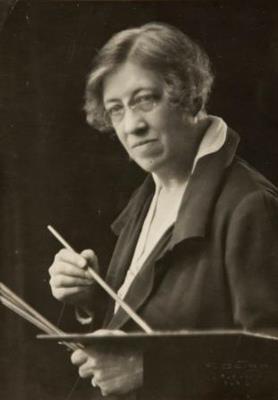
Biography
Born in Portland, Victoria, in 1864[1], Goodsir first studied at the Bendigo School of Mines and Industries before travelling to Paris for serious training at the Académie Julian under Jean-Paul Laurens, and subsequently at the Académie Colarossi and the Académie Delécluse. Her technique favoured oils over watercolours, and her portraits were marked by controlled composition and a preference for direct psychological engagement over flattery.
Her work appeared at the Salon des Indépendants, the Société Nationale des Beaux-Arts, London's Royal Academy, and the Royal Institute. She died in Paris in 1939[1]. The Goodsir Scholarship at the Bendigo Art Gallery continues in her name, and Goodsir Place in Canberra was named in her honour in 1978.
Timeline
- 1864Born in Portland, Victoria, Australia
- 1881Studied at the Bendigo School of Mines and Industries
- 1921Moved to Paris and took rooms on rue de l'Odéon
- 1939Died in Paris
Notable Works
Tap to view larger.
Next stop
Browse the movements →
Every movement in the collection, from the Renaissance to Pop art.
Related Artists


Frequently Asked Questions
What is Agnes Goodsir known for?
Agnes Goodsir is known for painting portraits of a varied cast of people, including Bertrand Russell, Leo Tolstoy, Ellen Terry, and Banjo Paterson.What is Agnes Goodsir's most famous work?
It is difficult to name one single work as Agnes Goodsir's most famous. However, 'The Letter' (1921[1]) is a popular choice. This oil painting shows a woman in a blue dress, seated at a table and reading a letter. The work is admired for its intimate and contemplative mood, as well as its skillful use of light and colour. Goodsir was an Australian[1] artist who spent much of her career in Paris. She was known for her portraits, still lifes, and interior scenes. Her work often featured women in domestic settings, and she had a particular talent for capturing the details of everyday life. While 'The Letter' remains a highlight, Goodsir produced a range of notable works throughout her career, each contributing to her artistic recognition.What should I know about Agnes Goodsir's prints?
When considering Agnes Goodsir's prints, it's useful to understand some basic printmaking terminology. A 'vintage print' means the photograph was printed around the time the negative was taken. A 'period print' is one made within roughly 10 to 15 years after the shot. If a print date is unknown, or more than 15 years after the shot, it's considered an 'old print', as opposed to a 'modern print', which is recent. An 'original print' is a definitive print made by the artist or under their direct supervision. A 'facsimile' is a print made by re-photographing a print, or using the original negative, with a base and processing as close as possible to a reference print (generally a vintage one). Printmakers often limit editions, marking each print in pencil with the edition number on the bottom left margin, the title in the centre, and the signature on the right. Though unregulated, these conventions add value if followed, and commercial descriptions are expected to be truthful.What style or movement did Agnes Goodsir belong to?
Agnes Goodsir (1864[1]-1939[1]) was an Australian[1] artist who spent much of her career in Paris. Although not directly affiliated with one particular movement, her work shows the influence of several styles. Goodsir's portraits and still lifes often display a realist approach, with careful attention to detail and accurate representation. However, she also incorporated elements of Impressionism, particularly in her use of light and colour. Some of her paintings have a Post-Impressionist feel, with simplified forms and a focus on subjective expression. Living and working in Paris during the early 20th century, Goodsir would have been exposed to a wide range of artistic trends. Her art reflects this exposure, blending aspects of realism, Impressionism, and Post-Impressionism into a style that is distinctly her own. She captured the spirit of her time while maintaining an individual artistic vision.What techniques or materials did Agnes Goodsir use?
Unfortunately, the provided texts do not contain information about Agnes Goodsir's techniques or materials. The passages discuss the artist Rosalie Gascoigne's methods and materials, which included weathered or recycled wood in various forms, such as fencing, building materials, soft-drink boxes, and furniture. Gascoigne also incorporated plant materials, specifying both the common and botanical names when known, for example, 'dried grass (possibly African lovegrass Eragrostis curvula)'. Other materials used were glass or ceramic insulators, plywood, and composition board (also known as MDF). From 1980, most panel constructions were braced with aluminium strips. The texts also mention that descriptions of materials often included their original use. However, these details pertain to Gascoigne, not Goodsir. Without relevant reference material, I cannot provide a reliable answer to your question about Agnes Goodsir's artistic techniques.What was Agnes Goodsir known for?
Agnes Goodsir (1864[1]-1939[1]) was an Australian[1] portraitist known for her depictions of women, often in domestic settings. Born in Portland, Australia, she studied art in Melbourne and later in Paris at the Académie Julian. Goodsir remained in Europe for most of her career, living primarily in Paris and London. Goodsir's style often incorporated elements of Impressionism and Post-Impressionism. Her portraits are noted for their intimate and informal quality, capturing the personality of her sitters. She received recognition during her lifetime, exhibiting her work in both France and England. Although she painted a number of self-portraits, she is better known for portraits of her female friends. Her work provides a glimpse into the lives of women artists and intellectuals in the early 20th century.When did Agnes Goodsir live and work?
Agnes Goodsir was an Australian[1] artist who spent much of her working life in Paris. She was born in 1864[1] and died in 1939[1]. Goodsir is best known for her portraits and still-life paintings. Goodsir lived and worked in a period that saw significant shifts in the art world, including the rise of Post-Impressionism and other modern movements. While the reference texts do not directly mention Goodsir, they do discuss the artistic milieu of her time, referencing exhibitions in cities like Glasgow and Liverpool that included artists such as Renoir, Monet, and Sargent. These exhibitions provide a sense of the artistic trends and contemporaries that Goodsir would have been aware of during her career.Where can I see Agnes Goodsir's work?
Agnes Goodsir's art can be viewed in several locations. The Art Gallery of New South Wales, in Sydney, has a number of her works. The National Gallery of Australia, in Canberra, also holds examples of her paintings. Peggy Guggenheim, Solomon's niece, assembled a collection documenting major movements of twentieth-century art. In 1969, the Solomon R. Guggenheim Museum invited Peggy to exhibit her collection in New York. She then donated her palazzo and art collection to the Solomon R. Guggenheim Foundation. She asked that the collection remain in Venice and continue to be open to the public during the summers. Although the gift was accomplished during Peggy Guggenheim's lifetime, it was not until her death at the end of 1979 that the foundation established by her uncle took on the management and full responsibility for the collection.Who did Agnes Goodsir influence?
It is difficult to say precisely who Agnes Goodsir influenced. Rosalie Gascoigne, an Australian[1] artist, has been compared to Tom Roberts and Fred Williams. Sasha Grishin wrote in 1998 that, as with Roberts and Williams, Gascoigne had given a new reading to the Australian environment; it is now possible to view the environment through her eyes. Gascoigne's panel-reliefs are built from found packing crate materials gathered during exploratory voyages from her Canberra homestead/studio. The resulting surfaces and textural patterns resemble the process-scarred abstractions of post-minimalism, but projecting humour, pathos and poetry. Gascoigne seems to instinctively know that if you approach a question from an open position, rather than with a preconceived answer, the way will be revealed to you. Gascoigne exhibited internationally, including at the Rooseum in Malmö, Sweden, in 1989.Who was Agnes Goodsir?
Rosalie Gascoigne (born 25 January 1917[1], died in 1943) lived three distinct lives. The first was as a child in Auckland, New Zealand. The second was as a wife and mother in Mount Stromlo and Canberra, Australia. The third was as an artist. Gascoigne had a love of nature and the outdoors. She found this nourishing because the natural world fed the ‘pleasures of the eye’. She found it liberating because in the vastness of the landscape she found the freedom to be herself. She often observed, ‘You can’t do better than nature’. She taught herself how to preserve grasses and leaf forms. By the late 1950s, she was using mixtures of flowers, grasses, driftwood, and other materials in her arrangements for flower shows. In September and November 1958, she had her first wins with ‘a modern arrangement with driftwood’. Her September arrangement was the outstanding exhibit in the decorative section. One of Rosalie’s great strengths was in sections calling for more imaginative arrangements.Why are Agnes Goodsir's works important today?
Without specific information on Agnes Goodsir's life and work, it is difficult to assess her importance today. However, we can consider the broader context of early twentieth-century art and the ongoing interest in artists who may have been overlooked in their time. Many artists, especially women, faced obstacles in gaining recognition. A renewed examination of their contributions provides a more complete understanding of art history. This reevaluation considers a wider range of perspectives and artistic approaches. The focus is on artists whose work expands our understanding of the period. Interest in Goodsir may stem from a desire to explore diverse voices and challenge traditional narratives. Her work may offer fresh insights into the social, cultural, and artistic concerns of her era. Further research into her specific achievements and artistic style would be needed to fully determine her current significance.What was Agnes Goodsir's art style?
Goodsir's technique favoured oils over watercolours, and her portraits were marked by controlled composition and a preference for direct psychological engagement over flattery.
Sources
Editorial draws on the following primary and tertiary references for Agnes Goodsir.
- [1] wikipedia Wikipedia: Agnes Goodsir Used for: biography, birth dates, death dates, identifiers, movement attribution, nationality.
- [2] book Dorling Kindersley, Artists: Inspiring Stories of the World's Most Creative Minds Used for: biography.
- [3] book Post-impressionism : cross-currents in European painting Used for: biography.
- [4] book Post-impressionism : cross-currents in European painting Used for: biography.
Editorial overseen by Solis Prints. Sources verified 2026-08-29. Click a source for details, or hover over [N] in the page above to preview.
Editorial standardsMethodologyCorrectionsAI disclosureAbout the editorial team