



Arthur Streeton
- Heidelberg School
Arthur Streeton spent the summer of 1888[2] sleeping in an abandoned homestead on a hilltop in Heidelberg, a suburb north-east of Melbourne, surrounded by eucalyptus scrub and a 'gold and blue' sky that would define his reputation. From that Eaglemont camp, alongside Tom Roberts and Frederick McCubbin, he produced the defining images of Australian[2] Impressionism: sun-bleached paddocks, harbour light, and the peculiar haze of the Australian summer. Golden Summer, Eaglemont (1889) became the first painting by an Australian-born artist to be exhibited at London's Royal Academy, winning a mention honourable at the 1892 Paris Salon.
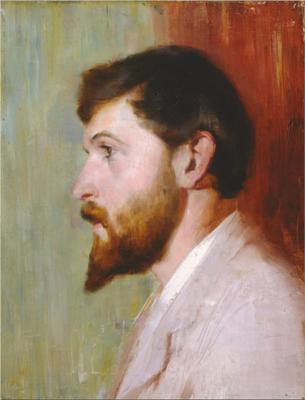
Biography
Born at Mount Moriac, Victoria, in 1867[2], Streeton had begun training at the National Gallery School in Melbourne at fifteen. By the mid-1880s he was painting en plein air at Mentone Beach with Roberts, and the informal Heidelberg School[2] collective took shape. After relocating to Sydney in 1890[2] he refined his palette further, experimenting with extreme vertical formats influenced by Japanese kakemono scrolls. He also found time for activism: in 1893 his open letter to the Daily Telegraph, known as 'Streeton's shriek', opposed a mining company's proposal to build a colliery on Sydney Harbour. His subsequent painting Cremorne Pastoral (1895) helped mobilise public opposition, and the project was abandoned.
Streeton sailed for London in 1897[2], joined the Chelsea Arts Club, married Canadian violinist Esther Clench in 1908, and painted Venice on their honeymoon. His English career never quite matched his Australian[2] standing, but he returned in 1924 to become the dominant figure in Australian landscape painting. At 48 he had volunteered for the Royal Army Medical Corps during the First World War; in 1918 he was appointed Australian Official War Artist, attached to the 2nd Division AIF in France.
Knighted in 1937[2], Streeton won the Wynne Prize in 1928 for Afternoon Light, Goulburn Valley. His market has only grown since his death in 1943[2]: Golden Summer, Eaglemont changed hands privately for A$3.5 million in 1995, and The Grand Canal set an auction record of A$3.068 million in April 2021. In 2015 his Blue Pacific (1890) entered the permanent collection of the National Gallery, London, displayed alongside Monet and Manet.
Timeline
- 1867Born in Mount Moriac, Victoria.
- 1882Began training at the National Gallery School in Melbourne at 15.
- 1888Spent the summer in Heidelberg, near Melbourne, with Tom Roberts and Frederick McCubbin, forming the Heidelberg School collective.
- 1889Painted "Golden Summer, Eaglemont".
- 1890Relocated to Sydney and experimented with vertical formats.
- 1893Wrote an open letter to the Daily Telegraph opposing a mining company's proposal on Sydney Harbour.
- 1895Painted "Cremorne Pastoral", which mobilised public opposition to the mining project.
- 1897Sailed for London and joined the Chelsea Arts Club.
- 1908Married Canadian violinist Esther Clench.
- 1918Appointed Australian Official War Artist, attached to the 2nd Division AIF in France.
- 1937Knighted.
Notable Works
Tap to view larger.
Where to See Arthur Streeton
1 museum worldwide.
-
10 works
Art Gallery of South Australia
Adelaide, Australia
10:00–17:00 daily, closed Christmas Day · Free

Next stop
Browse the movements →
Every movement in the collection, from the Renaissance to Pop art.
Arthur Streeton prints
Hand-finished archival prints from Arthur Streeton's body of work.

Related Artists


Take Arthur Streeton home.
See all Arthur Streeton prints →Frequently Asked Questions
What is Arthur Streeton known for?
Arthur Streeton is known for producing defining images of Australian[2] Impressionism, specifically sun-bleached paddocks, harbour light, and the haze of the Australian summer. His 1889[2] painting, Golden Summer, Eaglemont, was the first work by an Australian-born artist to be exhibited at London's Royal Academy.What should I know about Arthur Streeton's prints?
Arthur Streeton (1867[2]-1943[2]) was an Australian[2] impressionist painter. Although best known for his oil paintings, he also produced a number of prints, mainly etchings. These prints often depict similar subjects to his paintings, such as Australian scenery and rural life. Streeton was a member of the Heidelberg School[2], also known as Australian Impressionism. This movement focused on painting en plein air (outdoors) to capture the natural light and atmosphere of the Australian bush. Streeton's prints reflect this interest in light and atmosphere, often using delicate lines and tones to create a sense of depth and space. His prints are not as widely known or collected as his paintings, making them a more accessible entry point for those interested in his work. They offer a different perspective on his artistic vision, showing his skill as a draughtsman and printmaker. Streeton's prints are a valuable part of his artistic output, providing insight into his working methods and his appreciation for the Australian environment.What style or movement did Arthur Streeton belong to?
Arthur Streeton is best known as an Australian[2] Impressionist artist. This style is related to French Impressionism, which took hold during the mid-19th century. Like the French Impressionists, Streeton and other Australian painters of the period, such as Tom Roberts and Frederick McCubbin, took their easels outdoors to capture the fleeting effects of light and atmosphere on the world around them. This approach, known as plein-air painting, allowed them to directly observe and represent nature. While Streeton's work shares similarities with French Impressionism, it also developed its own distinct character, influenced by the Australian landscape and culture. He is celebrated for his depictions of the Australian outback, with its vast plains, eucalyptus trees, and clear, bright light. Streeton's paintings often evoke a sense of national identity and pride in the Australian landscape.What techniques or materials did Arthur Streeton use?
Arthur Streeton was an Australian[2] Impressionist painter who worked primarily in oils. He is known for his handling of light and colour, particularly in depictions of the Australian landscape. Streeton favoured painting *en plein air*, directly observing and capturing the effects of sunlight on his subjects. This approach required a rapid and spontaneous technique. He often used broad brushstrokes and a relatively high-keyed palette to convey the heat and luminosity of the Australian climate. Like many Impressionists, Streeton experimented with different surfaces and grounds. He sometimes worked on commercially prepared canvases, but also prepared his own supports. His grounds varied in colour, from light to mid-toned, influencing the overall tonality of the finished painting. Streeton's technique also involved layering paint, often applying thin washes of colour over a preliminary sketch or underpainting. He built up form and depth through successive layers, creating a sense of atmosphere and space. While he is not especially known for surface texture, he did sometimes employ impasto, particularly in areas of strong light or detail.When did Arthur Streeton live and work?
Arthur Streeton (1867[2]-1943[2]) was an Australian[2] painter. He is associated with the Heidelberg School[2], also known as Australian Impressionism. Streeton was born near Geelong, Victoria. He began art studies at the National Gallery School in Melbourne in 1882[2]. There, he met fellow artists Frederick McCubbin and Tom Roberts. These artists formed the core of the Heidelberg School. Their work focused on painting *en plein air*, capturing the Australian light and bush. Key paintings include Streeton's *Golden Summer, Eaglemont* (1889) and *The Purple Noon's Transparent Might* (1896). In 1897, Streeton travelled to London. He exhibited at the Royal Academy and spent time painting in England and Europe. He returned to Australia in 1906, but travelled to Europe again in 1907-1914[2]. During World War I, Streeton served with the Royal Army Medical Corps. He was later appointed an official war artist. After the war, he settled permanently in Australia. He continued to paint and exhibit, becoming a significant figure in Australian art. Streeton died in Melbourne in 1943.Where can I see Arthur Streeton's work?
To view works by Arthur Streeton, a good starting point is the Art Gallery of New South Wales in Sydney, Australia. Many galleries and museums hold collections of Impressionist, Post-Impressionist, and modern art. These include the Musée du Louvre, the Musée d’Orsay, the Musée National d’Art Moderne (Centre Georges Pompidou) in Paris; the National Gallery of Scotland and the Scottish National Gallery of Modern Art in Edinburgh; the Fitzwilliam Museum in Cambridge; and Leeds City Art Gallery. Other European museums with collections of this kind are the Koninklijk Museum voor Schone Kunsten in Antwerp; the Musées Royaux des Beaux-Arts de Belgique in Brussels; the Narodni Galerie in Prague; the Museo Nacional del Prado in Madrid; the Alte Pinakothek in Munich; and the Hermitage Museum in St Petersburg.Who did Arthur Streeton influence?
Arthur Streeton, an Australian[2] Impressionist painter, is associated with the Heidelberg School[2], also known as Australian Impressionism. His influence is most apparent in the generation of artists that followed him in Australia, who adopted his plein air techniques and interest in depicting the Australian countryside. Though it is difficult to trace direct lines of influence, Streeton's work impacted the development of Australian art by popularising a specifically Australian style of painting. Artists such as Elioth Gruner, who is known for his depictions of Australian light and atmosphere, owe a debt to Streeton and the Heidelberg School. Later artists continued to explore similar themes and techniques, building on the foundations laid by Streeton and his contemporaries. Streeton's emphasis on capturing the unique qualities of the Australian environment had a significant effect on subsequent generations of painters in the region. He helped to create a visual language for representing Australia, one that continues to resonate with artists and audiences today.Who influenced Arthur Streeton?
The Impressionists looked to the Louvre to inform their art. They studied old masters, appropriating aspects relevant to their own explorations. Sixteenth-century Venetian masters and Peter Paul Rubens taught them the appeal of pure colour. French painters were perhaps closest to the Impressionists' concerns. Antoine Watteau's broken strokes of bright colour, and his ability to render nature’s shimmering effects with a delicately nuanced palette, made an important contribution. Honoré Fragonard's expressive handling also proved influential. These two painters had already distanced themselves from a lacquer-smooth paint surface in the eighteenth century. Form and brushwork played an important part in their canvases. They demonstrated that brushwork could render movement and the changing effects of nature, and that it was not necessary to discreetly conceal it.Why are Arthur Streeton's works important today?
Arthur Streeton (1867[2]-1943[2]) was an Australian[2] Impressionist painter. He is associated with the Heidelberg School[2], also known as Australian Impressionism, which developed in the late 19th century. Streeton's works are important for several reasons. They offer a view into the Australian landscape and way of life during the late 19th and early 20th centuries. His paintings often depict scenes of rural Australia, including farms, rivers, and the outback. They capture the light and colours of the Australian environment, and reflect a sense of national identity. Interest in artists of the Art Nouveau period, and those who followed, has grown since the 1970s, as people seek to reconnect with collective experiences. The challenges these artists addressed, such as the isolation of modern life, remain relevant today.
Sources
Editorial draws on the following primary and tertiary references for Arthur Streeton.
- [1] museum Art Gallery of South Australia Used for: museum holdings.
- [2] wikipedia Wikipedia: Arthur Streeton Used for: biography, birth dates, death dates, identifiers, movement attribution, nationality.
- [3] book Beard, Lee, 1973- author, Butler, Adam, author; Van Cleave, Claire, author; Fortenberry, Diane, author; Stirling, Susan, author, Beard, Lee, 1973- author, Butler, Adam, author; Van Cleave, Claire, author; Fortenberry, Diane, author; Stirling, Susan, author - The Art Book_ New Edition, Mini Format Used for: biography, stylistic analysis.
- [4] book Post-impressionism : cross-currents in European painting Used for: biography, stylistic analysis.
- [5] book Post-impressionism : cross-currents in European painting Used for: biography, stylistic analysis.
- [6] book Hodge, Susie, 1960- author, The short story of women artists : a pocket guide to movements, works, breakthroughs, & themes Used for: biography.
Editorial overseen by Solis Prints. Sources verified 2026-09-22. Click a source for details, or hover over [N] in the page above to preview.
Editorial standardsMethodologyCorrectionsAI disclosureAbout the editorial team