



About Felix Labisse
1905–1982
French painter known for hybrid female figures with animal heads, drawn to Surrealism though never officially claimed by it.
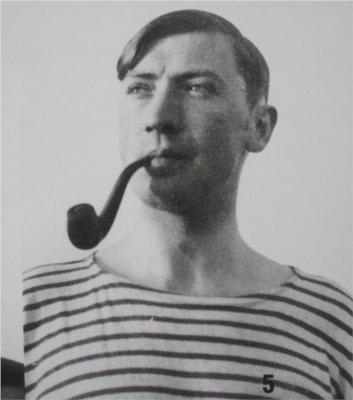
Museums5
Countries4
Largest reported holdingMusée d'art moderne de Paris, Paris · 3 recorded works
Loading map…
Where to see Felix Labisse
Collection holdings are reported here; current display varies. Check with each museum before visiting.
-
3 recorded works
Musée d'art moderne de Paris
Paris, France
Also here (6)
-
2 recorded works
Mu.ZEE - Kunstmuseum aan Zee
Ostend, Belgium


-
1 recorded work
Museum Boijmans Van Beuningen
Rotterdam, Netherlands
-
1 recorded work
Vanderbilt Museum of Art
Nashville, United States
-
1 recorded work
Musée National d'Art Moderne
Paris, France


Frequently Asked Questions
Where can I see Felix Labisse's work?
To view works by Felix Labisse, consider visiting museums that feature Art Deco or Modern art. These include institutions in France, Belgium, Spain, Portugal, Canada, and the United States. In France, you might find his pieces at the Musée des Arts Décoratifs in Paris, or the Musée d’Art et d’Industrie in Roubaix. The Musée des Beaux-Arts in Nancy is another option. Other European museums include the Brangwyn Museum in Bruges, Belgium; the Museu Calouste Gulbenkian in Lisbon, Portugal; and the Museu d’Art Modern in Barcelona, Spain. In North America, collections can be viewed at the Los Angeles County Museum of Art (LACMA); the Metropolitan Museum of Art; the Minneapolis Institute of Arts; the Museum of Modern Art in New York; the Royal Ontario Museum in Toronto; the Virginia Museum of Fine Arts; and the Wolfsonian at Florida International University.What should I know about Felix Labisse's prints?
Felix Labisse (1905[1]-1982[1]) was a French painter, writer, and stage designer associated with Surrealism and magic realism. While he is best known for his paintings, he also produced prints, often lithographs and etchings. Labisse's prints share thematic and stylistic elements with his paintings. Recurring motifs include female figures, often with ambiguous or androgynous qualities; cats; dreamlike interiors; and theatrical settings. His colour palettes tend towards muted tones, with occasional flashes of brighter colour to create dramatic effects. His printmaking techniques varied, with some works displaying fine, precise linework and others a more painterly, expressive approach. He often combined different printmaking methods to achieve particular textures and effects. Collectors should note that the value and availability of Labisse's prints can vary depending on the size of the edition, the condition of the print, and its provenance. Examples can be found in museum collections and at auction.Why are Felix Labisse's works important today?
Felix Labisse (1905[1]-1982[1]) was a French painter associated with Surrealism, though he maintained his independence from the group. His paintings often feature dreamlike imagery, female figures, and theatrical settings. The importance of Labisse's works today lies in their unique approach to the figure and the exploration of psychological themes. While some critics argue that modern art owes its fame more to social conflict than artistic merit, Labisse's art offers a different perspective. His paintings invite viewers to engage with the subconscious and explore the boundaries between reality and imagination. Labisse's focus on personal mythology and symbolism sets him apart. His works provide a counterpoint to art that is overly focused on theory or historical context. Instead, Labisse prioritises the creation of a pictorial fact, as opposed to simply reconstituting an anecdote. This emphasis on the artwork's independent value, regardless of external factors, remains relevant in contemporary art.Who did Felix Labisse influence?
Although Félix Labisse is not mentioned in connection with specific artists, his milieu can be mapped through those who influenced him. As a member of the later generation of the Fauves, Labisse would have been part of a movement that included Henri Matisse, André Derain, and Maurice de Vlaminck. The Fauves built on the work of Paul Gauguin, Émile Bernard, and Paul Sérusier. The critic Louis Vauxcelles coined the term 'fauve' (wild beast) at the Salon d'Automne of 1905[1], in the same way the word 'impressionist' had been used earlier. Matisse and Albert Marquet had been students together, first at the École des Arts Décoratifs, then at the École des Beaux-Arts. After leaving the École, Matisse met Derain, who was living near Vlaminck, and the two shared a studio. The impact of the Van Gogh exhibition of 1891 cemented their coherence as a group.Who influenced Felix Labisse?
Félix Labisse (born 1905[1]) was acquainted with James Ensor, who painted masked figures and carnival processions. Labisse also knew Michel de Ghelderode, a poet known for his mysterious style. These connections influenced Labisse's artistic development. Labisse aimed to conjure images inspired by old books of magic spells, chance encounters, and the unusual aspects of everyday life. His art incorporated succubi and incubi, spirits considered heretical during the Middle Ages. However, a seventeenth-century theologian, Systran d’Amino, regarded them as reasonable creatures, both corporeal and platonic, living among humans, being born, and dying like humans; Labisse shared this view. In 1930[1], he contributed to the production of films such as *Le chien andalou*, *L'âge d'or*, *Les mystères des beaux yeux*, and *La mort de verre*. While maintaining his independence, Labisse associated with Surrealist figures like Philippe Soupault, but also with Robert Desnos, Paul Éluard, and Jacques Prévert. His work displays a dreamlike atmosphere and a baroque spirit.What is Felix Labisse's most famous work?
It is difficult to identify one single work as Felix Labisse's most famous. He produced paintings, illustrations, and theatre designs from the 1920s until his death in 1982[1], developing a recognisable personal style that mixed surrealism with eroticism. Labisse is known for his depictions of female figures, often in dreamlike or fantastical settings. He explored themes of metamorphosis, desire, and the subconscious. His paintings often feature recurring motifs, such as sphinxes, cats, and hybrid creatures, contributing to his unique visual vocabulary. He also produced stage designs and costumes for theatre and ballet. He illustrated books, including editions of poetry and erotica. He was associated with Surrealism, exhibiting with the group and exploring similar themes in his art. He developed a distinctive style characterised by fluid lines, bold colours, and a sense of theatricality.What style or movement did Felix Labisse belong to?
Felix Labisse (1905[1]-1982[1]) is usually associated with Surrealism, though he maintained an independent path. André Breton included Labisse in his 1965[1] book, *Surrealism and Painting*, placing him within the movement. However, Labisse's style diverged in significant ways. He explored themes of metamorphosis, eroticism, and the subconscious, often populating his canvases with dreamlike figures and unsettling juxtapositions. His work has a theatrical quality, perhaps influenced by his early involvement with stage design. Labisse developed a personal iconography featuring recurring motifs such as sphinxes, mannequins, and hybrid creatures. While Surrealism provided a starting point, Labisse's artistic vision remained uniquely his own, defying easy categorisation. His paintings evoke a sense of mystery and psychological tension, inviting viewers into a strange, symbolic world.What was Felix Labisse known for?
Felix Labisse (1905[1]-1982[1]) was a French painter, writer, and stage designer, associated with Surrealism and known for his dreamlike imagery. Although he never officially joined the Surrealist group, his work shares many characteristics with the movement. These include the exploration of the unconscious, the use of bizarre and irrational juxtapositions, and the creation of enigmatic, symbolic figures. He developed a personal style that blended Surrealist ideas with his own unique vision. Labisse's paintings often feature hybrid creatures, mysterious women, and unsettling scenes, all rendered with precise detail. His colour palettes could range from muted and atmospheric to bold and theatrical. He was interested in the themes of metamorphosis, desire, and the hidden aspects of the human psyche. Beyond painting, Labisse designed sets and costumes for theatre and ballet productions, including works by Shakespeare and contemporary playwrights. He also wrote poetry and essays, further exploring the themes present in his visual art.
Sources
Where to See guide aggregates verified holdings of Felix Labisse's works across the following collections.
- [1] wikipedia Wikipedia: Felix Labisse Used for: biography.
- [2] book Beard, Lee, 1973- author, Butler, Adam, author; Van Cleave, Claire, author; Fortenberry, Diane, author; Stirling, Susan, author, Beard, Lee, 1973- author, Butler, Adam, author; Van Cleave, Claire, author; Fortenberry, Diane, author; Stirling, Susan, author - The Art Book_ New Edition, Mini Format Used for: biography.
- [3] book guggenheim-paintingsfromare00solo Used for: biography.
- [4] book guggenheim-twopri00weis Used for: biography.
Editorial overseen by Solis Prints. Sources verified 2026-10-14. Click a source for details, or hover over [N] in the page above to preview.
Editorial standardsMethodologyCorrectionsAI disclosureAbout the editorial team