



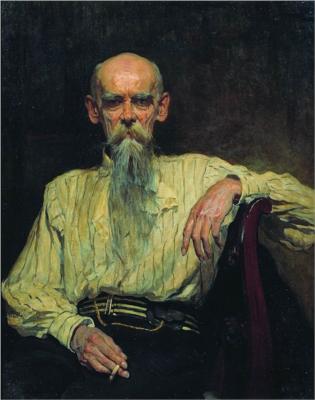
About Efim Volkov
Russian Soviet Federative Socialist Republic · 1844–1920
- landscape painting
Russian landscape painter of the Peredvizhniki who spent fifty years recording the bogs, birch forests, and moonlit meadows of the northern countryside.
Museums2
Countries2
Most worksTretyakov Gallery, Moscow · 1 works
Loading map…
Where to see Efim Volkov
Ranked by works you can see in person.
-
1 works
Tretyakov Gallery
Moscow, Russia
-
1 works
National Museum in Warsaw
Warsaw, Poland


Frequently Asked Questions
Where can I see Efim Volkov's work?
It is difficult to pinpoint exactly where one might view Volkov's work today. Many museums acquired avant-garde art in the early twentieth century; however, some works went missing in the early 1920s. Museums sometimes deaccessioned art considered to be of low value. Some were even destroyed. However, some museums with holdings of Russian avant-garde art include the Albright-Knox Art Gallery (Buffalo, New York), the Dallas Museum of Art, the Los Angeles County Museum of Art, and the Solomon R. Guggenheim Museum (New York). European museums include the Galleria internazionale d'arte moderna, Ca' Pesaro (Venice) and the Wilhelm Hack Museum (Ludwigshafen). In the UK, one might try the Brighton Museum & Art Gallery, the Manchester Art Gallery, or the Victoria & Albert Museum (London).What should I know about Efim Volkov's prints?
Efim Volkov (1844[1]-1920[1]) was a Russian artist known for his atmospheric depictions of the Russian countryside. While details about Volkov's printmaking activities are scarce, understanding the context of printmaking in late 19th and early 20th century Russia offers some insight. During this period, original prints gained recognition as a major artistic medium. Artists started signing their prints to distinguish them from commercial reproductions, which testified to the print's authenticity. Edition sizes were often limited and numbered, influencing the price and preventing excessive printing as plates wore down. Original prints allowed artists to reach a wider audience due to their greater availability and lower cost compared to other art forms. Some prints served illustrative purposes, exploring the interplay between written and visual elements.Why are Efim Volkov's works important today?
Efim Volkov (1844[1]-1920[1]) was a Russian artist known for his atmospheric paintings. He was a member of the Peredvizhniki movement, also known as The Wanderers. This group of Russian realist artists formed in protest against academic restrictions; they aimed to depict Russian life and society. Volkov's importance lies in his contribution to Russian realist painting. His works offer insight into the Russian countryside during the late 19th and early 20th centuries. He captured the mood of the Russian seasons; his paintings often evoke a sense of melancholy. His landscapes are characterised by their attention to light and atmosphere. Volkov's skill in capturing the subtle nuances of nature made him a popular artist in his time. Today, his works are appreciated for their historical value and artistic merit. They provide a window into a specific time and place in Russian history. Volkov's paintings are held in major Russian art museums; they continue to be studied by art historians and enjoyed by the public.What techniques or materials did Efim Volkov use?
Efim Volkov (1844[1]-1920[1]) was a Russian artist known for his atmospheric paintings. He primarily worked in oils. He also produced some works in watercolour and tempera. Volkov’s technique involved layering paint to create subtle tonal gradations. His application of paint was often smooth, with soft edges. This blended the colours and forms in his compositions. He aimed to capture the mood of the Russian countryside. Volkov was a member of the Peredvizhniki movement, also known as the Wanderers. This group of Russian realist artists moved away from academic art. They wanted to depict the lives of ordinary people and the Russian landscape. They often worked en plein air, painting outdoors. This allowed them to directly observe the effects of light and atmosphere. Volkov’s paintings often feature muted colours, reflecting the northern light. He used these to create a sense of quiet and melancholy. His choice of materials and techniques supported his artistic goals. He sought to portray the beauty and character of the Russian natural world.Who did Efim Volkov influence?
Albrecht Dürer's art affected numerous artists during his lifetime, and interest in his work was revived during the Dürer Renaissance (approximately 1570 to 1630). Hans Hoffmann was a primary representative of this movement. Rudolph II assembled a large collection of Dürer's works. Even as Dürer's popularity waned in the seventeenth and eighteenth centuries, artists continued to pay homage to his work. Caravaggio's 1602 painting, *Taking of Christ*, borrows from Dürer's woodcut, *Beheading of St John the Baptist* (1510). Diego Velázquez's *Las Hilanderas* in the Prado also seems to allude to Dürer's engraving of *Adam and Eve*. Rembrandt owned Dürer's book on proportion with woodcuts, and adapted a figure from Dürer's *Large Passion* for his etching of *The Blindness of Tobit*. In 1925, Otto Dix painted *Portrait of the Lawyer Hugo Simons*, inspired by Dürer's self-portrait drawings. Lucian Freud's 1975-6 portrait of Frank Auerbach also shows the influence of Dürer's *Four Apostles*. Norman Rockwell included Dürer in his *Triple Self-Portrait* of 1960, along with Rembrandt, Van Gogh, and Picasso.Who influenced Efim Volkov?
Efim Volkov (1844[1]-1920[1]) was a Russian artist known for his paintings of Russian scenery. Although information about his direct influences is limited in English-language sources, we can infer some artistic connections from his training and the milieu in which he worked. Volkov studied at the Imperial Academy of Arts in Saint Petersburg, a centre for artistic training. There, he would have been exposed to the dominant styles and established masters of the time. The curriculum emphasised technical skill and often favoured academic traditions. The influence of the Barbizon School of French painting is also a possibility. This group of artists, active from the 1830s to 1870s, rejected academic conventions and focused on direct observation of nature. Their emphasis on plein-air painting and realistic depictions of rural life resonated with many Russian artists, including those who, like Volkov, focused on Russian scenery. Artists such as Ivan Shishkin, a contemporary of Volkov, also demonstrate this interest in naturalism.What is Efim Volkov's most famous work?
Efim Volkov (1844[1]-1920[1]) was a Russian artist known for his atmospheric paintings of the Russian countryside. While it is difficult to identify a single "most famous" work, several paintings are particularly well known and representative of his style. One frequently cited example is "October" (1883[1]), which depicts a bleak, muddy path winding through a birch forest in autumn. This work is typical of Volkov's ability to capture the melancholy beauty of the Russian seasons. His paintings often feature muted colours and a sense of quiet contemplation. Another notable work is "March" (1896), showing a snow-covered field under a grey sky. Like "October", "March" demonstrates Volkov's talent for portraying the subtle nuances of light and atmosphere in the Russian landscape. Volkov's works are held in major Russian museum collections, including the State Russian Museum in Saint Petersburg and the Tretyakov Gallery in Moscow. These paintings offer a view into the Russian countryside and the artist's sensitive observation of nature.What style or movement did Efim Volkov belong to?
Efim Volkov (1844[1]-1920[1]) was a Russian painter, associated with the Russian realist movement. Realist artists aimed to depict subjects and situations with accuracy, avoiding idealisation or romantic interpretation. In painting, realism often involved close observation and detailed representation, with an emphasis on portraying everyday life. Volkov's work focused on Russian scenery and rural subjects. He studied the hue, value, and intensity of colour as they relate to near, middle, and far areas, and then mixed the colour on the palette. He looked at his subject again to understand the shape of the area to be painted, and then began painting the shape. He looked at his subject, and painted more of the shape. He looked again. He spent as much time looking as he did painting. His paintings are characterised by attention to detail and an accurate depiction of natural light and atmosphere.
Sources
Where to See guide aggregates verified holdings of Efim Volkov's works across the following collections.
- [1] wikipedia Wikipedia: Efim Volkov Used for: biography.
- [2] book Kovtun, Evgueny(Author), Art of Century : Russian Avant-Garde Used for: biography.
- [3] book R. Bruce Elder, Cubism and Futurism_ Spiritual Machines and the Cinematic Effect (Film and Media Studies) Used for: stylistic analysis.
- [4] book R. Bruce Elder, Cubism and Futurism_ Spiritual Machines and the Cinematic Effect (Film and Media Studies) Used for: stylistic analysis.
- [5] book Weisstein, Ulrich., Expressionism As an International Literary Phenomenon Used for: stylistic analysis.
- [6] book Yevgenia Petrova (editor), Origins of the Russian avant-garde_ celebrating the 300th anniversary of St. Petersburg_ the Walters Art Museum, Baltimore (13 February-25 May 2003), Fine Arts Museums of San Francisco (29 June-21 September 2003) Used for: biography.
- [7] book Peter. Leek, Russian Painting Used for: biography.
Editorial overseen by Solis Prints. Sources verified 2026-08-31. Click a source for details, or hover over [N] in the page above to preview.
Editorial standardsMethodologyCorrectionsAI disclosureAbout the editorial team