



Efim Volkov
- landscape painting
Efim Volkov spent most of his career painting what other Russian landscapists overlooked: the damp, unheroic terrain of the northern bogs. In an era when the Peredvizhniki (Wanderers) movement was filling canvases with social conscience, Volkov found his subject in the quieter drama of a marsh in autumn, or moonlight catching birch trees in November.
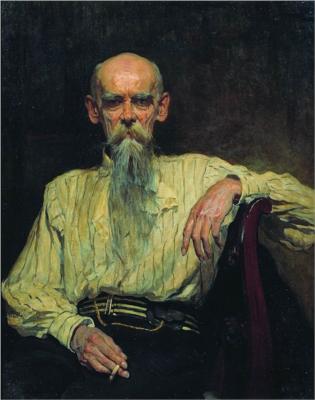
Biography
Born in St Petersburg in 1844[1], the son of a medical assistant, Volkov worked briefly at the Ministry of Justice before committing to art full-time. He studied at the Imperial Academy of Fine Arts and received the 'Free Artist' designation in 1870[1] for a view of St Petersburg and its surroundings. His 1872 painting 'Bog in Autumn' caught the attention of critics at the Imperial Society's exhibition and was sent to the Universal Exhibition in London, where it received positive notices. Volkov joined the Wanderers in 1878 and exhibited with them annually through the following decade.
His output was enormous: over 500 paintings, plus hundreds of studies. The recurring motifs are consistent throughout, sodden ground, stands of birch, mist, early snow on open meadows. After the death of his daughter in 1884[1], he and his wife travelled through Greece, Turkey, Egypt, and Palestine. The resulting seascapes and Mediterranean landscapes are noticeably brighter, more at ease with sunlight, than anything he had painted before.
By 1905[1] the Peredvizhniki were losing cultural authority, and Volkov's reputation declined with the movement. He was elected Academician in 1899 but died in near-poverty in Petrograd in 1920[1]. He is buried at Smolensky Cemetery.
Timeline
- 1844Born in St Petersburg, the son of a medical assistant.
- 1870Received the 'Free Artist' designation from the Imperial Academy of Fine Arts for a view of St Petersburg and its surroundings, at 26.
- 1872His painting "Bog in Autumn" was exhibited at the Imperial Society's exhibition and sent to the Universal Exhibition in London, aged 28.
- 1878Joined the Wanderers movement, at 34, and exhibited with them annually for the next decade.
- 1884Following the death of his daughter, aged 40, he and his wife travelled through Greece, Turkey, Egypt, and Palestine.
- 1899Elected Academician, at 55.
- 1920Died in near-poverty in Petrograd, at 76. He is buried at Smolensky Cemetery.
Notable Works
Tap to view larger.
Next stop
Browse the movements →
Every movement in the collection, from the Renaissance to Pop art.
Related Artists



Frequently Asked Questions
What is Efim Volkov known for?
Efim Volkov is known for painting the damp, unheroic terrain of the northern bogs. He found his subject in the quieter drama of a marsh in autumn, or moonlight catching birch trees.What is Efim Volkov's most famous work?
Efim Volkov (1844[1]-1920[1]) was a Russian artist known for his atmospheric paintings of the Russian countryside. While it is difficult to identify a single "most famous" work, several paintings are particularly well known and representative of his style. One frequently cited example is "October" (1883[1]), which depicts a bleak, muddy path winding through a birch forest in autumn. This work is typical of Volkov's ability to capture the melancholy beauty of the Russian seasons. His paintings often feature muted colours and a sense of quiet contemplation. Another notable work is "March" (1896), showing a snow-covered field under a grey sky. Like "October", "March" demonstrates Volkov's talent for portraying the subtle nuances of light and atmosphere in the Russian landscape. Volkov's works are held in major Russian museum collections, including the State Russian Museum in Saint Petersburg and the Tretyakov Gallery in Moscow. These paintings offer a view into the Russian countryside and the artist's sensitive observation of nature.What should I know about Efim Volkov's prints?
Efim Volkov (1844[1]-1920[1]) was a Russian artist known for his atmospheric depictions of the Russian countryside. While details about Volkov's printmaking activities are scarce, understanding the context of printmaking in late 19th and early 20th century Russia offers some insight. During this period, original prints gained recognition as a major artistic medium. Artists started signing their prints to distinguish them from commercial reproductions, which testified to the print's authenticity. Edition sizes were often limited and numbered, influencing the price and preventing excessive printing as plates wore down. Original prints allowed artists to reach a wider audience due to their greater availability and lower cost compared to other art forms. Some prints served illustrative purposes, exploring the interplay between written and visual elements.What style or movement did Efim Volkov belong to?
Efim Volkov (1844[1]-1920[1]) was a Russian painter, associated with the Russian realist movement. Realist artists aimed to depict subjects and situations with accuracy, avoiding idealisation or romantic interpretation. In painting, realism often involved close observation and detailed representation, with an emphasis on portraying everyday life. Volkov's work focused on Russian scenery and rural subjects. He studied the hue, value, and intensity of colour as they relate to near, middle, and far areas, and then mixed the colour on the palette. He looked at his subject again to understand the shape of the area to be painted, and then began painting the shape. He looked at his subject, and painted more of the shape. He looked again. He spent as much time looking as he did painting. His paintings are characterised by attention to detail and an accurate depiction of natural light and atmosphere.What techniques or materials did Efim Volkov use?
Efim Volkov (1844[1]-1920[1]) was a Russian artist known for his atmospheric paintings. He primarily worked in oils. He also produced some works in watercolour and tempera. Volkov’s technique involved layering paint to create subtle tonal gradations. His application of paint was often smooth, with soft edges. This blended the colours and forms in his compositions. He aimed to capture the mood of the Russian countryside. Volkov was a member of the Peredvizhniki movement, also known as the Wanderers. This group of Russian realist artists moved away from academic art. They wanted to depict the lives of ordinary people and the Russian landscape. They often worked en plein air, painting outdoors. This allowed them to directly observe the effects of light and atmosphere. Volkov’s paintings often feature muted colours, reflecting the northern light. He used these to create a sense of quiet and melancholy. His choice of materials and techniques supported his artistic goals. He sought to portray the beauty and character of the Russian natural world.What was Efim Volkov known for?
Efim Volkov (1844[1]-1920[1]) was a Russian artist known for his atmospheric representations of the Russian countryside. Landscape painting emerged as a distinct genre in Russia during the late eighteenth and early nineteenth centuries. Early artists in this area, such as Fyodor Alexeyev, Fyodor Matveyev, Maxim Vorobiev and Sylvester Shchedrin, were influenced by the Latin tradition. Later, painters such as Venetsianov created works with a more identifiably Russian character. Volkov's work often featured muted tones and subtle lighting, creating a sense of tranquility and quiet observation. He captured the essence of the Russian seasons, from snow-covered fields to golden autumn forests, with a focus on realism. His paintings evoke a feeling of intimacy with nature, characteristic of Russian art of the period.When did Efim Volkov live and work?
Efim Volkov was active as an artist in the late 19th and early 20th centuries. More specifically, he was born in 1844[1] and died in 1920[1]. He was a Russian painter known for his contributions to the art world during this period. Volkov engaged in house painting, decorating, and restoration work from 1903[1] to 1908. He studied at the private studio of academician Lev Dmitriev-Kavkazsky. From 1908 to 1910, he attended the St Petersburg Academy. In 1912, he travelled to Italy and France. In 1913, with Iosif Shkolnik, he designed decor for Vladimir Mayakovsky’s tragedy Vladimir Mayakovsky. From 1914 to 1915, he illustrated futurist booklets and published a long poem with his own illustrations.Where can I see Efim Volkov's work?
It is difficult to pinpoint exactly where one might view Volkov's work today. Many museums acquired avant-garde art in the early twentieth century; however, some works went missing in the early 1920s. Museums sometimes deaccessioned art considered to be of low value. Some were even destroyed. However, some museums with holdings of Russian avant-garde art include the Albright-Knox Art Gallery (Buffalo, New York), the Dallas Museum of Art, the Los Angeles County Museum of Art, and the Solomon R. Guggenheim Museum (New York). European museums include the Galleria internazionale d'arte moderna, Ca' Pesaro (Venice) and the Wilhelm Hack Museum (Ludwigshafen). In the UK, one might try the Brighton Museum & Art Gallery, the Manchester Art Gallery, or the Victoria & Albert Museum (London).Where was Efim Volkov from?
Information about Efim Volkov's origins is scarce in the provided texts. However, some context can be gathered from related details. One passage refers to the Russian Soviet Federative Socialist Republic (RSFSR), which existed from 1917[1] to 1922, and later became part of the USSR. Another passage mentions artists designing propaganda plates with RSFSR emblems and slogans. This suggests Volkov was working during a time of significant political and geographical reorganisation in Russia. The RSFSR was a vast territory, stretching from Finland to the Bering Strait. Without more specific information, it is impossible to pinpoint Volkov's precise place of birth or regional affiliation within the former Russian Empire, or the later Soviet Union. Further research would be needed to establish his specific origins.Who did Efim Volkov influence?
Albrecht Dürer's art affected numerous artists during his lifetime, and interest in his work was revived during the Dürer Renaissance (approximately 1570 to 1630). Hans Hoffmann was a primary representative of this movement. Rudolph II assembled a large collection of Dürer's works. Even as Dürer's popularity waned in the seventeenth and eighteenth centuries, artists continued to pay homage to his work. Caravaggio's 1602 painting, *Taking of Christ*, borrows from Dürer's woodcut, *Beheading of St John the Baptist* (1510). Diego Velázquez's *Las Hilanderas* in the Prado also seems to allude to Dürer's engraving of *Adam and Eve*. Rembrandt owned Dürer's book on proportion with woodcuts, and adapted a figure from Dürer's *Large Passion* for his etching of *The Blindness of Tobit*. In 1925, Otto Dix painted *Portrait of the Lawyer Hugo Simons*, inspired by Dürer's self-portrait drawings. Lucian Freud's 1975-6 portrait of Frank Auerbach also shows the influence of Dürer's *Four Apostles*. Norman Rockwell included Dürer in his *Triple Self-Portrait* of 1960, along with Rembrandt, Van Gogh, and Picasso.Who influenced Efim Volkov?
Efim Volkov (1844[1]-1920[1]) was a Russian artist known for his paintings of Russian scenery. Although information about his direct influences is limited in English-language sources, we can infer some artistic connections from his training and the milieu in which he worked. Volkov studied at the Imperial Academy of Arts in Saint Petersburg, a centre for artistic training. There, he would have been exposed to the dominant styles and established masters of the time. The curriculum emphasised technical skill and often favoured academic traditions. The influence of the Barbizon School of French painting is also a possibility. This group of artists, active from the 1830s to 1870s, rejected academic conventions and focused on direct observation of nature. Their emphasis on plein-air painting and realistic depictions of rural life resonated with many Russian artists, including those who, like Volkov, focused on Russian scenery. Artists such as Ivan Shishkin, a contemporary of Volkov, also demonstrate this interest in naturalism.Who was Efim Volkov?
Without specific reference material, I am unable to provide details regarding the life and career of Efim Volkov. I can say that during this period, many artists were involved in Soviet agitprop (agitation propaganda) movements. For example, in Petrograd, on the first anniversary of the October Revolution, Al'tman designed Zemlia trudiashchimsia (Land to the Workers, 1919[1]). According to Al'tman's widow, the colours green and red represented the land and the workers. The monumental style of the design emphasizes the importance of the theme. Russia was on the verge of collapse; yet, Al'tman was allotted fifty thousand feet of canvas to mount Futurist constructions and designs on the Winter Palace walls and on the General Staff Arch. The Aleksandr Column became a Futurist sculpture. Adamovich also designed several colourful propaganda plates containing the emblems of the new republic, complemented by revolutionary symbols and slogans.
Sources
Editorial draws on the following primary and tertiary references for Efim Volkov.
- [1] wikipedia Wikipedia: Efim Volkov Used for: biography, birth dates, death dates, identifiers, movement attribution, nationality.
- [2] book Kovtun, Evgueny(Author), Art of Century : Russian Avant-Garde Used for: biography.
- [3] book R. Bruce Elder, Cubism and Futurism_ Spiritual Machines and the Cinematic Effect (Film and Media Studies) Used for: stylistic analysis.
- [4] book R. Bruce Elder, Cubism and Futurism_ Spiritual Machines and the Cinematic Effect (Film and Media Studies) Used for: stylistic analysis.
- [5] book Weisstein, Ulrich., Expressionism As an International Literary Phenomenon Used for: stylistic analysis.
- [6] book Yevgenia Petrova (editor), Origins of the Russian avant-garde_ celebrating the 300th anniversary of St. Petersburg_ the Walters Art Museum, Baltimore (13 February-25 May 2003), Fine Arts Museums of San Francisco (29 June-21 September 2003) Used for: biography.
- [7] book Peter. Leek, Russian Painting Used for: biography.
Editorial overseen by Solis Prints. Sources verified 2026-08-31. Click a source for details, or hover over [N] in the page above to preview.
Editorial standardsMethodologyCorrectionsAI disclosureAbout the editorial team