

About Bas Jan Ader
Museums3
Countries2
Largest reported holdingMuseum Boijmans Van Beuningen, Rotterdam · 4 recorded works
Loading map…
Where to see Bas Jan Ader
Collection holdings are reported here; current display varies. Check with each museum before visiting.
-
4 recorded works
Museum Boijmans Van Beuningen
Rotterdam, Netherlands
-
1 recorded work
National Gallery of Art
Washington D.C., United States


-
1 recorded work
Museum of Modern Art
New York City, United States

Frequently Asked Questions
Why are Bas Jan Ader's works important today?
Bas Jan Ader's work remains important because it explores themes of failure, vulnerability, and the search for meaning, which continue to resonate with contemporary audiences. Ader's practice, though brief due to his disappearance at sea in 1975[1], is characterised by performative actions, photography, and film. Many of his pieces involve acts of falling, such as *Fall I, Los Angeles* (1970[1]) and *Fall II, Amsterdam* (1970), where he documented himself falling from a chair or a roof. These works are often interpreted as metaphors for human limitations and the absurdity of existence. His most well-known work, *In Search of the Miraculous* (1975), involved a solo sailing trip across the Atlantic, a voyage from which he never returned. Ader's art prefigures later developments in performance and conceptual art. His willingness to embrace risk and uncertainty, combined with the poetic nature of his gestures, has made him a significant figure for artists examining similar themes today. His work prompts reflection on mortality, the human condition, and the search for something beyond the everyday.What techniques or materials did Bas Jan Ader use?
Bas Jan Ader's artistic practice incorporated a range of media, often with a performative element. He is known for his use of photography and film to document actions and events. Ader's work frequently involved gravity and the exploration of falling. For example, he created a series of short films showing himself falling from various heights, such as off a chair or a roof. These films, along with photographs, captured the fleeting moments of these actions. His conceptual approach extended to other mediums, including posters and postcards. These often featured simple, direct imagery and text, reflecting his interest in ideas of failure, vulnerability, and the human condition. Ader also employed found objects and text in his work, incorporating elements of chance and everyday life into his artistic explorations.Who did Bas Jan Ader influence?
It is difficult to identify specific individuals directly influenced by Bas Jan Ader, but some connections can be drawn to artists who explore similar themes. Anri Sala, for example, manipulates film conventions and narrative structures, combining techniques from film noir to documentary styles. Sala concentrates on the intersection between fiction and reality, memory, and truth, similar to Ader's explorations of these themes through performance and film. Olafur Eliasson challenges perceptions of reality through simulations of natural phenomena. His work often exposes the mechanisms of fabrication, freeing viewers from romantic notions of nature. This approach shares some conceptual space with Ader's deconstruction of artistic gestures and his focus on the act of creation itself. More broadly, Ader's interest in the body, performance, and the use of film as a medium connects him to a wider group of artists who emerged in the late 1960s and 1970s. These artists questioned traditional artistic aesthetics and explored new ways of engaging with the world, often through documentation of simple actions and explorations of vulnerability.Who influenced Bas Jan Ader?
Bas Jan Ader's influences are not well documented. However, some context can be gleaned from the artistic environment of the time. During the mid-20th century, movements such as Abstract Expressionism and the Bauhaus had a significant impact on art education and practice. At Black Mountain College, Josef Albers, formerly of the Bauhaus, taught students to explore visual perception and material analysis. Albers encouraged experimentation with unconventional materials and techniques, an approach that resonated with artists seeking to break from tradition. Figures like Robert Rauschenberg, who studied with Albers, began to incorporate representational imagery into their work, challenging the dominance of pure abstraction. Rauschenberg's use of found objects and innovative photographic techniques reflected a desire to engage with the world around him. The influence of John Cage and Merce Cunningham at Black Mountain further encouraged interdisciplinary approaches and a blurring of boundaries between art forms. While it is difficult to pinpoint specific artists who directly influenced Ader, it is likely that he was aware of these broader trends in contemporary art. The emphasis on experimentation, conceptual exploration, and the integration of art with everyday life would have provided a fertile ground for Ader's own artistic development.What is Bas Jan Ader's most famous work?
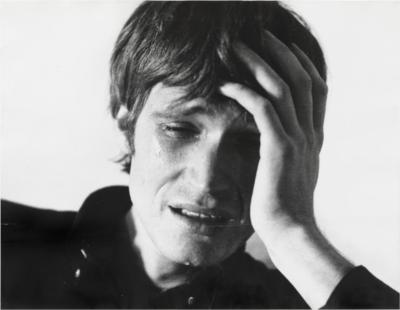
It is difficult to name Bas Jan Ader's single most famous work, as his practice involved various performance pieces, films, photography, and conceptual art. One of his best-known pieces is *Fall I, Los Angeles, 1970[1]*. In this work, Ader filmed himself falling from the roof of his house. This piece is part of a series of works that explore the theme of falling, both literally and figuratively. Another notable work is *I'm Too Sad to Tell You*, 1971, which exists as a film and a photograph. In the film, Ader is seen crying, his face conveying intense emotion. The photograph captures a still image from the film, further emphasising the artist's emotional state. Ader's final work, *In Search of the Miraculous*, began in 1975[1]. It was a planned transatlantic voyage in a small sailboat. Ader disappeared at sea, and the work was never completed, adding a layer of mystery and poignancy to his artistic output.What style or movement did Bas Jan Ader belong to?
Bas Jan Ader's work resists easy categorisation. His performances and conceptual pieces from the late 1960s and early 1970s share some characteristics with movements like Conceptual art and Minimalism; however, Ader's work often incorporated elements of risk, failure, and a melancholic romanticism that set him apart. Some critics link him to the broader context of Post-Minimalism, which saw artists moving away from the austere geometry and objecthood of Minimalism toward more subjective, process-oriented, and often ephemeral works. Ader's use of film and photography to document his performances aligns him with Conceptual art's emphasis on idea over object. Yet, his pieces often possess an emotional resonance absent from more detached conceptual practices. His work remains unique, defying straightforward classification.What was Bas Jan Ader known for?
Bas Jan Ader, a Dutch[1]-American conceptual and performance artist, is best known for works involving falls. These pieces often explored themes of failure, vulnerability, and the search for the miraculous in everyday life. Ader's work frequently took the form of short films, photographs, and performances. In one of his most recognised pieces, *Fall I, Los Angeles*, 1970[1], Ader is seen falling from a chair. Another work, *Fall II, Amsterdam*, also from 1970, shows him falling into a canal. These actions, seemingly simple, were carefully staged and documented, turning them into meditations on gravity, risk, and the human condition. Ader's most ambitious project was *In Search of the Miraculous*, a planned transatlantic voyage in a small sailboat. The voyage began in 1975[1], but his boat was found adrift off the coast of Ireland. Ader was never found, adding an element of mystery and tragedy to his artistic output. His disappearance has become part of his artistic narrative, solidifying his position as a cult figure in conceptual art.What is Bas Jan Ader known for?
Bas Jan Ader is known for films and photographs of physical failure. His signature pieces include films of him dropping from a roof and riding a bicycle into a canal, as well as a silent film of him weeping.
Sources
Where to See guide aggregates verified holdings of Bas Jan Ader's works across the following collections.
- [1] wikipedia Wikipedia: Bas Jan Ader Used for: biography.
- [2] book guggenheim-amsterdamparisdu00solo Used for: biography, stylistic analysis.
- [3] book guggenheim-berriarei00bilb Used for: stylistic analysis.
- [4] book guggenheim-masterp00solo Used for: biography.
- [5] book guggenheim-transfsi00wald Used for: biography.
- [6] book Masterpieces of western art : a history of art in 900 individual studies from the Gothic to the present day Used for: biography.
- [7] book edited and annotated by Lucy R. Lippard, Six years_ the dematerialization of the art object from 1966 to 1972_ a cross-reference book of information on some esthetic boundaries_ consisting of a bibliography into which are inserted a fragmented Used for: biography, stylistic analysis.
Editorial overseen by Solis Prints. Sources verified 2026-10-14. Click a source for details, or hover over [N] in the page above to preview.
Editorial standardsMethodologyCorrectionsAI disclosureAbout the editorial team