

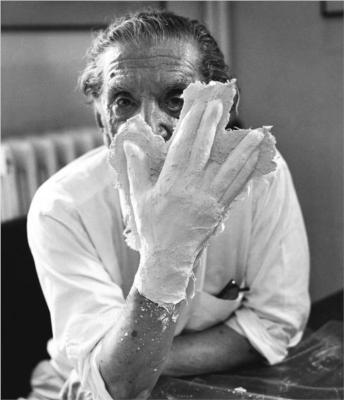
About Abidin Dino
Museums2
Countries2
Most worksMusée d'art moderne de Paris, Paris · 2 works
Loading map…
Where to see Abidin Dino
Ranked by works you can see in person.
-
2 works
Musée d'art moderne de Paris
Paris, France
Also here (6)
-
1 works
Seattle Art Museum
Seattle, United States


Frequently Asked Questions
Where can I see Abidin Dino's work?
Abidin Dino's work can be viewed in several public collections. These include the Musée National d'Art Moderne, at the Centre Georges Pompidou, in Paris; the Metropolitan Museum of Art, in New York; and the National Museums of Scotland, in Edinburgh. Other museums that hold his work are the Royal Ontario Museum, in Toronto; the Los Angeles County Museum of Art (LACMA); and the Victoria & Albert Museum, in London. Additional locations include the Brighton Museum & Art Gallery, Manchester Art Gallery, and the Geffrye Museum, all located in the UK. In the United States, one may find his pieces at the Charles Hosmer Morse Museum of American Art (Winter Park, Florida), the Minneapolis Institute of Arts, the Museum of Modern Art (New York), and the Wolfsonian at Florida International University (Miami Beach, Florida).What should I know about Abidin Dino's prints?
Abidin Dino (1913[1]-1993[1]) was a Turkish[1] artist and intellectual, well known for his drawings, paintings, and graphic art. He also worked as a caricaturist, sculptor, and writer. Dino's prints often feature themes of social commentary and the human condition. He had an interest in portraying labourers, villagers, and the urban poor. His style moved between figuration and abstraction, often characterised by strong lines and expressive forms. He used a variety of printmaking techniques, including etching and lithography. Dino spent many years in exile, living in Paris from 1952[1] until his death. This period had a considerable effect on his artistic output. His work became more experimental and reflected a sense of displacement. He engaged with contemporary artistic movements, while maintaining a connection to his Turkish heritage. His prints can be found in major museum collections, and they remain popular among collectors interested in modern Turkish art and politically engaged art. They offer insight into Dino's unique perspective on the world.Why are Abidin Dino's works important today?
Abidin Dino (1913[1]-1993[1]) was a Turkish[1] artist and intellectual whose career spanned painting, drawing, illustration, writing, and film. His art provides insight into 20th-century Turkish social and political history. Dino's early work included political cartoons and illustrations for leftist publications. He lived in exile from Turkey at various times, residing in Paris from the 1950s. His paintings often address themes of social justice, alienation, and the human condition. Figures such as peasants and workers appear frequently in his output. His body of work is stylistically diverse, ranging from figurative to abstract. Recurring motifs include hands, circles, and abstracted human forms. Dino engaged with modernism, while remaining connected to his cultural background. Dino's art is important because it offers a visual record of Turkey's modern transformation and its internal tensions. He combined artistic expression with social commentary, creating a body of work that invites reflection on the relationship between the individual and society. His art remains relevant for its humanistic perspective and its exploration of universal themes.What techniques or materials did Abidin Dino use?
It is difficult to summarise Abidin Dino's techniques and materials, as the definition of "technique" in art is complex. It includes not only the physical materials used, but also the artist's intellectual intentions and methods of execution. Artists use varied painting materials, such as natural and chemical pigments in fresco, egg tempera, watercolour and oil. More contemporary materials include acrylics, household emulsions, and mixed media, which combines a range of different materials in one work. Sculptors traditionally used materials such as wood, marble and bronze, but contemporary artists also use non-art materials, such as cardboard, plastic and everyday household items. Technical knowledge informs art history. Artists are not always confined by the medium in which they work; they make choices outside the constraints of materials and techniques. Understanding the techniques and processes used by artists, and the interface between the qualities of medium and technique and the aesthetic decisions made by the artist, is essential.Who did Abidin Dino influence?
Abidin Dino's influence is difficult to measure directly. The mid-20th-century art world in South Asia saw a tension between adherence to tradition and the embrace of post-cubist modernism. Artists like Abdur Rahman Chughtai were criticised by a younger generation for being overly concerned with Eastern artistic character, while figures such as Shakir Ali sought a more cosmopolitan approach, integrating Western influences. Shakir Ali critiqued what he saw as Chughtai's orientalism, arguing for the unifying aspects of both classical and modern art. Ali's focus on the relationship between modernism and subjectivity had a deep effect on emerging artists in Pakistan. His approach, which involved discovering materials, exploring the inner self, and connecting with society, foreshadowed later developments in the region. While some artists, such as Zainul Abedin and Sadequain, aimed to broaden their audience through public works and social interventions, much of the art of the period existed within studio-gallery-collector circles.Who influenced Abidin Dino?
Abidin Dino was influenced by several artists and movements. László Moholy-Nagy noted that Dino was inspired by Rembrandt's drawings, finding in them an emotional force and psychological depth that resonated with his own desire for quick results in draftsmanship. Dino also admired Vincent van Gogh's drawings, particularly their analytical nature and texture, which taught him about expressing three-dimensional quality through line. Another artist, Mario Merz, stated that he had gotten to know Matti Moreni, a painter working in an expressionist, figurative mode. Moreni encouraged Merz to make art. Merz also encountered the work of Luigi Spazzapan, a painter associated with the group 'I sei pittori di Torino', and was influenced by their sense of art as intensity. These encounters shaped Dino's artistic development and contributed to his unique style.What is Abidin Dino's most famous work?
Abidin Dino was a Turkish[1] artist and intellectual, best known for his contributions to modern Turkish art. While he produced a varied body of work throughout his career, including paintings, drawings, and writings, it is difficult to identify one single piece as his 'most famous'. However, one of his important paintings is Card Players, an acrylic on canvas, measuring 167 x 187 centimetres. It depicts two girls playing cards in a meadow, with a city visible in the background. Dino's art often incorporated elements from different cultures and periods, blending them into a unified chromatic scene. His work frequently includes ordinary objects and mythological depictions, set within Mediterranean settings. Dino's style is marked by a synthesis of drawing and colour, creating dream-like allegories that invite contemplation.What style or movement did Abidin Dino belong to?
Abidin Dino's artistic style defies easy categorisation, as he moved between different approaches throughout his career. He is often associated with social realism, reflecting his interest in the lives of ordinary people and his political views. During the 1930s, Dino was part of the "D Group" of Turkish[1] artists, who aimed to depict social realities and everyday life. His work from this period often featured scenes of workers, villagers, and urban life, rendered in a style that combined elements of realism with touches of expressionism. Later in his career, Dino's style became more abstract and experimental. He explored different media and techniques, and his work took on a more lyrical and symbolic quality. While he never completely abandoned his social concerns, his later work was less overtly political and more focused on personal expression. Therefore, while social realism is a significant aspect of his artistic identity, it does not fully encompass the range of his stylistic development.
Sources
Where to See guide aggregates verified holdings of Abidin Dino's works across the following collections.
- [1] wikipedia Wikipedia: Abidin Dino Used for: biography.
- [2] book guggenheim-guggenheimintern1964allo Used for: biography.
- [3] book guggenheim-refigur00kren Used for: biography.
- [4] book Masterpieces of western art : a history of art in 900 individual studies from the Gothic to the present day Used for: biography.
Editorial overseen by Solis Prints. Sources verified 2026-08-25. Click a source for details, or hover over [N] in the page above to preview.
Editorial standardsMethodologyCorrectionsAI disclosureAbout the editorial team