



Patrick Caulfield
Caulfield left school at fifteen and got a job as a filing clerk at Crosse and Blackwell, the food company. He was moved to the design studio, where he washed brushes and varnished chocolates for display cases. He decided to become an artist after watching the 1952 film Moulin Rouge about Toulouse-Lautrec.
Biography
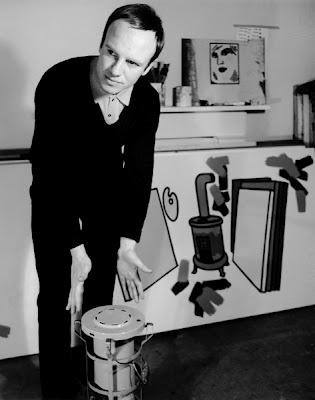
He joined the RAF at seventeen for national service, then studied at the Royal College of Art[5] from 1960 to 1963, alongside Hockney, Allen Jones, R.B. Kitaj, and Derek Boshier. The 1964 New Generation exhibition at the Whitechapel Gallery tagged him as Pop Art. He rejected the label for the rest of his life, calling himself a formal artist.
His paintings use bold, flat outlines and blocks of colour. They depict interiors, still lifes, restaurants, and domestic scenes with a deadpan quality that sits somewhere between commercial illustration and painting. The spaces are often empty or nearly so. A potted plant, a wine glass, a candle: the objects are ordinary but the treatment makes them strange. He was nominated for the Turner Prize in 1987. David Bowie and Charles Saatchi both collected his work. He died in 2005. The street in Acton where he was born was renamed Caulfield Road.
Timeline
- 1936Born in Acton, west London. His father was an engineer, and the family lived modestly throughout the war years.
- 1960Enrolled at the Royal College of Art in London at the age of 24, where his contemporaries included David Hockney, Allen Jones, and R.B. Kitaj.
- 1964Exhibited in the "New Generation" show at the Whitechapel Gallery in London at the age of 28, establishing his bold, flat-colour style with heavy black outlines.
- 1967Began teaching at Chelsea School of Art in London at the age of 31, a position he held for several years while continuing to develop his painting practice.
- 1981Completed "After Lunch" at the age of 45, a painting that juxtaposed his signature flat graphic style with a photorealistic passage of a chateau view. The work became one of his most celebrated pieces.
- 1999Shortlisted for the Turner Prize at the age of 63, making him the oldest nominee in the award's history at that time. The nomination recognised his continued relevance in British art.
- 2005Died in London at the age of 69 following a long illness. A retrospective at Tate Britain followed in 2013, reaffirming his distinctive contribution to post-war British painting.
Notable Works
Tap to view larger.
Where to See Patrick Caulfield
6 museums worldwide.
-

-
5 works
Vanderbilt Museum of Art
Nashville, United States
Tue–Fri 11:00–16:00, Sat–Sun 12:00–17:00, closed Mondays · Free
-
 3 works
British Council
London, United Kingdom
-
2 works
Government Art Collection
London, United Kingdom
-
1 works
Manchester Art Gallery
Manchester, United Kingdom
-
1 works
Walker Art Gallery
Liverpool, United Kingdom


Next stop
Pop Art →
Explore the artists and ideas of Pop Art.
Patrick Caulfield prints
Hand-finished archival prints from Patrick Caulfield's body of work.
 Sausage - Patrick Caulfield
From £28.00
Sausage - Patrick Caulfield
From £28.00
 Portrait of a Frenchman - Patrick Caulfield
From £28.00
Portrait of a Frenchman - Patrick Caulfield
From £28.00
 Small Window - Patrick Caulfield
From £37.00
Small Window - Patrick Caulfield
From £37.00
 Found Objects - Patrick Caulfield
From £28.00
Found Objects - Patrick Caulfield
From £28.00
 Les Demoiselles d'Avignon vues de derrière - Patrick Caulfield
From £30.00
Les Demoiselles d'Avignon vues de derrière - Patrick Caulfield
From £30.00
 Second Glass of Whisky - Patrick Caulfield
From £28.00
Second Glass of Whisky - Patrick Caulfield
From £28.00
Related Artists


_%E2%80%93_LOC.jpg)


Take Patrick Caulfield home.
See all Patrick Caulfield prints →Frequently Asked Questions
Is patrick caulfield still alive?
No, Patrick Caulfield died in 2005.Patrick caulfield art movement?
Patrick Caulfield was tagged as Pop Art after the 1964 New Generation exhibition, though he rejected this label.What is Patrick Caulfield's most famous work?
Patrick Caulfield is perhaps best known for his 1967 painting *After Lunch*. It is a representative work from his Pop Art period. Caulfield studied at Chelsea School of Art, then at the Royal College of Art[5] (1960 to 1963), where his contemporaries included David Hockney. His early pictures, such as *The Cha-Cha That Was Danced in the Early Hours of 24th March*, *We Two Boys Clinging Together*, and *Man in a Museum (or You're in the Wrong Movie)*, were exhibited in Hockney's 1988 retrospective. His paintings often depict interiors or still lifes, rendered in a flat, graphic style with bold black outlines and areas of solid colour. *After Lunch* is typical of this approach; it presents a restaurant interior with simplified forms and minimal detail. Caulfield's work often incorporates elements of realism, such as photographic details or trompe-l'oeil effects, which contrast with the otherwise stylised imagery.What should I know about Patrick Caulfield's prints?
Patrick Caulfield (1936-2005) is known for his screenprints, often characterised by flat planes of colour enclosed by black lines. He studied at Chelsea School of Art (1956-1960) and the Royal College of Art[5] (1960-1963), and his work is associated with British Pop Art, although he rejected the label. Caulfield made prints throughout his career, sometimes working with Editions Alecto. His prints often rework or relate to his paintings. For example, the print *Ruins* (1964) shares its subject with a painting of the same year. Some prints, such as the *Suite 22*, are closely related as a series. His style often incorporates elements of photorealism alongside simplified, almost cartoonish, areas. Caulfield's prints frequently depict interiors or still lifes, using a limited colour palette to create a sense of coolness and detachment. He sometimes included areas of flat, unprinted paper as a compositional element. Later in his career, his prints became more complex, with greater variation in colour and texture.What style or movement did Patrick Caulfield belong to?
Patrick Caulfield is generally associated with Pop art, a movement that emerged in both London and New York during the late 1950s and 1960s. Pop art sought to challenge consumerism and mass media by incorporating imagery from popular culture into fine art. This involved a move away from the emotionalism of Abstract Expressionism. British Pop art, predating its American counterpart, often drew inspiration from American consumer goods and magazines. While Caulfield is considered part of this movement, his style had a cooler, more impersonal quality. Although the term 'Pop' has been applied to Caulfield, his work also shows connections to other movements. Some critics have drawn parallels between his art and styles such as Lich-art and Arte Povera.What techniques or materials did Patrick Caulfield use?
Patrick Caulfield is known for paintings that combine flat areas of colour with bold, black lines. He often depicted commonplace objects and interiors in a style that is both representational and abstract. Caulfield's early work, such as the painting *View of the Rooftops* (1963), used hardboard and household paint. This gave his pictures a flat, graphic quality. He sometimes incorporated areas of textured paint to create contrast. Screenprinting was another technique Caulfield used, attracted by its capacity for producing flat, unmodulated colour. He produced many prints throughout his career, including a series based on poems by Jules Laforgue. These prints demonstrate his interest in line, colour, and simplified forms. Later in his career, Caulfield began to incorporate more subtle tonal variations and details into his work. He would sometimes include areas of photorealism within his otherwise stylised compositions. This can be seen in paintings such as *After Lunch* (1975), which includes a photo-realistic still-life element.What was Patrick Caulfield known for?
Patrick Caulfield, born in 1936, was a British artist associated with Pop Art. Pop Art emerged in England in the mid-1950s. It gained momentum in New York in the 1960s, sharing attention with Minimalism. The critic Lawrence Alloway first used the term 'Pop Art' in 1958 to describe art that defied Abstract Expressionism, celebrated post-war consumerism, and seemed to worship materialism. Caulfield's work shares a cool, impersonal outlook, similar to American Pop Art. For a time, like David Hockney, he favoured working in acrylic or commercial household paint. Pop Art returned art to the material realities of everyday life and popular culture. It replaced the epic with the everyday, giving mass-produced items the same importance as unique ones. The media and advertising were favourite subjects, often celebrated with wit, in consumer society.When did patrick caulfield die?
Patrick Caulfield died in 2005 at the age of 69.When did Patrick Caulfield live and work?
Patrick Caulfield was born in London in 1922. In 1934, he began attending evening art classes in Pimlico. By 1936, he was working in the advertising department of an electrical engineering firm, while also taking evening classes at Westminster Technical College and Saint Martin's School of Art. A year later, he worked in the display department of Reimann Studios, where he spent much of his time in life class. From 1938 to 1940, Caulfield studied painting at the Royal Academy Schools. After taking an engineering draftsmanship course in 1940, he worked as a jig and tool draftsman until 1945. He resumed his studies at the Royal Academy Schools in 1946 but was expelled in July. From 1948 to 1951 he studied painting at the Slade School of Art, making many etchings. In 1952, he taught design to silversmithing, typography and industrial design students at the Central School of Arts and Crafts. From 1953 to 1966, Caulfield lectured at King's College, University of Durham (later the University of Newcastle-upon-Tyne).Where can I see Patrick Caulfield's work?
To view work by Patrick Caulfield, begin with the public collections in the United Kingdom. Several London museums own his prints and paintings; these include the Tate, the Victoria & Albert Museum, the National Gallery, the National Portrait Gallery, and the Courtauld Institute Galleries. Outside London, try the Manchester Art Gallery, the Brighton Museum & Art Gallery, the Ulster Museum[2] (Belfast), the Scottish National Gallery of Modern Art (Edinburgh), the Aberdeen Art Gallery and Museum, the Walker Art Gallery (Liverpool), the Leeds City Art Gallery, and the Southampton Art Gallery. In the United States, see the collections at the Metropolitan Museum of Art (New York), the Museum of Modern Art (New York), the Los Angeles County Museum of Art, the Minneapolis Institute of Arts, the Virginia Museum of Fine Arts (Richmond), and the Wolfsonian at Florida International University (Miami Beach). There is also work at the Royal Ontario Museum in Toronto.Where did patrick caulfield live?
The biography states that Patrick Caulfield was born in Acton, and a street there was later renamed Caulfield Road in his honour. He studied at the Royal College of Art[5] in London, and returned to London in 1968 after a brief time in Malibu.Where was Patrick Caulfield from?
Patrick Caulfield was born in Acton, West London, on 29 January 1936. His family later moved to Northolt, then Perivale, where he attended Ealing County Grammar School. His early interest in art led him to evening classes at Harrow School of Art from 1949 to 1953. He then enrolled at Hammersmith School of Art in 1954 before undertaking National Service in the Royal Air Force between 1955 and 1956. After National Service, Caulfield continued his artistic education at Chelsea School of Art from 1956 to 1959. Here, he studied alongside artists such as Allen Jones and David Hockney. Caulfield's time at Chelsea School of Art was important for his development as an artist; he experimented with different styles and techniques, eventually developing his signature style of bold lines and flat colours. Although associated with the Pop Art movement, Caulfield always resisted the label. He preferred to think of himself as a formal artist, concerned with the relationships between shapes, colours, and lines.
Sources
Editorial draws on the following primary and tertiary references for Patrick Caulfield.
- [1] museum Government Art Collection Used for: museum holdings.
- [2] museum Ulster Museum Used for: museum holdings.
- [3] museum National Galleries Scotland Used for: museum holdings.
- [4] museum Royal Academy of Arts Used for: museum holdings.
- [5] museum Royal College of Art Used for: museum holdings.
- [6] museum Whitworth Art Gallery Used for: museum holdings.
- [7] book Hodge, Susie;, Artists at Home Used for: museum holdings.
- [8] book Beard, Lee, 1973- author, Butler, Adam, author; Van Cleave, Claire, author; Fortenberry, Diane, author; Stirling, Susan, author, Beard, Lee, 1973- author, Butler, Adam, author; Van Cleave, Claire, author; Fortenberry, Diane, author; Stirling, Susan, author - The Art Book_ New Edition, Mini Format Used for: stylistic analysis.
- [9] book guggenheim-museum00solo Used for: stylistic analysis.
- [10] book guggenheim-richardhamilton00hami Used for: biography.
- [11] book Masterpieces of western art : a history of art in 900 individual studies from the Gothic to the present day Used for: biography.
- [12] book David Hockney, Secret knowledge _ rediscovering the lost techniques of the old masters Used for: biography.
- [13] book Beckett, Wendy, Sister Wendy's odyssey : a journey of artistic discovery Used for: biography.
- [14] book Anfam, David A;Callen, Anthea. Techniques of the impressionists, Techniques of the great masters of art Used for: biography, stylistic analysis.
- [15] book Landauer, Susan, The not-so-still life : a century of California painting and sculpture Used for: biography.
Editorial overseen by Solis Prints. Sources verified 2026-10-14. Click a source for details, or hover over [N] in the page above to preview.
Editorial standardsMethodologyCorrectionsAI disclosureAbout the editorial team