

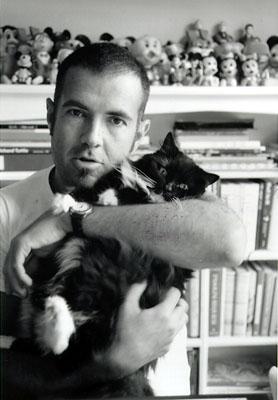
Felix Gonzalez-Torres
Cuban-born conceptual artist Félix González-Torres spent his career turning grief into open-ended gesture. Born in Guáimaro, Cuba in 1957[1], he moved to Puerto Rico at 12 before eventually settling in New York, where he earned an MFA from NYU in 1987[1] and joined the collective Group Material, whose interventionist exhibitions addressed AIDS, Reagan-era politics, and queer visibility.
Biography
His signature works dissolve the fixed object: candy piles that visitors are invited to eat, stacks of paper anyone may take, strings of light bulbs that loop across gallery ceilings, and paired wall clocks counting identical time. The weight of the candy often corresponds to a human body. In "Untitled" (Portrait of Ross in L.A.), 1991[1], the pile begins at 175 lbs, the healthy weight of his partner Ross Laycock, who died from AIDS-related illness in January 1991. As visitors take pieces, the work records attrition without demanding mourning.
González-Torres taught at NYU and CalArts, participated in the 1991[1] Whitney Biennial and the 1993 Venice Biennale, and received DAAD and NEA fellowships. He died in Miami on 9 January 1996[1], of AIDS-related complications, aged 38.
His posthumous market has grown substantially. In 2024, "Untitled" (America #3), 1992[1], an extension-cord light string, sold at Christie's for $13.6 million, setting an artist record. The work illustrates what González-Torres argued most plainly: that the art object is a relationship, not a possession, and that its meaning accrues through what is given away.
Timeline
- 1957Born in Guáimaro, Cuba.
- 1969Moved to Puerto Rico at 12.
- 1987Earned an MFA from NYU and joined the collective Group Material in New York.
- 1991Participated in the Whitney Biennial.
- 1991Created "Untitled" (Portrait of Ross in L.A.), a candy pile work representing his partner Ross Laycock.
- 1993Participated in the Venice Biennale.
- 1996Died in Miami of AIDS-related complications, aged 38.
Notable Works
Tap to view larger.
Next stop
Browse the movements →
Every movement in the collection, from the Renaissance to Pop art.
Related Artists




Frequently Asked Questions
What is Felix Gonzalez-Torres's most famous work?
It is difficult to single out one piece as Felix Gonzalez-Torres's most famous, but several works have become well known. He is remembered for his conceptual, Minimalist-style art, often addressing social issues such as AIDS. One notable piece is the 1991[1] billboard project installed around New York City, part of an exhibition at the Museum of Modern Art. It featured a black-and-white photograph of an empty, unmade double bed. The image evoked intimacy, loss, and the AIDS epidemic. Other significant works include "Untitled (Perfect Lovers)" (1991), consisting of two battery-powered clocks set to the same time. As time passes, the clocks fall out of sync, symbolising mortality and the loss of connection. Gonzalez-Torres also created piles of brightly wrapped sweets, such as "Untitled (Public Opinion)", displayed in corners or across floors. Viewers are invited to take and eat the sweets, the diminishing pile representing the body consumed by AIDS. These works transform everyday objects into meditations on love, loss, and political issues.What should I know about Felix Gonzalez-Torres's prints?
Felix Gonzalez-Torres is known for his conceptual approach; his prints often take the form of "stacks" of posters or sheets of paper. These are intended to be taken by viewers, thus distributing the artwork and engaging with themes of loss, dispersal, and community. Unlike traditional, editioned prints, Gonzalez-Torres's stacks are often produced in unlimited quantities, blurring the line between original and reproduction. The act of taking a print becomes an integral part of the artwork's meaning, challenging conventional notions of ownership and value. Some stacks feature text or imagery related to personal experiences, political issues, or art-historical references. The ephemeral nature of the stacks, as they diminish over time, reflects the transient nature of life and memory. The viewer's interaction completes the work.What style or movement did Felix Gonzalez-Torres belong to?
Felix Gonzalez-Torres (1957[1]-1996[1]) is often described as a Conceptual artist working in a Minimalist mode; his art also had elements of political activism. His work defies easy categorisation, and he is considered a Postmodern artist, seemingly unconcerned with a singular style. Gonzalez-Torres's pieces often transformed everyday objects into meditations on love, loss, and sociopolitical issues. He used commonplace materials, such as clocks, lightbulbs, and wrapped sweets, to suggest personal histories and universal human emotions. His "democratic" art required interaction from the viewer to activate and complete it. His output included stacks of paper and candy spills arranged in corners and across floors, which can be seen as subversive rearticulations of Minimalism's non-representational aesthetic. While recalling Carl Andre, Donald Judd, and Robert Morris, he reintroduced what had been sublimated in much Modernist art: desire, loss, vulnerability, and anger.What techniques or materials did Felix Gonzalez-Torres use?
Felix Gonzalez-Torres, born in Cuba, worked in a Conceptual, Minimalist mode, often addressing social issues like AIDS. His art employed commonplace materials to explore personal history and universal human emotion. Gonzalez-Torres created works using lightbulbs, clocks, paper stacks, and candy. The lightbulbs, hung from the ceiling, eventually burn out. Two battery-powered clocks, as in *Untitled (Perfect Lovers)* (1991[1]), are set to the same time; however, they fall out of sync, reflecting mortality and the passing of time. Candy spills, such as *Untitled (Public Opinion)*, consist of black rod liquorice. *Untitled (Placebo)* (1991) uses silver-wrapped sweets. Viewers may take and eat the candy, the gradual disappearance alluding to the body consumed by AIDS. These spills and stacks have ideal weights, and certificates of authenticity do not require owners to replenish them. In 1991, Gonzalez-Torres arranged for a black-and-white photograph of an empty, unmade bed to be installed on billboards around New York. His art transformed everyday objects into meditations on love and loss.What was Felix Gonzalez-Torres known for?
Felix Gonzalez-Torres (1957[1]-1996[1]) was a Cuban-born American Conceptual and Minimalist artist. He is known for artworks that address a range of social and political issues, especially the AIDS crisis and its impact. His work often incorporated common objects in simple arrangements. Examples include piles of sweets, stacks of paper, strings of lights, and clocks. The sweets, for example, could be taken by viewers, the diminishing pile alluding to loss. The clocks, such as in *Untitled* (Perfect Lovers) (1991[1]), consisted of two battery-powered clocks set to the same time; as time passed, they would fall out of sync, a metaphor for mortality. Gonzalez-Torres frequently employed Minimalist aesthetics, yet he infused his work with personal and emotional content. His art invited viewer interaction to complete its meaning. In 1991, he arranged for a photograph of an empty bed to appear on billboards around New York City. The image evoked intimacy, loss, and the AIDS epidemic. He died of AIDS at the age of 38.When did Felix Gonzalez-Torres live and work?
Felix Gonzalez-Torres was born in 1957[1] in Guáimaro, Cuba. In 1981[1], he emigrated to the United States during the Mariel boatlift. He lived and worked primarily in New York City. Gonzalez-Torres's artistic career began to gain recognition in the 1980s, a period when he co-founded Group Material. His work often combined elements of Conceptual art, Minimalism, and political activism. He created pieces that invited interaction to activate and complete them. His art addressed a range of social issues, most notably the AIDS crisis. He used commonplace materials; stacks of paper, piles of sweets, and lightbulbs to suggest personal histories and universal emotions. Gonzalez-Torres employed these objects to explore themes of love, loss, vulnerability, and anger. Gonzalez-Torres died in Miami, Florida, in 1996[1] at the age of 38, due to AIDS.Where can I see Felix Gonzalez-Torres's work?
Felix Gonzalez-Torres's work has been featured in many group exhibitions. These include the 1993[1] Biennial Exhibition at the Whitney Museum of American Art, New York; Documenta IX, Museum Fridericianum, Kassel (1992); and kpojtiLo '93 (part of XLV Biznnale di l/enez^a), Venice. His art also appeared in 'American Art in the Twentieth Century: Painting and Sculpture, 1913-1993[1]' at Martin-Gropius-Bau, Berlin, and The Royal Academy of Arts, London (1993). Later exhibitions include 'Carnegie International 1995', The Carnegie Museum of Art, Pittsburgh; 'Hall of Mirrors: Art and Film since 1945', The Museum of Contemporary Art, Los Angeles (which also travelled); and 'NowHere', Louisiana Museum of Modern Art, Humlebaek, Denmark. Gonzalez-Torres's pieces were also part of 'The Red Gate', Museum van Hedendaagse Kunst, Ghent, Belgium. His art was shown in 'The American Century: Art & Culture 1900-2000', Whitney Museum of American Art, New York (1999-2000).Where was Felix Gonzalez-Torres from?
Felix Gonzalez-Torres was born in Guáimaro, Cuba, in 1957[1]. He later lived in Madrid, Spain, from 1971[1] to 1979. Eventually, he moved to New York City in the United States. Gonzalez-Torres studied at the Pratt Institute and the Independent Study Program at the Whitney Museum of American Art. His work often explored themes related to identity, love, loss, and political issues. He became known for his use of simple, everyday materials, such as stacks of paper, candies, and light bulbs, to create installations that invited participation and reflection. Gonzalez-Torres's art challenged traditional notions of authorship and the art object, engaging viewers in a dialogue about personal and collective memory. He died in 1996[1], leaving behind a significant body of work that continues to resonate with audiences worldwide.Who did Felix Gonzalez-Torres influence?
Felix Gonzalez-Torres (1957[1]-1996[1]) is seen as a Conceptual artist working in a Minimalist mode. His art addresses a range of social issues, most powerfully AIDS. His influence can be seen in the work of artists associated with Relational Aesthetics. Nicolas Bourriaud's writings on the subject cite Gonzalez-Torres, his politics, working methods, and formal instability as a basis. Gonzalez-Torres's stacks of paper and candy spills rearticulate Minimalism's non-representational aesthetic. His work recalls Carl Andre's metal carpets, Donald Judd's sequenced boxes, and Robert Morris's Corner Piece (1964[1]). However, Gonzalez-Torres reintroduced desire, loss, vulnerability, and anger, which had been sublimated in much Modernist art. His art anticipated the networked sociality of Web 2.0 and the market for online data-mining. Group behaviour is tracked and used to develop new kinds of market intelligence.Who influenced Felix Gonzalez-Torres?
Felix Gonzalez-Torres (1957[1]-1996[1]) developed a unique artistic style. His influences are diverse, drawing from conceptual art, minimalism, and his personal experiences as a gay man during the AIDS crisis. Conceptual artists like Sol LeWitt, known for his serial structures and dematerialised art objects, provided a framework for Gonzalez-Torres's use of simple forms and everyday materials. The minimalist aesthetic, with its emphasis on geometric shapes and industrial production, is evident in his stacks of paper and candy spills. These works often carry deeper meanings related to loss, memory, and the ephemeral nature of life. The artist's engagement with political and social issues can be traced to predecessors such as Hans Haacke, who used art to critique institutional power structures. Like Haacke, Gonzalez-Torres addressed complex themes, including identity, sexuality, and the AIDS epidemic, through subtle and poetic gestures. His work invites participation and interpretation, challenging traditional notions of authorship and the art object.Who was Felix Gonzalez-Torres?
Felix Gonzalez-Torres (1957[1]-1996[1]) was a Cuban-born American Conceptual and Minimalist artist. He is known for his work addressing social issues, particularly the AIDS crisis. Gonzalez-Torres often employed commonplace materials in his art. These included clocks, strings of lightbulbs, and piles of sweets. His "Untitled (Perfect Lovers)" (1991[1]) features two battery-powered clocks, initially set to the same time. As time passes, the clocks fall out of sync, creating a metaphor for mortality, relationships, and loss. Similarly, his candy spills used the gradual disappearance of the sweets to reflect the body being consumed by AIDS. His art often took the form of "stacks" or "candy spills", which viewers were permitted to take from, within certain parameters. These works require interaction from the viewer to activate and complete them. Gonzalez-Torres's stacks and spills have been interpreted as a type of gift exchange. Gonzalez-Torres's work often combined Conceptual art, Minimalism, and political activism. He died of AIDS at the age of 38.Why are Felix Gonzalez-Torres's works important today?
Felix Gonzalez-Torres (1957[1]-1996[1]) created art that remains relevant because of its poetic treatment of social issues and its engagement with the public. Born in Cuba, he arrived in the United States during the Mariel boatlift in 1981[1]. His art often addressed the AIDS crisis, which claimed his partner's life and, later, his own. Gonzalez-Torres's conceptual approach, combined with minimalist aesthetics, allowed him to transform everyday objects into meditations on love, loss, and political concerns. For example, his "candy spills", piles of sweets that viewers could take, represented the weight of his lover's body and its consumption by AIDS; the diminishing candy symbolised the physical wasting away of someone with the illness. Two identical clocks, initially synchronised but inevitably falling out of time, served as a metaphor for mortality and the fragility of relationships. His work extended beyond gallery walls. In 1991, he placed a photograph of an empty bed, suggestive of intimacy and loss, on billboards throughout New York City. This brought discussions of AIDS, relationships, and grief into the public sphere. Gonzalez-Torres's art invited interaction and interpretation, making it a democratic form that continues to resonate.
Sources
Editorial draws on the following primary and tertiary references for Felix Gonzalez-Torres.
- [1] wikipedia Wikipedia: Felix Gonzalez-Torres Used for: biography, birth dates, death dates, identifiers, movement attribution, nationality.
- [2] book guggenheim-hugob00gugg Used for: biography.
- [3] book guggenheim-rroseisr00bles Used for: biography.
- [4] book Braun, Emily, 1957-; Asor Rosa, Alberto; Royal Academy of Arts (Great Britain), Italian art in the 20th century : painting and sculpture, 1900-1988 Used for: biography.
Editorial overseen by Solis Prints. Sources verified 2026-10-07. Click a source for details, or hover over [N] in the page above to preview.
Editorial standardsMethodologyCorrectionsAI disclosureAbout the editorial team