



Emperor Huizong
Zhao Ji, who ruled China as the eighth emperor of the Song Dynasty under the reign name Huizong from 1100 to 1126, is one of the few rulers in history whose artistic legacy entirely overshadows his political record. That record was catastrophic. His reign ended with the Jingkang Incident of 1127, when Jurchen Jin forces stormed the capital Bianjing (modern Kaifeng), capturing Huizong along with his son Emperor Qinzong and most of the court. The Jin ruler titled him "Besotted Duke" (Hunde), a calculated humiliation. He died in captivity in Heilongjiang in 1135[1], aged 52.
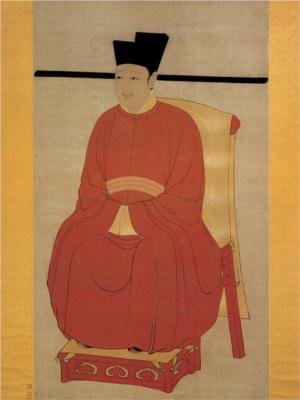
Biography
Before the fall, he spent three decades building one of the most ambitious cultural programmes in Chinese imperial history. His Xuanhe Painting Catalogue listed 6,397 paintings from the imperial collection across 231 artists, with bird-and-flower painters Huang Quan and Huang Jucai together accounting for nearly 700 works. In 1104 he formalised this connoisseurship by establishing a painting school under the Directorate of Education, with a curriculum of six subjects and examinations based on poetic couplets rather than technical drills.
As a practitioner, Huizong excelled in two areas. His bird-and-flower paintings, such as *Five-Colored Parakeet on Blossoming Apricot Tree* and the handscroll *Finches and Bamboo* (now at the Metropolitan Museum of Art), are precise to the point of botanical record. His calligraphy, known as the "Slender Gold" style for the way its fine, angular strokes resemble twisted gold filaments, remains one of the most recognisable personal hands in Chinese art history.
He also commissioned a copy of Zhang Xuan's *Court Ladies Preparing Newly Woven Silk*. The original is lost. His version survives.
Timeline
- 1082Born Zhao Ji, later Emperor Huizong of the Song Dynasty.
- 1100Became the eighth emperor of the Song Dynasty, ruling under the reign name Huizong.
- 1104Established a painting school under the Directorate of Education, with a curriculum of six subjects and examinations based on poetic couplets.
- 1126Huizong's reign ended with the Jingkang Incident.
- 1127Captured by Jurchen Jin forces during the Jingkang Incident, along with his son Emperor Qinzong, when the capital Bianjing (modern Kaifeng) was stormed.
- 1127Given the title "Besotted Duke" (Hunde) by the Jin ruler.
- 1135Died in captivity in Heilongjiang, aged 52.
- 1135Created "Slender Gold" style calligraphy, known for its fine, angular strokes.
Notable Works
Tap to view larger.
Next stop
Browse the movements →
Every movement in the collection, from the Renaissance to Pop art.
Related Artists
_%E2%80%93_LOC.jpg)


Frequently Asked Questions
What is Emperor Huizong known for?
Emperor Huizong is known for his ambitious cultural programmes and his contributions to painting and calligraphy. He established a painting school and excelled in bird-and-flower paintings and calligraphy, developing the "Slender Gold" style.What should I know about Emperor Huizong's prints?
Emperor Huizong (reigned 1100-1125) of the Song Dynasty was a significant figure in Chinese art. He was not only a patron but also a practitioner of the arts, known for his painting and calligraphy. Huizong updated the court's art collections and compiled a catalogue of paintings, the Xuanhe Painting Catalogue, which is a valuable resource for information on painters, painting titles, and attitudes towards court and literati painters. Huizong established a formal painting school as part of educational reforms in 1104. This school offered instruction in religious art, figures, buildings, birds, animals, flowers, and bamboo. Students were educated in ancient dictionaries and calligraphy. Exams tested the ability to capture poetic meaning in paintings, valuing subtlety and allusion. The curriculum aimed to train painters who could express ideas and feelings naturally, rather than merely copying earlier masters. Huizong's interest in the arts extended to collecting ancient bronzes, influencing ceramic shapes and decorations. His patronage marked a turning point for ceramics in China, establishing a production standard that elevated ceramics to a prestigious art form.What style or movement did Emperor Huizong belong to?
Emperor Huizong (reigned 1100-1125) was a Song dynasty emperor with a significant role as an arbiter of taste and a reformer of the arts. He is associated with a preference for subtlety and allusion, seen in both painting and ceramics. Huizong established a formal painting school in 1104 as part of state education reforms. This school trained painters in various subjects, including religious art, figures, and architecture. Students were educated in calligraphy and literary subjects, and examinations stressed the ability to capture poetic meaning in paintings, valuing indirection over direct representation. Huizong also updated the court's art collections, compiling the Xuanhe Painting Catalogue, which documented over 6,000 paintings. He appreciated earlier Song court painters, especially bird-and-flower painters. The catalogue also acknowledged literati painting, including monochrome bamboo and plum flower works. In ceramics, Huizong is associated with the Ru style, known for its bluish glaze. He is credited with choosing this subtle style over more decorated wares. Some scholars suggest he established a palace kiln to supervise the production of Ru ware, influencing imperial aesthetics. The interest in ancient bronzes also influenced ceramic shapes, with ritual forms and motifs appearing.What techniques or materials did Emperor Huizong use?
Emperor Huizong (reigned 1100-1125) was a painter and calligrapher who also reformed painting education at court. He established a formal painting school in 1104 as part of a larger overhaul of state education; the painting school was part of the Directorate of Education. Instruction was offered in six subjects: religious art, figures, buildings, birds and animals, flowers and bamboo, and landscapes. Students were expected to be literate and were instructed in etymology, providing them with a foundation in calligraphy. Exams for the literati track required students to create a painting that captured the meaning of a poetic couplet. Grading placed a premium on indirection, subtlety, and allusion. Huizong updated the court collections of artworks, especially calligraphy, paintings, and antiquities. He had a catalogue compiled of the best paintings in his collection; the Xuanhe Painting Catalogue lists 231 artists and 6397 paintings. The catalogue also introduced a category of monochrome bamboo and plum flower painting, the type of painting favoured by poets and writers. Huizong is also held responsible for choosing Ru style ceramics, with its bluish glaze, over decorated wares. The glaze was inspired by Korean blue-green ware.What was Emperor Huizong known for?
Emperor Huizong, who reigned from 1100 to 1125, was a Song dynasty emperor known for his patronage of the arts and his efforts to elevate the status of artists. He was himself a painter and calligrapher, who would sometimes collaborate with court artists. Huizong updated the court's art collections, especially calligraphy, paintings, and antiquities. He compiled a catalogue of his painting collection, the *Xuanhe Painting Catalogue*, which listed 231 artists and 6397 paintings. The catalogue is a source for painters’ biographies and contemporary attitudes toward court and literati painters. In 1104, Huizong established a formal painting school as part of state education reforms. The school offered instruction in religious art, figures, bird and animal painting, and architecture. Students were literate and received instruction in etymology and calligraphy. Examinations required students to create a painting that captured a poetic couplet, with an emphasis on indirection and subtlety. Huizong's patronage extended to ceramics. He is considered responsible for popularising Ru ware, with its bluish glaze. He may have established a palace kiln to supervise production and meet his aesthetic requirements, influencing the development of Guan kilns. His patronage elevated ceramics, making them a material worth collecting and writing about.When did Emperor Huizong live and work?
Emperor Huizong reigned from 1100 to 1125. He was a significant figure in the Northern Song dynasty. Beyond his role as emperor, Huizong was a noted patron of the arts and an artist himself. He established a formal painting school in 1104 as part of a wider reform of state education. This school, under the Directorate of Education, offered instruction in religious art, figures, buildings, and bird-and-flower painting. Students were trained in calligraphy and etymology, and grading emphasised capturing the subject's feeling and form naturally. Huizong also updated the court's art collections, compiling a catalogue of paintings listing 231 artists and 6397 works. This catalogue, the Xuanhe Painting Catalogue, is a valuable source of information on painters' lives and contemporary attitudes to painting. He appreciated earlier Song court painters, especially bird-and-flower painters such as Huang Quan and Huang Jucai. Huizong is also associated with a Song imperial ceramic style. He is credited with choosing Ru style, a bluish glaze, and establishing a palace kiln to supervise its production.Who did Emperor Huizong influence?
Emperor Huizong influenced court painters through the establishment of a formal painting academy around 1104. This school was part of a broader reform of state education, intended to elevate technical fields by attracting educated men. The painting school offered instruction in six subjects: religious art, figures, scenery, birds and animals, flowers and bamboo, and architecture. Students were required to be literate and were instructed in etymology, providing a foundation in calligraphy. Examinations required students to create paintings that captured the meaning of poetic couplets, valuing indirection and subtlety. Huizong used his personal collection of paintings to educate court artists. Painters who served under him were shown paintings from the palace collection every ten days. The emperor also collaborated with court artists and sometimes gave his own paintings to officials. Huizong's influence extended to ceramics. His interest in ancient bronzes influenced ceramic shapes and decorations, with ritual forms and motifs appearing on metal vessels. Kilns developed translucent sky-blue glazes, marking the introduction of a new ceramic style.Who influenced Emperor Huizong?
Emperor Huizong, who ruled from 1100 to 1125, was influenced by earlier Song court painters, especially bird-and-flower painters such as Huang Quan and his son Huang Jucai. The emperor's painting catalogue listed 349 paintings by the father and 332 by the son, more than any other painters. Huizong also interacted with the educated literati who comprised his court, showing them his paintings and sometimes collaborating with court artists. He updated the court collections of artworks, especially calligraphy, paintings, and antiquities, because private collectors had improved connoisseurship. Huizong compiled a catalogue of his paintings, listing 231 artists and 6397 paintings. Huizong established a formal painting school in 1104 as part of an overhaul of state education. The school offered instruction in religious art, figures, birds and animals, flowers and bamboo, and architecture. Students were instructed in etymology and calligraphy. Examinations required students to create paintings that captured the meaning of poetic couplets, placing a premium on indirection, subtlety, and allusion.Who was Emperor Huizong?
Zhao Ji ruled China as the eighth emperor of the Song Dynasty, taking the reign name Huizong. He ruled from 1100 to 1126 and is known for his artistic achievements, which overshadow his political record.Why are Emperor Huizong's works important today?
Emperor Huizong, who reigned from 1100 to 1125, is important for his contributions to Chinese art and culture. He was a man of letters; he interacted with court officials as an equal, often gifting them his paintings. He sometimes collaborated with court artists, adding poems to their works. Huizong updated the court's art collections, especially calligraphy, paintings, and antiquities. He commissioned the Xuanhe Painting Catalogue, a listing of over 6,000 paintings by 231 artists. This catalogue provides information on painters' lives, painting titles, and period attitudes toward court and literati painters. The catalogue also embraced literati painting styles, such as monochrome bamboo and plum flower works. Huizong also reformed the education system, establishing schools for painting, calligraphy, mathematics, and medicine throughout the empire. This ensured court painters were not only skilled but also well educated. His interest in ancient bronzes influenced ceramic shapes and decorations. Huizong's patronage of the arts had a significant effect on ceramics. He is credited with popularising Ru ware, with its bluish glaze, over decorated styles. He established production standards that were followed by later dynasties. This elevated ceramics, making them a prestigious material for collecting and study.How did Emperor Huizong die?
Emperor Huizong died in 1135[1] at the age of 53.
Sources
Editorial draws on the following primary and tertiary references for Emperor Huizong.
- [1] wikipedia Wikipedia: Emperor Huizong Used for: biography, birth dates, death dates, identifiers, movement attribution, nationality.
- [2] book ids, 37424.indb Used for: biography.
- [3] book Martin J. Powers, Katherine R. Tsiang (eds.), A Companion to Chinese Art (Blackwell Companions to Art History) Used for: biography, stylistic analysis.
- [4] book Marcello Ghilardi;Hans-Georg Moeller;, The Bloomsbury Research Handbook of Chinese Aesthetics and Philosophy of Art Used for: biography.
Editorial overseen by Solis Prints. Sources verified 2026-10-16. Click a source for details, or hover over [N] in the page above to preview.
Editorial standardsMethodologyCorrectionsAI disclosureAbout the editorial team