



Bada Shanren
- Four Monks
When Bada Shanren painted a mandarin fish in 1694[1], he accompanied it with a poem referencing the mythical Lake Qu'e, a classical symbol of an emperor's unjust removal from power. Contemporary readers would have recognised this as a direct comment on the fall of the Ming dynasty and the illegitimacy of Qing rule. For a man born into the Ming imperial line, such allusions were not nostalgia but a sustained, carefully deniable act of dissent encoded in scholarly language.
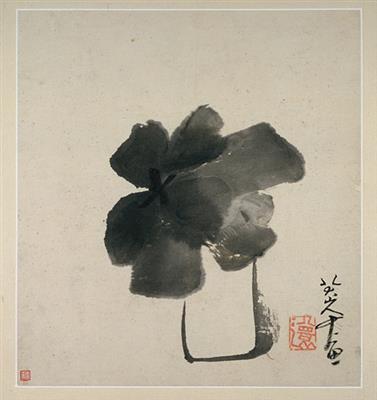
Biography
Born Zhu Da in 1626[1] in Nanchang, Jiangxi Province, he was a great-great-grandson of one of the dynasty's founding princes. After the Qing conquest in 1644[1], he fled to a Buddhist temple at nineteen and spent approximately thirty years as a monk, eventually achieving a senior abbotship. Around 1680 he left the priesthood to work as a professional artist, exhibiting behaviour that contemporaries called mad but which many scholars regard as a calculated performance designed to avoid political scrutiny.
His paintings are unlike anything else in the Chinese[1] tradition. He left most of the picture surface empty, placed fish and birds at the centre of compositions that seemed cosmically spare, and employed a brush style so idiosyncratic that scholars have argued it cannot be mistaken for the work of anyone else. Rocks float in mid-air; birds survey the viewer with a mischievous expression. Of his 179 surviving works, 167 date from the final twenty years of his life (1684[1]–1705[1]).
Qi Baishi and Zhang Daqian both copied his work extensively. The Freer Gallery in Washington held major retrospectives in 2003 and 2015. A single hanging scroll, Mynah Birds, Old Tree Branch and Rocks, measuring 206.4 by 54.6 cm, is held at the Nelson-Atkins Museum in Kansas City.
Timeline
- 1626Born Zhu Da in Nanchang, Jiangxi Province; he was a great-great-grandson of a Ming dynasty founding prince.
- 1644At 19, after the Qing conquest, he fled to a Buddhist temple.
- 1680Around this time, he left the priesthood after approximately thirty years to work as a professional artist.
- 1694Painted a mandarin fish accompanied by a poem referencing Lake Qu'e, alluding to the fall of the Ming dynasty.
Notable Works
Tap to view larger.
Next stop
Browse the movements →
Every movement in the collection, from the Renaissance to Pop art.
Related Artists




Frequently Asked Questions
What is Bada Shanren known for?
Zhu Da is known for his painting, Mynah Birds, Old Tree Branch, and Rocks. It is a hanging scroll using ink on silk.What is Bada Shanren's most famous work?
Bada Shanren (circa 1626[1]-1705[1]) is best known for his deceptively simple paintings of birds, fish, fruit, and flowers. He often worked in ink monochrome, with minimal colour. It is difficult to name a single "most famous" work, as his reputation rests on the large body of paintings and calligraphy he produced after 1660[1]. However, some individual works are particularly well known. *Two Eagles* (circa 1690s, Princeton University Art Museum) is a frequently reproduced example of his bird paintings. The eagles glare in opposite directions, embodying the artist's own sense of dislocation and anger after the fall of the Ming dynasty. *Fish and Rocks* (circa 1690s, Freer Gallery of Art, Smithsonian Institution, Washington DC) is another celebrated painting. It shows a fish in a lotus pond, with typically bold brushstrokes and economical composition. Bada Shanren's paintings are admired for their expressive brushwork, their apparent spontaneity, and the air of suppressed emotion they convey. His distinctive style influenced many later Chinese[1] painters.What should I know about Bada Shanren's prints?
Bada Shanren (born Zhu Da, c. 1626[1]-1705[1]) was a Chinese[1] painter and calligrapher of the early Qing dynasty. As a member of the Ming royalty, he adopted his alias after the fall of the Ming dynasty in 1644[1]. His art is often interpreted as an expression of grief and resistance. Prints of Bada Shanren's work offer an accessible way to engage with his distinctive style. He is known for his abbreviated, expressive brushwork, often depicting birds, fish, and flowers with a sense of melancholy or irony. His compositions frequently feature large areas of blank space, typical of the classic Chinese style. When examining prints of Bada Shanren's paintings, pay attention to the quality of the brushstrokes and the rendering of ink tones. Also note the presence and style of any seals or inscriptions, which can provide information about the work's history and authenticity. Connoisseurs of Chinese art examine the seals and colophons of successive collectors to assess a work's authenticity.What style or movement did Bada Shanren belong to?
Bada Shanren (born Zhu Da, 1626[1]-1705[1]) is usually described as an Individualist painter. This label distinguishes him from artists working within the orthodox traditions of the time. During the early Qing dynasty, many artists remained loyal to the fallen Ming. Bada, a member of the Ming royal line, became a Buddhist monk after the dynasty fell. Grief, bitterness, and cynicism marked his life. His art displays asymmetry and a sense of surreal transformation. His brushwork was bold and minimal; each stroke defined volume and texture. Bada’s tragic life deepened his disdain for artistic conventions. His art became an enigmatic disguise for rebellious expression. His calligraphy, while more traditional, retained an individualistic quality. Other individualist painters include K’un-ts’an, Kung Hsien, and Tao-chi. Tao-chi, a relative of Bada, advocated for artistic independence, rebelling against past styles. These individualists represent an important alternative to orthodox painting during a time of political upheaval.What techniques or materials did Bada Shanren use?
Bada Shanren, active in the 17th century, worked primarily with ink and brush on paper. Mastery of brush handling was essential to his technique. He would mix ink with water to achieve a range of tones and effects. The artist's choice of paper or silk was also important, as the interaction between the ground material and the ink affected the final appearance. Different papers offer varied absorbency, influencing the depth and quality of the brushwork. A paper that lost its sizing, for instance, would absorb more ink, creating a mottled effect. Bada Shanren's brushstrokes could be categorised as either "central point" (brush handle held perpendicular to the paper) or "slanting point" (brush handle at a forty-five degree angle). The "slanting point" was used to articulate textures on rock surfaces. He may have used an unsupported wrist for free shapes, and a supported wrist for precise structures.Where can I see Bada Shanren's work?
Bada Shanren's work can be viewed in museums that hold significant collections of Chinese[1] art. In the United Kingdom, the British Museum and the Victoria & Albert Museum (V&A) in London have extensive Chinese art collections, including paintings and ceramics. The Ashmolean Museum at the University of Oxford also possesses a collection of early Chinese ceramics and a growing collection of contemporary Chinese painting. The Sir Percival David Foundation of Chinese Art (SOAS), also in London, houses one of the world’s finest collections of Chinese ceramics. Outside the UK, the Musée Guimet in Paris has a Chinese department with around 20,000 objects, covering seven millennia of Chinese art. The Hong Kong Museum of Art has galleries focusing on Chinese antiquities, fine art, and paintings. The National Palace Museum in Taipei houses treasures from the Forbidden City and other examples of Chinese classical art. The Art Gallery of New South Wales in Sydney has Chinese collections covering 7,000 years of artistic evolution.Who did Bada Shanren influence?
It is difficult to identify specific artists directly influenced by Bada Shanren, but the question of artistic influence itself has been analysed by art historians. Willem de Kooning, for example, claimed Courbet as a point of reference. He stated that Courbet could walk in a forest and see something concretely, such as the bark on a tree, and be obsessed by it. De Kooning proposed the idea that contemporary artists keep influencing the old masters. He suggested that someone like Clyfford Still, who probably never looked at Monet, got others to see Monet. Paul Cézanne's Bridge at Maincy (1879-80) invokes Courbet's Shaded Stream (1865). Jeff Wall's photograph The Drain (1989) has iconographic roots that lead back to Courbet, via Cézanne. The world of art theory and practice has become so pluralistic that no movement, or great artist, could possibly dominate a significant group. Nevertheless, if a painter wants to consider their role in contemporary art, it is nearly impossible to ignore what Picasso accomplished with the basic materials of the painter: the drawing stick, the canvas, and the paint.Who influenced Bada Shanren?
Bada Shanren (born Zhu Da, about 1626[1]-1705[1]) was a Chinese[1] painter and calligrapher of the early Qing period. As a member of the Ming Dynasty imperial family, he took refuge in Buddhist monasteries after the dynasty's collapse in 1644[1]. Late in life, he became a professional artist in Nanchang. Bada Shanren's artistic style is individual, but it has identifiable sources. He was trained in calligraphy from a young age. His painting style owes a debt to the earlier Zhe School painters, particularly its founder Dai Jin (1388-1462[1]). His ink-wash style also reflects the influence of Xu Wei (1521-1593). Later in his career, Bada Shanren developed a distinctive, abbreviated style, using broad brushstrokes and leaving areas of the paper blank. His work often features birds, fish, and flowers, rendered with a unique, almost satirical, expressiveness. He is considered one of the most important individualist painters of the early Qing period, though his influences are traceable to earlier masters.Who was Bada Shanren?
Bada Shanren (1626[1]-1705[1]) was a Han Chinese[1] painter and calligrapher. He was born Zhu Da, a member of the Ming Dynasty royal family. After the collapse of the Ming in 1644[1], he became a Chan Buddhist monk, taking the religious name Bada Shanren around 1653. His paintings often feature birds, fish, fruit, flowers, and other natural subjects. These are rendered in an individualistic, expressive style using monochrome ink. His brushwork is characterised by bold, wet strokes and a reduction of detail. Compositions often feature empty space, creating a sense of isolation. Bada Shanren's paintings can appear simple, yet they demonstrate sophistication. He is considered an important figure in Chinese art history, and his work has influenced many later artists. His paintings are held in museum collections around the world.Why are Bada Shanren's works important today?
Bada Shanren (born Zhu Da, around 1626[1]; died 1705[1]) was an innovative painter and calligrapher during the early Qing dynasty. As a member of the Ming imperial family, he became a Buddhist monk after the dynasty's collapse. His importance lies in his unique approach to art making during a time of intense artistic self-awareness. Some artists and critics attempted to rethink the artist's relationship with the past. Some championed uniqueness and originality. Bada Shanren employed brushwork and compositional forms unlike known styles. Theorists like Shi Tao addressed how to avoid constraints from imitation and the refusal to imitate. Shi Tao argued that the purpose of style is the elimination of personal constraints. Every person has a style by virtue of the individual stroke. The person is in the style and, more specifically, in the brushstroke. Bada Shanren's art can be viewed in the context of this debate about originality and the artist's relationship to historical styles.What was Bada Shanren's art style?
His paintings are unlike anything else in the Chinese[1] tradition; he left most of the picture surface empty and placed fish and birds at the centre of compositions that seemed cosmically spare. Bada Shanren employed a brush style so idiosyncratic that scholars have argued it cannot be mistaken for the work of anyone else; rocks float in mid-air, and birds survey the viewer with a mischievous expression.
Sources
Editorial draws on the following primary and tertiary references for Bada Shanren.
- [1] wikipedia Wikipedia: Bada Shanren Used for: biography, birth dates, death dates, identifiers, movement attribution, nationality.
- [2] book Martin J. Powers, Katherine R. Tsiang (eds.), A Companion to Chinese Art (Blackwell Companions to Art History) Used for: biography, stylistic analysis.
- [3] book Dorling Kindersley, Artists: Inspiring Stories of the World's Most Creative Minds Used for: biography.
- [4] book guggenheim-centuryincrisism00andr Used for: biography, stylistic analysis.
- [5] book Michael J. Hatch;, Networks of Touch Used for: biography, stylistic analysis.
Editorial overseen by Solis Prints. Sources verified 2026-09-23. Click a source for details, or hover over [N] in the page above to preview.
Editorial standardsMethodologyCorrectionsAI disclosureAbout the editorial team