



Derek Boshier
- contemporary art
Among the original cohort of British[1] Pop artists, Derek Boshier arrived at the Royal College of Art in 1959[1] and found himself studying alongside David Hockney, R. B. Kitaj, Allen Jones, and Patrick Caulfield. While others in that circle were drawn to celebrity and consumer pleasure, Boshier pushed the form towards political critique.
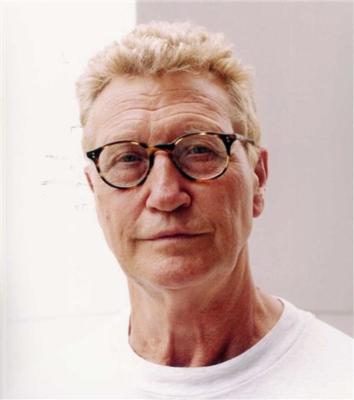
Biography
His first Pop painting, Situation in Cuba (1961[1]), showed the American flag eating into the Cuban flag, a direct response to the Bay of Pigs invasion. That same year he exhibited in the landmark Young Contemporaries show. In 1962 Ken Russell filmed him alongside Peter Blake, Pauline Boty, and Peter Phillips for the BBC documentary Pop Goes the Easel; Russell noted that Boshier's work carried a distinctly intellectual, analytical tenor compared to his peers. Drawing on Kellogg's cereal packaging and Pepsi logos as raw material, his paintings dissected rather than celebrated post-war consumerism.
By the early 1970s Boshier had set painting aside, working in photography, film, video, and assemblage. He taught at the Central School of Art and Design, where one of his students was John Mellor, later known as Joe Strummer of The Clash. The connection proved productive: Boshier designed the band's second song book and also worked with David Bowie and the Pretty Things. He returned to painting by the end of the decade.
His later output continued across six decades without slowing. A 2017[1] Guggenheim Fellowship recognised his sustained contribution, and his work entered the collections of Tate Britain, the Museum of Modern Art, the Centre Pompidou, and the Yale Center for British[1] Art. He died on 5 September 2024[1], aged 87. A 1962 canvas, Man Versus Look, Versus Life, Versus Time, Versus Man About, sold at auction in 2019 for £237,500.
Timeline
- 1937Born in 1937, Derek Boshier became part of the British Pop art movement.
- 1959At 22, Boshier began studying at the Royal College of Art with David Hockney and others.
- 1961Boshier created "Situation in Cuba", his first Pop painting, as a response to the Bay of Pigs invasion.
- 1961Boshier exhibited in the Young Contemporaries show.
- 1962He was filmed by Ken Russell for the BBC documentary Pop Goes the Easel alongside Peter Blake and others.
- 1970Boshier stopped painting and began working in photography, film, video, and assemblage.
- 1970Boshier taught at the Central School of Art and Design, where Joe Strummer was among his students.
- 1979Boshier returned to painting.
- 2017Boshier received a Guggenheim Fellowship.
- 2024Boshier died on 5 September, aged 87.
Notable Works
Tap to view larger.
Next stop
Browse the movements →
Every movement in the collection, from the Renaissance to Pop art.
Related Artists



Frequently Asked Questions
What is Derek Boshier known for?
Derek Boshier is known for being among the original cohort of British[1] Pop artists. He is also known for pushing the Pop art form towards political critique, using his paintings to dissect post-war consumerism.What is Derek Boshier's most famous work?
Derek Boshier is best known for his Pop art, particularly his works from the 1960s. He employs bold colours and graphic imagery, often engaging with themes of consumerism and popular culture. One of his most recognised pieces is the 1962[1] painting, *Image in Revolt*. It is an oil on canvas work. *Image in Revolt* uses collage elements and text fragments, typical of the early Pop art style. The work critiques the pervasive influence of media and advertising. Another notable work is *The Identi-kit Man* (1964). This piece further explores the artist's interest in identity construction and the impact of mass media on individual perception. Boshier's work from this period is characterised by its critical examination of contemporary society. He questions the role of images in shaping our understanding of the world. Boshier's art provides a commentary on the cultural shifts of the 1960s. His pieces remain relevant for their insights into the relationship between art, commerce, and identity.What should I know about Derek Boshier's prints?
Derek Boshier's prints, like all fine art prints, are considered original works if they meet certain criteria. The Professional Art Dealers Association of Canada defines an original print as an image conceived by the artist as a print and executed solely as a print, usually in a numbered edition, and signed by the artist. Each print in the edition is an original, printed from a plate, stone, screen, block or other matrix created for that purpose. There is no one original print from which copies are made. Each print is inked and pulled individually; it is a multi-original medium. The number of prints in the edition is decided by the artist. The sequential numbering provides an accounting for the number of prints in the edition. Each print has a specific number; i.e. 12/25 (The edition is 25, the particular print is number 12). Early prints were usually not numbered or signed; in some cases the artist might have signed the plate or stone itself, with no pencilled signature on each print. Prints should be stored interleaved with acid-free tissue in a drawer or box. Because of the fugitive nature of many pigments, the prints should not be hung for long periods in bright light. Certain colours fade faster than others giving the print a completely different appearance than intended. Prints should also not be hung over radiators or other heat sources.What techniques or materials did Derek Boshier use?
Derek Boshier is associated with Pop art, and his practice includes painting, collage, photography, printmaking, and three-dimensional constructions. In the 1960s, Boshier worked with screen printing, often using simplified imagery and bold colour combinations. He explored commercial aesthetics and mass media imagery in his prints and paintings. His early works frequently incorporated references to advertising, consumer culture, and contemporary events. Later, Boshier moved between different media, producing drawings, paintings, and collages that combined varied source material. He has also created album covers for musicians such as David Bowie and The Clash, further demonstrating his interest in popular culture. Boshier taught at various institutions, including the Royal College of Art, and his work has been exhibited internationally. His approach is characterised by experimentation and a willingness to engage with diverse visual languages.What was Derek Boshier known for?
Derek Boshier is a British[1] artist associated with the Pop Art movement. His work often incorporates themes related to popular culture and political commentary. Early in his career, Boshier explored topics such as the Space Race and international politics in his art. One example of this is his 1958[1] painting, "Hers is a lush situation". It was inspired by an analysis of the 1957 Buick in the American magazine *Industrial Design*. Boshier also created related studies and texts that explored composition, ideology, and the qualities of pressed steel in automobile bodies. Boshier's work engages with mass media and advertising. He appropriates imagery from sources like Andrex toilet paper adverts, using them to explore themes of reverence, cynicism, and what he termed "cool" or "non-Aristotelian" reactions to popular culture.When did Derek Boshier live and work?
Derek Boshier is a British[1] Pop artist, printmaker, sculptor, and academic. He was born in Portsmouth, England, in 1937[1]. Boshier studied at the Yeovil School of Art, Somerset, from 1953[1] to 1957, and then at the Royal College of Art, London, from 1959 to 1962, where he was associated with the British Pop Art movement. His contemporaries included David Hockney, Allen Jones, Peter Phillips, and R. B. Kitaj. He taught at the Central School of Art and Design, London, from 1962 to 1969. In the 1980s, Boshier relocated to the United States. He taught at the University of California, San Diego, from 1980 to 1997. He then moved to Houston, Texas, where he continues to live and work.Where can I see Derek Boshier's work?
To view Derek Boshier's work, several institutions hold pieces. In the UK, you can visit the Brighton Museum & Art Gallery (Royal Pavilion Gardens, Brighton), Manchester Art Gallery (Mosley Street, Manchester), the National Museums of Scotland (Royal Museum, Chambers Street, Edinburgh), and the Victoria & Albert Museum (Cromwell Road, London). Outside the UK, notable locations include the Los Angeles County Museum of Art (LACMA, 5905 Wilshire Boulevard, Los Angeles), the Metropolitan Museum of Art (1000 Fifth Avenue, New York), the Minneapolis Institute of Arts (2400 Third Avenue South, Minneapolis), and the Museum of Modern Art (11 West 53rd Street, New York). Other options are the Royal Ontario Museum in Toronto; the Virginia Museum of Fine Arts in Richmond, Virginia; and the Wolfsonian at Florida International University in Miami Beach.Who did Derek Boshier influence?
It is difficult to make definitive claims about Boshier's influence based on the material provided. One passage mentions Bill Ainslie, a South African artist, who was encouraged to pursue abstract art after seeing the work of fellow South African artist, Portway. Portway's techniques also impacted Louis Maqhubela, who met Portway in England in 1966[1]. Another passage discusses the Australian art scene and its reception of international Modernist ideas in the 1960s. The critic Allan McCulloch criticised an exhibition as "the wholesale imitation of another country's abstract art". Ian Burn, an artist included in the show, noted that Hard-edge and Colour-field painting arbitrarily displaced expressionist figurative work and abstract views in Australia.Who influenced Derek Boshier?
It is difficult to identify specific influences on Derek Boshier from the material provided. The passages contain many names of artists and illustrators; however, they are presented in lists or within discussions of other figures. For example, the name William Blake appears, but only as an illustrator. Aubrey Beardsley is mentioned in relation to Toulouse-Lautrec. Rosalie Gascoigne admired Ken Whisson, Pablo Picasso and Colin McCahon. Other artists and illustrators named include Hans Sebald Behan, Thomas Bewick, Émile Bernard and Frank Brangwyn. The passages also mention illustrators of children's stories, such as Ernest Shepherd, and naturalists like Eric Fitch Dagleish. Keith Henderson is noted for his stylised decorations, while Rex Whistler is recognised for his humour. Without further context, it is impossible to say definitively which, if any, of these individuals had a direct impact on Boshier's artistic development.Who was Derek Boshier?
Derek Boshier was among the original British[1] Pop artists, studying at the Royal College of Art with David Hockney and others. He used his art for political critique, in contrast to his peers who focused on celebrity and consumerism.Why are Derek Boshier's works important today?
Derek Boshier is an important figure in British[1] Pop art. He is known for his paintings, prints, and sculptures that critique consumer culture and political power. Born in Portsmouth in 1937[1], Boshier studied at the Royal College of Art alongside David Hockney, Allen Jones, and Peter Phillips. These artists helped define the Pop art movement in Britain. Boshier's early work often combined images from advertising, mass media, and art history. He questioned the values of a society increasingly shaped by commercialism. In the 1960s, Boshier created works commenting on the Vietnam War and nuclear proliferation. His series "The Vietnam Pictures" used bold colours and simplified forms to convey his anti-war message. Later, he explored the impact of television on society. His prints often incorporate logos, slogans, and celebrity images. Boshier has taught at various institutions, including the Central School of Art and Design and the Royal College of Art. His work has been exhibited internationally, and it remains relevant for its critical engagement with contemporary issues. His art encourages viewers to think about the messages they receive from the media and the forces that shape their world.What was Derek Boshier's art style?
Derek Boshier's art style is Pop art. He drew on Kellogg's cereal packaging and Pepsi logos as raw material for his paintings.
Sources
Editorial draws on the following primary and tertiary references for Derek Boshier.
- [1] wikipedia Wikipedia: Derek Boshier Used for: biography, birth dates, death dates, identifiers, movement attribution, nationality.
- [2] book Landon, Carolyn, Banksia Lady - Celia Rosser, Botanical Artist Used for: biography.
- [3] book guggenheim-richardhamilton00hami Used for: stylistic analysis.
- [4] book Alastair Sooke, Pop Art Used for: biography, stylistic analysis.
- [5] book Sooke, Alistair, Pop Art Una storia a colori Used for: biography, stylistic analysis.
- [6] book Jule, Walter, Precarious Balance Used for: biography.
Editorial overseen by Solis Prints. Sources verified 2026-09-30. Click a source for details, or hover over [N] in the page above to preview.
Editorial standardsMethodologyCorrectionsAI disclosureAbout the editorial team