



Alison Wilding
- contemporary art
Alison Wilding emerged from the same London milieu as Anthony Gormley and Richard Deacon, part of the generation of British[1] sculptors who reinvented the medium in the 1980s without looking to New York for direction. Born in Blackburn in 1948[1], she studied at Ravensbourne College and the Royal College of Art, and had her first solo show at the Serpentine Gallery in 1985.
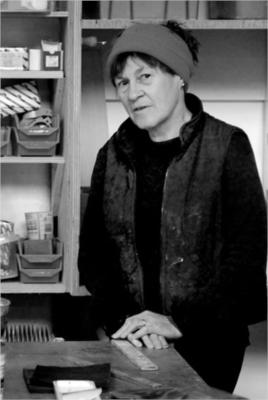
Biography
Her sculptures resist easy description because Wilding resists easy materials. She has said simply that she likes "stuff", and her works often pair materials that seem to have no business together: beeswax with galvanised steel, rubber with copper, darkness with light. The effect is of objects holding opposing forces in careful equilibrium. Stormy Weather (1987), made from pigment, beeswax and oil on galvanised steel, is representative of this approach.
The Turner Prize shortlisted her in both 1988 and 1992. A retrospective at Tate Liverpool in 1991, titled Immersion: Sculpture from Ten Years, consolidated her position within what was then being called New British[1] Sculpture. In 1999 she installed Ambit in the River Wear in Sunderland: stainless-steel tubes floating in the water, later scrapped in 2014.
She became a Royal Academician in 1999, received the Paul Hamlyn Award in 2008, was appointed OBE in 2019, and has held the Eranda Professorship of Drawing at the Royal Academy Schools since 2018. Her work remains resolutely uncommercial and quietly influential.
Timeline
- 1948Born in Blackburn, England
- 1985First solo show at the Serpentine Gallery
- 1987Created 'Stormy Weather' sculpture
- 1988Shortlisted for the Turner Prize
- 1991Retrospective at Tate Liverpool: 'Immersion'
- 1992Shortlisted for the Turner Prize again
- 1999Installed 'Ambit' in the River Wear, Sunderland
- 1999Became a Royal Academician
- 2008Received the Paul Hamlyn Award
- 2014'Ambit' sculpture was scrapped
- 2018Appointed Eranda Professor at Royal Academy Schools
- 2019Appointed Officer of the Order of the British Empire (OBE)
Notable Works
Tap to view larger.
Next stop
Browse the movements →
Every movement in the collection, from the Renaissance to Pop art.
Related Artists




Frequently Asked Questions
What is Alison Wilding known for?
Alison Wilding is known for her sculptures that pair seemingly incompatible materials. Her works often combine beeswax with galvanised steel, rubber with copper, and darkness with light. The effect is of objects holding opposing forces in careful equilibrium.What is Alison Wilding's most famous work?
It is difficult to name Alison Wilding's single most famous work, as her career has spanned several decades and encompassed a range of styles and materials. However, several of her pieces have received considerable attention and acclaim. "Bird" (1996), "Cloister" (1978), and "Piece to walk around" (1981) are among her better-known creations. Other significant works include "Clouds I" (1992), "Clouds II" (1992), and "Clouds III" (1992). Wilding's output includes "City birds" (1981), "Orchard" (1986), and "Parrots" (1980). She has also produced series of works, such as the "Pineapple pieces" from 1985, which consist of seven individual artworks. Her diverse body of work resists easy categorisation, but these examples offer a glimpse into her artistic practice.What should I know about Alison Wilding's prints?
Alison Wilding is a contemporary British[1] sculptor, and printmaking forms a significant part of her practice. Her prints often relate to her sculptural work, exploring similar themes and forms in two dimensions. Wilding's prints are not mere reproductions of her sculptures, but rather independent works of art that explore the possibilities of the print medium. She frequently uses techniques such as etching, lithography, and screen printing to create layers of texture and tone. These processes allow her to investigate ideas of transparency, opacity, and the interplay of light and shadow, which are also central to her sculpture. Her prints often feature abstract or semi-abstract forms, which can be seen as explorations of space, volume, and the relationship between positive and negative forms. She is interested in how these forms can evoke a sense of movement, tension, or balance. The prints are often characterised by a subtle colour palette, with a focus on tonal variations and the interplay of different surfaces.What style or movement did Alison Wilding belong to?
It is difficult to assign Alison Wilding to a single movement, as she began exhibiting in the late 1970s, a period when art movements 'emerged and dissolved with increasing speed'. The late twentieth century saw artists employ a broader range of materials and processes than ever before. Two broad tendencies of the period were Pluralism and Postmodernism. Pluralism incorporated a variety of styles, ideas and cultural trends, without any dominant culture leading the way. Postmodernism is another umbrella term for art movements that sought to challenge aspects of Modernism. Postmodern art is often quirky, absurd, irreverent, or meaningless. Another movement active in the 1970s was Neo-Expressionism, typified by brash figurative paintings created with unusual techniques. Neo-Geo, short for 'Neo-Geometric Conceptualism', described artists who criticised mechanisation and commercialism. Styles varied, but all these artists began from similar standpoints and all worked figuratively, drawing on earlier movements.What techniques or materials did Alison Wilding use?
Alison Wilding is known for sculpture using a wide range of materials and processes. She often combines industrial materials, such as steel, with more traditional sculptural media like stone or wax. Wilding's early work involved casting. Later, she moved to more constructed forms. These often explore interior and exterior space. Examples include "Stormy Weather" (1987), made of lead, and "Match" (2001), made of painted steel. She frequently exploits the properties of her chosen materials. This can involve contrasting textures or patinas. Her work often incorporates light and shadow as integral elements. Wilding's methods are diverse. She uses fabrication, casting, carving, and assemblage, depending on the specific demands of the piece. The Kilkenny limestone piece "Ambit" (2013) demonstrates her interest in contrasting textures.What was Alison Wilding known for?
Alison Wilding (born 1948[1]) is a British[1] sculptor known for her abstract works. She often combines industrial materials, such as steel and lead, with more traditional sculptural materials like stone or wood. The interplay between these materials, and the forms she creates, is a distinctive aspect of her practice. Wilding studied at the Bath Academy of Art and the Royal College of Art. Her sculptures often explore spatial relationships, playing with positive and negative space. She is interested in how viewers perceive and interact with her pieces. Throughout her career, Wilding has had many solo exhibitions in Britain and abroad. She was elected to the Royal Academy of Arts in 1999. Her work is held in public collections, including the Tate and the Victoria and Albert Museum.When did Alison Wilding live and work?
Alison Wilding was born in 1948[1]. She is a contemporary British[1] sculptor. Wilding studied at the Bath Academy of Art from 1967 to 1968, and then at the Ravensbourne College of Art and Design from 1968 to 1971. After her formal education, she continued to live and work in Britain. Her career developed through the 1980s and 1990s, with exhibitions in Britain and internationally. She became known for her sculptures that often combine industrial materials with more organic forms, exploring themes of space, light, and volume. Wilding's work can be found in numerous public collections, including the Tate, the Victoria and Albert Museum, and the British Museum. She was elected to the Royal Academy of Arts in 1999. She continues to produce sculpture and exhibit her work.Where can I see Alison Wilding's work?
Alison Wilding's sculptures and other works have been collected by a number of public institutions. These include the National Gallery of Victoria (Melbourne), the Newcastle Art Gallery (New South Wales), the New England Regional Art Museum (Armidale, New South Wales), and the Parliament House Art Collection (Canberra). You can also find her pieces at the Queensland Art Gallery and the Gallery of Modern Art (Brisbane). Other locations with her work include the Queensland University of Technology Art Collection (Brisbane), the Queen Victoria Museum and Art Gallery (Launceston, Tasmania), the RMIT University Art Collection (Melbourne), and the TarraWarra Museum of Art (Healesville, Victoria). Finally, the Tasmanian Museum and Art Gallery (Hobart) also holds examples of her output. Check with these institutions directly for current display information.Where was Alison Wilding from?
Alison Wilding is British[1]. She was born in Shropshire in 1948[1]. Wilding studied at the Bath Academy of Art and the Royal College of Art, London. She is known for her sculpture and installation work, often using industrial materials. Her work explores themes of space, form, and the interplay of light and shadow. She has exhibited widely both in Britain and internationally. Examples of her public commissions include 'Ambit' (2004) for the Hull Truck Theatre, and 'Assembly' (2013) at the Cass Sculpture Foundation. Wilding was elected to the Royal Academy in 1999 and was made a Commander of the Order of the British Empire (CBE) in 2008. She continues to live and work in London.Who did Alison Wilding influence?
It is difficult to say exactly who Alison Wilding influenced. Rosalie Gascoigne spoke to students at the Canberra School of Art in 1985 about influence. She cautioned them that 'everybody takes on influence, but you have to digest them until you get them down to what you honestly feel yourself and what you like… You want to speak louder than they do when you have finished.' Gascoigne herself referenced the work of Ellsworth Kelly, Morris Louis, and Cy Twombly. Another artist, Donald Wilkinson, had a close friendship with painter Winifred Nicholson. Nicholson's knowledge of the British[1] avant-garde movement of the 1920s and 1930s, and her acquaintance with important artists from that circle, brought contemporary art[1] history to life for him. Wilkinson also sought inspiration from J.M.W. Turner and John Sell Cotman, even visiting the same locations that inspired their watercolours.Who influenced Alison Wilding?
Alison Wilding's artistic lineage includes Constantin Brâncuşi, Alexander Calder, Barbara Hepworth, and Ben Nicholson. These artists, active in the early to mid-20th century, represent a strong current of abstraction and constructivism. Brâncuşi, born in Romania in 1876, is known for simplified, essential forms. Calder, born in 1898, pioneered the mobile, introducing kinetic elements to sculpture. Hepworth, born in 1903, explored the interplay of mass and void, often using organic shapes. Nicholson, born in 1894, worked with geometric abstraction, frequently in painted reliefs. These artists, along with others such as Piet Mondrian and Sophie Taeuber-Arp, form a constellation of influences for later artists. Their emphasis on form, material, and spatial relationships resonates in the work of artists like Wilding.
Sources
Editorial draws on the following primary and tertiary references for Alison Wilding.
- [1] wikipedia Wikipedia: Alison Wilding Used for: biography, birth dates, death dates, identifiers, movement attribution, nationality.
- [2] book Landon, Carolyn, Banksia Lady - Celia Rosser, Botanical Artist Used for: biography.
- [3] book guggenheim-australianvision00wald Used for: biography.
- [4] book guggenheim-emergingartists100wald Used for: biography.
Editorial overseen by Solis Prints. Sources verified 2026-10-07. Click a source for details, or hover over [N] in the page above to preview.
Editorial standardsMethodologyCorrectionsAI disclosureAbout the editorial team