



Carol Rama
- Transavantgarde
- Movimento Arte Concreta
- concrete art
Carol Rama's first solo exhibition, held in Turin in 1945[1], was shut down by police on moral grounds within days of opening. She was 27. The watercolours on show depicted eroticism, disability, and genitalia with a directness that had no precedent in Italian[1] art at the time, and very little since. She continued working in near-total obscurity for the next three decades.
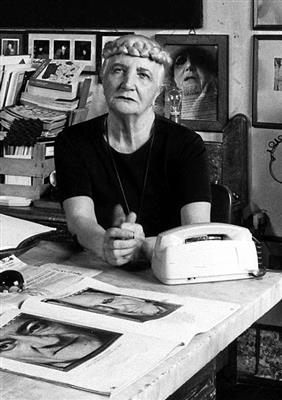
Biography
Born Olga Carolina Rama in Turin on 17 April 1918[1], she was self-taught, absorbing what she could from salon gatherings at the studio of the Symbolist painter Felice Casorati. Her early life was marked by catastrophe: her father went bankrupt and killed himself while she was a teenager, and her mother was committed to a psychiatric asylum. The series of figurative watercolours she made in the late 1930s and 1940s, known as the *Appassionata* works, transform these biographical fractures into images of bodies and wheelchairs and isolation that feel nothing like polite confession.
From the 1950s, she moved away from figuration into assemblage, incorporating rubber tubing, syringes, bicycle tyres, and prosthetic-looking fragments of industrial material. The 1971[1] work *Arsenale* uses layered car tyres across the canvas surface. These pieces resist both Arte Povera and Surrealism as neat categories, though they share affinities with both.
In 1978[1], the curator Lea Vergine included her in the exhibition 'The Other Half of the Avant-Garde: 1910–1940[1],' which brought sustained critical attention to her work for the first time. Broader recognition came slowly. At the 50th Venice Biennale in 2003, she was awarded the Golden Lion for Lifetime Achievement at the age of 85. A major survey, 'Carol Rama: Antibodies,' opened at the New Museum in New York in 2017, two years after her death. She had spent most of her career working in the same city where the police had first objected to her.
Timeline
- 1918Born Olga Carolina Rama in Turin on 17 April.
- 1930Her father went bankrupt and died by suicide when she was a teenager.
- 1940Created the *Appassionata* series of figurative watercolours, continuing into the 1940s.
- 1945Her first solo exhibition in Turin was shut down by police on moral grounds.
- 1950Moved away from figuration into assemblage, using materials such as rubber tubing and syringes.
- 1971Created the work "Arsenale", using layered car tyres.
- 1978Included in the exhibition 'The Other Half of the Avant-Garde: 1910–1940', curated by Lea Vergine.
- 2003Awarded the Golden Lion for Lifetime Achievement at the Venice Biennale, at 85.
- 2015Died in Turin.
Notable Works
Tap to view larger.
Next stop
Browse the movements →
Every movement in the collection, from the Renaissance to Pop art.
Related Artists


Frequently Asked Questions
What is Carol Rama known for?
Carol Rama was an Italian[1] artist who gained recognition later in her career, receiving the Golden Lion for Lifetime Achievement at the Venice Biennale in 2003[1]. She is known for her work in watercolours and assemblage, which often incorporated unconventional materials such as rubber tubing and car tyres.What is Carol Rama's most famous work?
It is difficult to name Carol Rama's single "most famous work" definitively, as her notability arises from her complete oeuvre and its iconoclastic nature. However, several specific works appear repeatedly in catalogues and retrospectives. From her earlier period, examples include *Leaf* (1952[1]), *Seed in the Wind* (1953), *Tree* (1953), and *Gypsy Wagon* (1953). *The Welder* (1956) is part of the collection of the Museo Civico di Torino, Galleria d'Arte Moderna. Later, during a period when she incorporated found objects and unconventional materials, she produced works such as *Small Salami* (1966-67), and *Horse Theater* (1967). *On the Street* (1967) is also in the collection of Turin's Galleria d'Arte Moderna. Throughout the 1970s, Rama created many works on transparent paper, often titled simply *Drawing*, and dated from 1970 to 1979. In 1980, she produced two versions of *Painting is Long and Fast*.What should I know about Carol Rama's prints?
Carol Rama, an Italian[1] artist, produced prints alongside her better-known paintings and watercolours. Her prints, like her other works, often explored themes of sexuality, the body, and societal constraints. Rama experimented with various printmaking techniques, including etching, lithography, and screen printing. These methods allowed her to create images with layered textures and bold lines, fitting her provocative subject matter. It is important to note the distinction between an original print and a reproduction. An original print is conceived as a print and executed solely as a print, often in a numbered edition, and signed by the artist. Each print is individually inked and pulled from the matrix. A reproduction, however, is a copy of a work originally created in another medium, such as painting, and reproduced through photomechanical means. Buyers should confirm the status of a print before purchase.What style or movement did Carol Rama belong to?
Carol Rama's artistic affiliations are complex, as she resisted easy categorisation. Her career spanned many decades and various styles. In the post-war period, Italy saw a division between artists who embraced abstract art as a sign of political and creative freedom, and those whose realist style aligned with the Communist party. Rama's work does not fit neatly into either camp. Some have linked her to movements such as Arte Povera, due to her use of unconventional materials. Others see connections to Futurism, particularly in the dynamism and energy of some of her pieces. Her work also shares concerns with the artists identified as part of the transavantgarde, such as themes of androgyny and deliberate clumsiness in drawing. Ultimately, Rama's individualistic approach makes it difficult to assign her to a single style or movement. Her art engages with multiple trends, while maintaining a unique and often provocative character.What techniques or materials did Carol Rama use?
Carol Rama employed a range of unconventional techniques and materials throughout her career. In the early 1970s, she combined materials with contrasting qualities, such as glass, dry wood, and stucco. She framed panes of dusty glass with stucco, creating a heavy material that contrasted with the lightness of glass. Rama incorporated found objects into her work, including empty wine bottles, engine parts, and glass. She transfixed these objects with neon light, which she sometimes painted a cold red. This was intended to eliminate the idea of the object as a recognisable entity. She also experimented with materials like cloth soaked in kaolin and glue, sewing-machine seams, cotton wool, expanded polystyrene, straw, plastic, fur, and rabbit skin. She made "magic bases" where any object placed on them became a work of art. For her paintings, Rama sometimes sprayed enamel or pigment on surfaces, creating a phantasmagorical effect. She also included fragile materials, such as leaves, snail shells, and tape, in her drawings and paintings.What was Carol Rama known for?
Carol Rama (1918[1]-2015[1]) was an Italian[1] artist known for work that defied easy categorisation. Her practice incorporated diverse materials and techniques. Initially, Rama's art was associated with figurative watercolour drawings, but she later moved towards abstraction. Her work often explored themes of sexuality, the body, and sociopolitical issues. In the late 1930s, Rama's early watercolours faced censorship due to their explicit content. After this setback, she moved away from the public eye. In the late 1940s and early 1950s, Rama engaged with the Movimento Arte Concreta[1] (MAC); Concrete Art. This Milan-based group sought to create purely abstract art, devoid of symbolism or reference to the external world. Rama's involvement with MAC marked a shift in her artistic approach, as she experimented with geometric forms and non-representational compositions. Later works included collages and assemblages using unconventional materials such as rubber, taxidermy eyes, and inner tubes. These pieces often carried a sense of the macabre and challenged traditional notions of beauty and taste.When did Carol Rama live and work?
Carol Rama was born in Turin, Italy, in 1918[1]. She remained in Turin throughout her life, working there until her death in 2015[1]. Rama's career began in the 1930s; however, her work gained more attention after 1945[1]. She is associated with the Arte Nucleare movement, which was founded by Enrico Baj and Sergio Dangelo in 1952. This movement sought to abolish traditional artistic forms while retaining figuration. Rama's work was exhibited alongside artists like Carla Accardi, Afro Basaldella, and Emilio Vedova. Her practice engaged with movements such as Spatialism, which Lucio Fontana promoted through manifestos and exhibitions. She continued to produce work and exhibit internationally until the final years of her life.Where can I see Carol Rama's work?
Carol Rama's artwork has been featured in numerous exhibitions and is held in several public and private collections. In Italy, her work has been displayed at the Galleria Civica d’Arte Moderna in Turin, the Civico Museo d’Arte Contemporanea in Milan, and the Galleria Nazionale d’Arte Moderna in Rome. Other European museums that have exhibited her pieces include the Kunstmuseum in Basel, the Musée National d’Art Moderne, Centre Georges Pompidou, in Paris, and the Kunsthaus in Zurich. In North America, Rama's art has been shown at The Museum of Modern Art and the Solomon R. Guggenheim Museum in New York, as well as the Art Gallery of Ontario in Toronto. Her pieces are also held in the collections of the Hirshhorn Museum in Washington, D.C., and The Menil Collection in Houston, Texas. These venues have all, at one time or another, provided opportunities to view her creations. However, as exhibition schedules change, it is advisable to check with individual institutions for current displays of her work.Where was Carol Rama from?
Carol Rama was born in Turin, a city in the Piedmont region of northern Italy. Turin is a major industrial and cultural centre, known for its architecture, historical importance, and its role in Italian[1] cinema and automobile manufacturing. Rama's life in Turin significantly shaped her artistic development. The city's cultural environment, with its mix of tradition and modernity, provided a backdrop for her artistic explorations. She engaged with the local art scene and developed relationships with other artists in the area. Turin, during Rama's early career, was a place of contradictions; it was a centre of industry, but also a place where artistic experimentation could occur. The city offered her both inspiration and challenges, influencing the themes and styles that would characterise her work.Who did Carol Rama influence?
It is difficult to name specific artists who were directly influenced by Carol Rama. Italian[1] art today is complex, with regional variations in style, custom, and taste. The early twentieth-century Metaphysical school and later movements like Arte Povera have a complex relationship with the past. Italian postwar art often alluded to its Futurist roots. Artists such as Alberto Burri, Piero Dorazio, and Lucio Fontana drew inspiration from earlier movements. Burri combined materials, Dorazio explored luminous chromaticism, and Fontana broadened his language to move from spatial concepts to a manifesto for television. Emilio Vedova controlled Boccioni's materials through theatrical gestures. The generation emerging after 1945[1] continually referred back to the language of Futurist painters. The Futurists' speed of vision and action led to an anti-monumentality that endowed the ephemeral with permanence. This capacity to register the intersection of past and present is unique to Italian art.Who influenced Carol Rama?
Carol Rama (1918[1]-2015[1]) was exposed to a variety of artistic currents and personalities. Vittore Grubicy de Dragon, a Milanese artist and dealer, promoted the work of the Scapigliati artists, Giovanni Segantini, and others. Grubicy also introduced Segantini's divisionist technique, and he encouraged young Futurists such as Romolo Romani and Carlo Carra. Rama also drew inspiration from international magazines, particularly regarding Jackson Pollock. She saw Pollock's work as a more potent and less exaggerated form of artistic advancement than that of the Situationists. She also encountered Ezra Pound in Turin, who she said was poetically involved in her work to a high degree. In the early 1960s, Rama's work moved toward internationalism, and she exhibited alongside Lucio Fontana and Pinot Gallizio.Who was Carol Rama?
Carol Rama (1918[1]-2015[1]) was an Italian[1] artist whose career resisted easy categorisation. Rama began painting at home, inspired by painter Felice Casorati. Luigi Carluccio, an art historian, organised a show of young artists in Turin, where Rama exhibited her work. Rama's early work was figurative, often depicting provocative and unsettling imagery. These watercolours, featuring nude figures in unusual poses, caused scandal and led to censorship. She explored themes of female sexuality, disability, and societal constraints, often drawing from personal experiences. In the 1950s, Rama moved towards abstraction, experimenting with materials such as tyres, inner tubes, and found objects. Her work from this period has been associated with the Art Informel movement, though she expressed opposition to it. She met Ezra Pound, who became a poetic influence in her work. In the 1960s, she created *bricolage* works, incorporating objects like doll eyes and animal claws. Later in life, she returned to watercolour, creating abstract compositions with a focus on line and colour.
Sources
Editorial draws on the following primary and tertiary references for Carol Rama.
- [1] wikipedia Wikipedia: Carol Rama Used for: biography, birth dates, death dates, identifiers, movement attribution, nationality.
- [2] book guggenheim-futurismmodernfo00solo Used for: biography, stylistic analysis.
- [3] book guggenheim-mariomerz00cela Used for: biography.
- [4] book Braun, Emily, 1957-; Asor Rosa, Alberto; Royal Academy of Arts (Great Britain), Italian art in the 20th century : painting and sculpture, 1900-1988 Used for: biography, stylistic analysis.
- [5] book Post-impressionism : cross-currents in European painting Used for: stylistic analysis.
Editorial overseen by Solis Prints. Sources verified 2026-10-07. Click a source for details, or hover over [N] in the page above to preview.
Editorial standardsMethodologyCorrectionsAI disclosureAbout the editorial team