

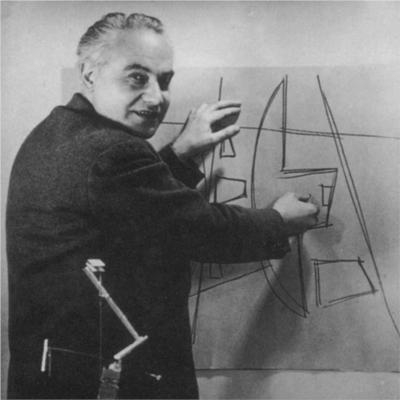
Atanasio Soldati
- Movimento Arte Concreta
Atanasio Soldati is best understood as a figure of two distinct formations: the Milanese modernist scene of the 1930s and the postwar founding of Italian[1] Concrete Art. Born in Parma in 1896[1], he trained as an architect before committing fully to painting, and the structural instinct remained visible throughout his career. His 1930s abstractions drew on late Synthetic Cubism, holding their compositional grids in what one scholar has described as a quality of metaphysical suspension, linking him to De Chirico's Italian inheritance despite the wholly non-figurative surface.
Biography
By 1935[1] he had a solo exhibition at the Galleria del Milione in Milan, the city's primary venue for abstraction, where Lucio Fontana and Fausto Melotti also showed that year. He appeared in the second Quadriennale in Rome alongside Licini, Reggiani, and Ghiringhelli, the first time Italian[1] abstraction publicly presented itself as a coherent movement. A 1933 painting, Seascape, now in the Museo Civico d'Arte Contemporanea, Palazzo Reale, Milan, is among his earliest surviving non-figurative works.
The more lasting achievement was organisational. On 22 December 1948[1], Soldati and three colleagues, Gillo Dorfles, Gianni Monnet, and Bruno Munari, opened the first exhibition of Movimento Arte Concreta[1] (MAC) at the Libreria Salto, Milan. The group aligned with Theo van Doesburg's 1930 Concrete Art manifesto and distinguished itself from Roman abstraction by refusing all political commitment. Soldati designed the covers for the inaugural issue of the movement's bulletin Arte concreta in November 1951 and again for issue 8 in October 1952. Allegro e fuga (1950), oil on canvas at 79 x 98 cm, now held at the Galleria Gian Ferrari Arte Moderna in Milan, is the work most cited in major survey texts on the period. Soldati died in 1953[1], the year before the movement he helped found reached its widest recognition.
Timeline
- 1896Born in Parma.
- 1930His abstractions of this decade drew on late Synthetic Cubism.
- 1933Painted "Seascape", now in the Museo Civico d'Arte Contemporanea, Palazzo Reale, Milan.
- 1935Had a solo exhibition at the Galleria del Milione in Milan.
- 1948Opened the first exhibition of Movimento Arte Concreta (MAC) at the Libreria Salto, Milan, with Gillo Dorfles, Gianni Monnet, and Bruno Munari on 22 December.
- 1950Painted "Allegro e fuga", now held at the Galleria Gian Ferrari Arte Moderna in Milan.
- 1951Designed the covers for the inaugural issue of the movement's bulletin Arte concreta in November.
- 1952Designed the covers for issue 8 of Arte concreta in October.
- 1953Died in 1953, the year before the MAC movement reached its widest recognition.
Notable Works
Tap to view larger.
Next stop
Browse the movements →
Every movement in the collection, from the Renaissance to Pop art.
Related Artists



Frequently Asked Questions
What is Atanasio Soldati known for?
Atanasio Soldati is known for his role in the Milanese modernist scene of the 1930s and for co-founding the Movimento Arte Concreta[1] (MAC). He also designed covers for the MAC's bulletin, Arte concreta.What is Atanasio Soldati's most famous work?
It is difficult to name one single work as Atanasio Soldati's most famous. He is better known for his overall contribution to the development of abstract art in Italy. Soldati began his artistic career with figurative painting. However, he moved towards abstraction in the late 1930s. This change was influenced by his contact with other artists working in the abstract style. His abstract period is generally considered his most important. During the 1950s, Soldati refined his personal style of abstraction. He often used geometric forms and a restricted range of colours. These elements created a sense of balance and harmony in his compositions. Soldati's work from this period is highly regarded. He explored the possibilities of pure form and colour. Soldati's theories on art were articulated in his book *Non siamo soli* (We Are Not Alone), published in 1947[1]. The book is a significant contribution to the understanding of abstract art. It offers insights into Soldati's artistic philosophy.What should I know about Atanasio Soldati's prints?
Atanasio Soldati (1896[1]-1953[1]) was an Italian[1] artist associated with the Concrete Art movement. While he is known for his paintings and sculptures, Soldati also produced original prints, often sold through fine art galleries. These differ from offset reproductions (posters) that use photochemical means, and from giclée prints (fine art prints made using inkjet technology). Soldati's prints would have been created by hand, directly on the plate, woodblock, stone, or screen. This makes each print an original work of art. Printmaking techniques available to Soldati included woodcuts, engravings, linocuts, mezzotints, etchings, lithographs, and serigraphs (also known as silkscreen prints). Serigraphy uses a stencil to apply paint through a fine mesh onto paper. Lithography involves drawing on limestone or metal with a greasy crayon, then applying ink to the surface. Etching uses acid to create lines on a metal plate. Variations of etching include soft-ground etching, aquatint, and lift-ground or sugar-lift etching. Drypoint involves scratching directly into a metal plate with a needle.What style or movement did Atanasio Soldati belong to?
Atanasio Soldati is associated with the Concrete Art movement. This style of complete abstraction avoids reference to the visible world, and it rejects both lyricism and sentiment. In 1948[1], Soldati, along with Bruno Munari, Gillo Dorfles, and Gianni Monnet, founded the Movimento Arte Concreta[1] (MAC) in Milan. MAC embraced a broad definition of geometric abstraction. The group was influenced by Theo van Doesburg's 1930 manifesto, Art Concret, and the work of artists such as Jean Arp. Soldati designed covers for the MAC's journal, *Arte Concreta*. Concrete Art gained international attention, with groups forming in France, Switzerland, Argentina, Uruguay, and Cuba. An international exhibition of Concrete Art was held in Milan in 1947, featuring Soldati alongside artists such as Vasily Kandinsky and Max Bill.What techniques or materials did Atanasio Soldati use?
Without more specific source material, a detailed discussion of Soldati's techniques is impossible. However, some general observations about printmaking techniques of his era are possible. Engraving is a printmaking technique using metal plates. Lines are incised into a metal plate, which is then inked and printed. Etching is another method. A metal plate is coated with a waxy substance, and the artist scratches an image into the wax. The plate is then immersed in acid, which bites into the exposed metal, creating lines. The plate is then inked and printed, similar to engraving. Burin tools are used to directly cut lines into a metal plate. The printmaking process often involves considerable skill and careful execution.What was Atanasio Soldati known for?
Atanasio Soldati was an Italian[1] artist known for his role in the development of abstract and concrete art in Italy. In December 1948[1], Soldati, along with Bruno Munari, Giani Monnet, and Gillo Dorfles, founded the Movimento Arte Concreta[1] (MAC) or Concrete Art Movement in Milan. The group embraced geometric abstraction, drawing inspiration from artists such as Theo van Doesburg and Jean Arp. Van Doesburg's 1930 manifesto, Art Concret, also served as a central influence. Soldati's association with MAC placed him at the forefront of the concrete art movement in Italy, which sought to promote a non-figurative, geometric style. He designed covers for the journal *Arte Concreta* in November 1951 and October 1952. While the concrete art movement called for rationalism and internationalism, its remoteness limited its viability in the postwar climate. Nevertheless, Soldati, along with other members of MAC, played a role in shaping the course of Italian art during this period.Where can I see Atanasio Soldati's work?
While I don't have specific information about where to view Atanasio Soldati's work, I can offer some possibilities for museums that feature similar artists or movements. Several museums in Italy may hold examples of his work. These include the Fondazione Regionale Cristoforo Colombo (Genoa), the Museo del Bijou (Casalmaggiore), and the Museo Richard-Ginori della Manifattura di Doccia (Sesto Fiorentino). These locations include a range of decorative arts. You may also wish to consult museum websites or art databases to locate specific works by Soldati in public collections. Another approach involves researching galleries or private collections that specialise in Italian[1] art from the 20th century. Auction house catalogues may provide details on past sales and current ownership of his pieces. These resources will help you discover where to view and appreciate Soldati's artistic contributions.Who influenced Atanasio Soldati?
Atanasio Soldati (1896[1]-1953[1]) was an Italian[1] artist whose work moved from figurative painting to abstraction. His early artistic education took place at the Academy of Fine Arts of Brera, in Milan. Soldati's initial style was influenced by 20th-century Italian figurative painters. By the late 1930s, however, he had become interested in abstraction. This change was partly a response to the rise of Fascism, which promoted a conservative, representational aesthetic. His move toward abstraction was also shaped by his contact with other artists. He was associated with the Galleria Il Milione in Milan, an important centre for abstract art. Here, he encountered the work of Wassily Kandinsky, Joan Miró, and Piet Mondrian. These artists, particularly Mondrian, became important influences on Soldati's mature style. Soldati adopted a non-objective approach, using geometric forms and blocks of colour in his compositions. He became a leading figure in the Italian abstract art movement, advocating for its development and acceptance.Who was Atanasio Soldati?
Atanasio Soldati (1896[1]-1953[1]) was an Italian[1] artist, associated with the abstract and concrete art movements. Born in Parma, he initially studied law, but then switched to art, attending the Accademia di Brera in Milan from 1920[1] to 1923. Soldati's early work was figurative; however, a trip to Paris in 1929 exposed him to modernism and altered his artistic direction. He began experimenting with non-representational forms. By the 1930s, he was a committed abstract artist. In 1935, Soldati joined the Abstraction-Création group in Paris, connecting with other abstract artists. He promoted abstract art in Italy, which faced resistance during the Fascist era. He participated in numerous exhibitions, including shows at the Galleria Il Milione in Milan. After the Second World War, Soldati continued to develop his abstract style, incorporating geometric elements and exploring colour relationships. He wrote about his artistic theories, contributing to the discourse on abstract art. His work is held in major collections, including the Galleria Nazionale d'Arte Moderna in Rome.Why are Atanasio Soldati's works important today?
Atanasio Soldati (1896[1]-1953[1]) was an Italian[1] artist whose exploration of abstraction is still relevant. Initially involved with Futurism, he later moved towards a more personal abstract style. Soldati's importance lies in his contribution to the development of abstract art in Italy. After a period serving in the First World War, he studied law, then enrolled at the Accademia di Brera. He was associated with artists such as Carlo Carrà and Lucio Fontana. His early work showed Futurist influences, but by the 1930s he had moved to non-figurative compositions. These paintings often featured geometric shapes and subtle colour harmonies. Soldati's work provides insight into the artistic debates of his time. He sought a balance between formal structure and subjective expression. His paintings are a reminder of the diverse approaches within the abstract tradition.What was Atanasio Soldati's art style?
Soldati's 1930s abstractions were influenced by late Synthetic Cubism, incorporating compositional grids. These grids possessed what one scholar described as a quality of metaphysical suspension, linking him to De Chirico's Italian[1] inheritance, despite the non-figurative surface.
Sources
Editorial draws on the following primary and tertiary references for Atanasio Soldati.
- [1] wikipedia Wikipedia: Atanasio Soldati Used for: biography, birth dates, death dates, identifiers, movement attribution, nationality.
- [2] book Gianlorenzo Bernini : new aspects of his art and thought : a commemorative volume Used for: biography.
- [3] book Gianlorenzo Bernini: new aspects of his art and thought : a commemorative volume Used for: biography.
- [4] book guggenheim-metph00cela Used for: stylistic analysis.
- [5] book Braun, Emily, 1957-; Asor Rosa, Alberto; Royal Academy of Arts (Great Britain), Italian art in the 20th century : painting and sculpture, 1900-1988 Used for: biography.
- [6] book Post-impressionism : cross-currents in European painting Used for: biography.
- [7] book Post-impressionism : cross-currents in European painting Used for: biography.
Editorial overseen by Solis Prints. Sources verified 2026-09-30. Click a source for details, or hover over [N] in the page above to preview.
Editorial standardsMethodologyCorrectionsAI disclosureAbout the editorial team