

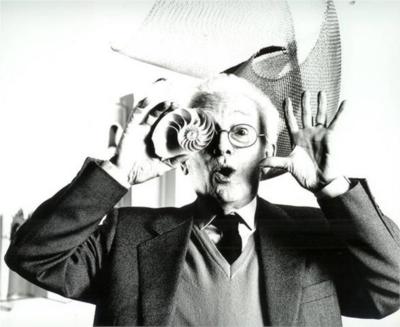
Bruno Munari
In 1957[1], Bruno Munari designed a cube-shaped ashtray for Danese Milano. It was eight centimetres on every side, anodized aluminium, and it won the Compasso d'Oro. This was not an accident: Munari spent six decades proving that the distance between art and everyday use was a false boundary.
Biography
Born in Milan in 1907[1], Munari began as a Futurist, following Marinetti's circle from 1927[1]. He broke with the movement after the Second World War, recoiling from its proto-Fascist associations, and in 1948 co-founded the Movimento Arte Concreta with Gillo Dorfles, Gianni Monnet, and Atanasio Soldati. Through the 1950s and 1960s he was a central figure in Arte Programmata, described by critics as the last avant-garde: a rigorous, gestalt-influenced attempt to develop mass-produced aesthetics using industrial technology as raw material.
The Danese collaboration produced objects that sit awkwardly between sculpture and product: the Lalzii pendant lamp of 1964[1], made from elastic-fabric tubing stretched over metal rings to 165 centimetres, and a Formica desk set of 1958 that entered the canon of postwar Italian[1] design. Munari also wrote and designed more than seventy children's books, earning the Hans Christian Andersen Award in 1974. His Libri illeggibili (Unreadable Books), wordless artist's books exploring paper, colour, and sequence, won the Golden Medal at the Triennale di Milano in 1957.
He continued working into his nineties, running Giocare con l'arte workshops at institutions across Italy until 1995[1]. He died in Milan in 1998[1]. His Cubo ashtray is still in production.
Timeline
- 1907Born in Milan.
- 1927Began associating with Marinetti's Futurist circle.
- 1948Co-founded the Movimento Arte Concreta with Gillo Dorfles, Gianni Monnet, and Atanasio Soldati.
- 1957Designed a cube-shaped ashtray for Danese Milano, which won the Compasso d'Oro. His "Libri illeggibili (Unreadable Books)" won the Golden Medal at the Triennale di Milano.
- 1958Created a Formica desk set that became part of the postwar Italian design canon.
- 1964Designed the Lalzii pendant lamp for Danese, made from elastic-fabric tubing stretched over metal rings.
- 1974Won the Hans Christian Andersen Award for his work on more than seventy children's books.
- 1995Continued working into his nineties, running Giocare con l'arte workshops at institutions across Italy until this year.
- 1998Died in Milan.
Notable Works
Tap to view larger.
Next stop
Browse the movements →
Every movement in the collection, from the Renaissance to Pop art.
Related Artists



Frequently Asked Questions
What is Bruno Munari known for?
Bruno Munari is known for blurring the lines between art and everyday objects. He designed the Cubo ashtray and Lalzii pendant lamp for Danese Milano, as well as a Formica desk set. He also wrote and designed over seventy children's books, including the wordless Libri illeggibili (Unreadable Books).What is Bruno Munari's most famous work?
Bruno Munari was a versatile Italian[1] artist; he worked as a designer, sculptor, photographer, and author. He is perhaps best known for his contributions to children's education and his innovative approach to art and design. While it is difficult to pinpoint one single "most famous" work, Munari's "Libri illeggibili" (Unreadable Books) are among his most recognised and influential creations. Started in the late 1940s, these books challenged conventional notions of reading and narrative. They consist of blank pages, pages with tactile materials, pages of varied sizes and shapes, or pages featuring abstract designs and unusual bindings. Munari aimed to stimulate imagination and creativity through these non-traditional books. He encouraged viewers, especially children, to interact with the books in a playful way, inventing their own stories and interpretations. The "Unreadable Books" series demonstrates Munari's belief in the importance of sensory experience and active participation in the artistic process. They remain popular examples of his experimental approach to art and education.What should I know about Bruno Munari's prints?
Bruno Munari (1907[1]-1998[1]) was an Italian[1] artist, designer, and inventor who worked across many media. He is associated with the Concrete Art movement, which favoured non-representational abstraction. Munari designed the cover for the journal *Art d'aujourd'hui* in 1952[1]. He also designed covers for the Milan-based *Arte concreta*; specifically, issues 5 and 10 in March and December 1952 respectively. In 1962, Munari co-organised *Arte programmata*, an exhibition of kinetic art, at the Olivetti store in Milan. Umberto Eco also contributed to the catalogue. The show presented "multiplied works" and "open work", concepts that suggest the possibility of printmaking or variable editioning. Printmaking sourcebooks often include Munari. *About Prints* (1962) and *Prints of the Twentieth Century: A History* (1976) may contain further information.What style or movement did Bruno Munari belong to?
Bruno Munari was associated with Futurism[1], particularly the "second phase" that began around 1915[1]. Futurism sought to reject conventionalism and embrace modernity, speed, and technology. The movement encompassed painting, sculpture, design, and other artistic fields. Munari's connection to Futurism is seen in his work in graphic arts and design. Futurism's second phase moved toward a synthetic style, using geometric forms and unconventional materials. Munari, along with other artists, expanded the movement's interests beyond painting and sculpture. After the Second World War, some Italian[1] artists continued to allude to their Futurist roots. However, the association of Futurism with Fascism led to a demonisation of the movement in some circles. Despite this, Futurism had a considerable effect on modern art and taste, envisioning trends in painting, sculpture, and design.What techniques or materials did Bruno Munari use?
Bruno Munari employed a wide range of materials and techniques throughout his career. In 1957[1], he created "achromes" using cloth soaked in kaolin and glue. By 1959, sewing-machine seams formed the screens for these "achromes". The following year, Munari experimented with cotton-wool and expanded polystyrene, as well as phosphorescent materials and cobalt chloride, which changed colour over time. 1961 saw him working with straw and plastic, creating white paintings incorporating balls of cotton-wool or fur, and clouds of natural or artificial fibres. He also produced a sculpture using rabbit skin. His practice extended to pneumatic sculptures called "air bodies" in 1959, and in 1960, he created sculptures in space using air jets to support spheres. Munari's exploration of lines led to works of varying lengths, up to 7200 metres. He also created "verification charts", incorporating maps, alphabets, and fingerprints, which were later lithographed and published. These examples illustrate Munari's diverse and experimental approach to art making.What was Bruno Munari known for?
Bruno Munari (1907[1]-1998[1]) was an Italian[1] artist, designer, and inventor who contributed to many areas, including painting, sculpture, design, and pedagogy. Munari engaged with Futurism[1] early in his career. The foundations of Italian design rest on the experiments of the Futurists; postwar cinema, photography, graphic arts, and furniture design would be inconceivable without the prior work of Munari, among others. In April 1947[1], he was involved with *Forma 1*, a monthly journal of figurative arts. Later, Munari contributed to *Arte astratta e concreta in Italia*, an exhibition catalogue, and designed covers for multiple issues of *Arte concreta* between 1951 and 1952. Munari’s work moved beyond traditional artistic boundaries, and he explored areas such as kinetic art, with his "useless machines", and participatory art, with his "workshops for children". He also wrote extensively on art, design, and visual communication, influencing generations of artists and designers.When did Bruno Munari live and work?
Bruno Munari was born on 19 February 1907[1] in Milan. He began working as a designer and artist in the late 1920s, associating with the Futurist movement. Munari experimented with photography, graphic design, and book design, in addition to creating objects and paintings. During the early 1930s, Munari created abstract cement tablets and joined the Abstraction-Création group in Paris. He also worked as a ceramicist in Albisola. After living in Argentina from 1939[1], he returned to Italy in 1947. There, he continued his work across different media, including painting, sculpture, and industrial design. He developed his Spatialist ideas, exploring space and light in art. Munari designed spatial environments for exhibitions, and he participated in events such as the Venice Biennale and Documenta. He died on 30 September 1998[1] in Milan.Where can I see Bruno Munari's work?
Works by Bruno Munari are held in various collections internationally. These include examples of his product design, such as 'Eyeglasses, I9SS', made of cardboard, and a 'Desk set' from 19^8, made of melamine and anodized aluminium. The desk set was manufactured by Bruno Danese. For those interested in viewing works by Bauhaus artists and designers (a movement with which Munari was associated), several museums have significant holdings. These include the Bauhaus-Archiv, Museum für Gestaltung, in Berlin; the Stiftung Bauhaus Dessau; and the Bauhaus-Museum Weimar. Outside of Germany, the Zentrum Paul Klee Bern in Switzerland, the Busch-Reisinger Museum in Cambridge, Massachusetts, and the Utsunomiya Museum of Art in Japan also maintain relevant collections.Where was Bruno Munari from?
Bruno Munari was Italian[1]. He was involved with the Milan art scene from 1945[1] to 1954. In December 1948, Munari co-founded MAC (Movimento Arte Concreta), translated as Concrete Art Movement, with Gianni Monnet, Atanasio Soldati, and Dorfles. MAC embraced a broad stylistic definition of geometric abstraction. The works of van Doesburg and Arp, and van Doesburg's 1930 manifesto Art Concret, were central influences on the group. A catalogue produced by Giuseppe Marchiori contained reproductions of work by Dorazio, Dorfles, Fontana, Augusto Garan, Lorenzo Guerrini, Galliano Mazzon, Monnet, Munari, Perilli, Soldati, Sottsass, and Luigi Veronesi. Munari also designed objects. Bruno Danese manufactured his desk set of melamine and anodized aluminium in 1958.Who did Bruno Munari influence?
Bruno Munari's influence can be seen across several artistic fields. His roots in Futurism[1], a movement that prized dynamism and innovation, connect him to later developments in Italian[1] art and design. After the Second World War, many Italian artists and designers looked back to Futurism. Munari, along with Anton Giulio Bragaglia, Depero, Carlo Mollino, and Enrico Prampolini, helped lay the foundations for Italian design. Their work impacted postwar cinema, photography, graphic arts, and furniture design. Munari's ideas also touched the architectural world. The 1964[1] Triennale in Milan, which explored leisure time and the rise of mass media, featured a multimedia exhibition. Munari collaborated with artists, musicians, and architects such as Vittorio Gregotti, Gae Aulenti, and the Vignelli's on this project. This interdisciplinary approach, where artists from different fields collaborated and cross-pollinated ideas, reflects Munari's wide-ranging influence. He also worked with Eugenio Carmi on children's books.Who influenced Bruno Munari?
Bruno Munari's artistic development was shaped by a number of influences. Early on, he engaged with Futurism[1], an Italian[1] avant-garde movement of the early 20th century. Key figures of Futurism, such as Filippo Tommaso Marinetti, informed Munari's early work. Other artists who affected Munari's outlook include Giacomo Balla, Umberto Boccioni, and Carlo Carrà. These artists explored themes of motion, technology, and the dynamism of modern life, ideas that resonated with Munari. Beyond Futurism, Munari was also aware of international trends in modern art. Artists like Paul Klee, Wassily Kandinsky, and Kurt Schwitters, associated with movements such as Constructivism and the Bauhaus, contributed to Munari's broader understanding of abstraction and the relationship between art, design and functionality.Who was Bruno Munari?
Bruno Munari was an Italian[1] artist and designer who worked across a range of media. He began as a Futurist before co-founding the Movimento Arte Concreta and becoming a central figure in Arte Programmata. He also designed objects for Danese Milano and wrote children's books.
Sources
Editorial draws on the following primary and tertiary references for Bruno Munari.
- [1] wikipedia Wikipedia: Bruno Munari Used for: biography, birth dates, death dates, identifiers, movement attribution, nationality.
- [2] book guggenheim-futurismmodernfo00solo Used for: biography.
- [3] book guggenheim-metph00cela Used for: biography, stylistic analysis.
- [4] book Braun, Emily, 1957-; Asor Rosa, Alberto; Royal Academy of Arts (Great Britain), Italian art in the 20th century : painting and sculpture, 1900-1988 Used for: biography.
Editorial overseen by Solis Prints. Sources verified 2026-10-07. Click a source for details, or hover over [N] in the page above to preview.
Editorial standardsMethodologyCorrectionsAI disclosureAbout the editorial team