



Carl Haag
- Orientalism
Carl Haag was 94 when he died in 1915[1], having outlived the Victorian watercolour establishment that made him famous by several decades. Born in Erlangen in 1820[1], he moved to England in 1847[1] and spent the next half-century mastering the meticulous, luminous technique that would make him one of the most sought-after Orientalist watercolourists of his generation.
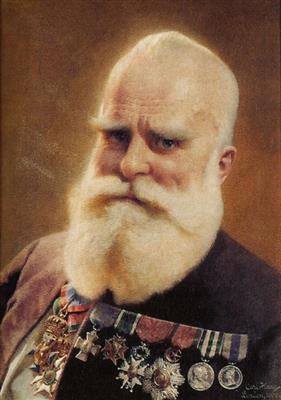
Biography
His reputation rested on two extended journeys to the Middle East. From 1858[1] to 1860, he shared a studio in Cairo with Frederick Goodall before moving through Jerusalem, Lebanon, and Syria. The studies he brought back formed the basis of large-scale works that combined documentary precision with an acuity for desert light that few contemporaries matched. A second Egyptian visit from 1873 to 1874 produced further material that sustained his practice into old age.
Queen Victoria was among his patrons. He also served as court painter to the Duke of Saxe-Coburg and Gotha, and his election as a full member of the Royal Society of Painters in Water Colours in 1853[1] confirmed his standing within the British[1] watercolour tradition. He was naturalistic where others were romantic, his figures from Nubia, Cairo, and the Holy Land rendered with the same care as the architectural detail around them.
By 1871[1] he had renovated a house in Hampstead and installed an Eastern-themed studio, a fashionable practice that mirrored the theatrical interiors of Leighton and Alma-Tadema. He retired from active practice in 1903, twelve years before his death, which came quietly in the German town of Oberwesel.
Timeline
- 1820Born in Erlangen.
- 1847Moved to England.
- 1853Elected as a full member of the Royal Society of Painters in Water Colours.
- 1858Travelled to the Middle East, sharing a studio in Cairo with Frederick Goodall.
- 1860Travelled through Jerusalem, Lebanon, and Syria.
- 1871Renovated a house in Hampstead and installed an Eastern-themed studio.
- 1873Made a second visit to Egypt.
- 1903Retired from active practice.
- 1915Died in Oberwesel at 94.
Notable Works
Tap to view larger.
Next stop
Browse the movements →
Every movement in the collection, from the Renaissance to Pop art.
Related Artists


Frequently Asked Questions
What is Carl Haag known for?
Carl Haag is known for his Orientalist watercolours, which combine documentary precision with an acuity for desert light. His reputation was built on studies from two extended journeys to the Middle East, and he became one of the most sought-after artists of his generation.What is Carl Haag's most famous work?
Carl Haag is best known for his detailed watercolour paintings of Middle Eastern and North African subjects, as well as Scottish Highland scenes. It is difficult to identify a single "most famous" work, as his popularity varied across different periods and regions. Haag travelled extensively throughout his career. These travels provided him with source material for many paintings. His Orientalist works, produced after travels in Egypt and the Middle East, gained considerable attention. Paintings such as "The Emir of Wady Halfa, Nubia, Receiving a Dispatch" (1860[1]) demonstrate his skill in portraying light and ethnographic detail. In Britain, Haag also received commissions from the royal family. Queen Victoria and Prince Albert were patrons, collecting his depictions of Balmoral and the Scottish Highlands. These paintings contributed to Haag's reputation as a skilled watercolourist, and they remain popular. Therefore, Haag's notability rests on a diverse body of work, encompassing both Orientalist scenes and Scottish subjects, rather than one singular, iconic piece.What should I know about Carl Haag's prints?
Carl Haag (1820[1]-1915[1]) was a German-born artist who became a naturalised British[1] subject and a painter to the royal family. He is best known for his Orientalist and genre scenes, often executed in watercolour. Haag studied at the academies of art in Nuremberg and Munich. He moved to London in 1847[1], where he received patronage from Queen Victoria and Prince Albert. This royal support helped to establish his reputation and career. He joined the Royal Watercolour Society in 1850, becoming a full member in 1852. From 1858 to 1860, Haag travelled extensively in the Middle East, including Egypt, Palestine, and Syria. These travels provided him with source material for many of his most popular works. He carefully documented the people, architecture, and customs of the region. His detailed and realistic style appealed to a British audience interested in the exotic cultures of the Ottoman Empire. Haag's prints are usually reproductions of his watercolour paintings. They were produced using various methods, including lithography and chromolithography. These prints made his work accessible to a wider audience beyond the elite circles who purchased his original watercolours. They offer an insight into Victorian-era Orientalism[1] and the taste for detailed, representational art.What style or movement did Carl Haag belong to?
Carl Haag (1820[1]-1915[1]) was a German-born artist who spent much of his career in Britain, and is best known for his Orientalist watercolours. Haag studied at the art academies in Nuremberg and Munich. He moved to Brussels in 1847[1], and then to London, where he received patronage from Queen Victoria and Prince Albert. He became a member of the Royal Watercolour Society in 1852, which gave him access to elite buyers and exhibition venues. In 1858, Haag travelled to Egypt, beginning a series of journeys to the Middle East. He also visited Palestine and Syria. During these travels, he created detailed studies of the people, architecture, and environment. Haag's paintings from these trips gained popularity because of their perceived accuracy and exotic subject matter. He depicted scenes of daily life, religious ceremonies, and portraits of local people. His work is characterised by its attention to detail and use of light and shadow. He returned to Germany in 1903, where he died in 1915.What techniques or materials did Carl Haag use?
Carl Haag was a 19th-century German artist who worked primarily in watercolour. He also made use of other media, such as oil paint, and was known for his skill in rendering detail. Haag's technique involved building up layers of colour to create depth and luminosity. He often used dry brush techniques to create texture, and he paid close attention to light and shadow to create a sense of realism. He travelled extensively, and his work often featured scenes from his travels, particularly in the Middle East and North Africa. He also painted portraits and historical subjects. Haag's work was popular during his lifetime, and he was a member of the Royal Watercolour Society. His paintings are now held in many public and private collections.What was Carl Haag known for?
Carl Haag was a 19th-century painter known for his Orientalist works. Orientalism[1], as a genre, gained traction in the 18th century, but it became more widespread in the 19th century due to events such as the Greek struggle for independence, Napoleon's Egyptian campaign, and the French campaign in Algeria. These events increased public interest in the region. Many artists travelled to the East, seeking inspiration and authentic material for their work. Horace Vernet, for example, travelled to Egypt, Syria, and Turkey in 1839[1] to gather material for Biblical scenes. Other artists who had never visited the East created their own evocations of these romantic lands from their imagination to satisfy public demand. These paintings offered a combination of savagery and sensuality set in opulent exoticism. The popularity of Eastern subjects lasted until after the turn of the century; in 1893, the Societé des Peintres Orientalistes was formed, with Gérôme as honorary president.When did Carl Haag live and work?
Carl Haag was born in 1820[1] in Bavaria. He died in 1915[1]. Haag studied at the Nuremberg Academy before moving to Brussels, then London, where he was a member of the Royal Academy. Haag travelled extensively, making extended trips to the Middle East. He was known for his detailed watercolour paintings of architecture and genre scenes. Haag's early training involved traditional painting studies at the Vienna Akademie der bildenden Künste, where he studied under Christian Griepenkerl in 1879[1]. However, he found the traditional methods uninspiring. A severe bout of meningitis interrupted his studies and left him deaf for the remainder of his life. In 1881, Haag encountered Emil Jakob Schindler's painting, Backwater of the Traun River near Goisern, which deeply affected him. Soon after, he became Schindler's private student and close friend, accompanying him on travels to various locations, painting alongside his teacher.Where can I see Carl Haag's work?
Carl Haag's work can be found in several public collections. In the United Kingdom, the Brighton Museum & Art Gallery, Manchester Art Gallery, National Museums of Scotland (Royal Museum), and the Victoria & Albert Museum hold examples. In Canada, the Royal Ontario Museum in Toronto has works by Haag. In the United States, you can view his art at the Metropolitan Museum of Art in New York, the Los Angeles County Museum of Art (LACMA), the Minneapolis Institute of Arts, the Virginia Museum of Fine Arts, the Wolfsonian at Florida International University, and the Charles Hosmer Morse Museum of American Art. Other museums that hold his work include the Art Gallery of New South Wales in Sydney, Musées Royaux des Beaux-Arts de Belgique in Brussels, and Narodni Galerie in Prague.Where was Carl Haag from?
Carl Haag was German. He was born in 1820[1] in Bavaria, which was then a kingdom within the German Confederation. Later, he became a naturalised British[1] citizen. Haag studied at the Academy of Fine Arts in Nuremberg and then at the Munich Academy. He began his career as a painter of portraits and genre scenes. In 1847[1], he moved to London, where he became a member of the Royal Watercolour Society. Haag travelled widely, visiting Egypt and the Near East. He made paintings of Middle Eastern subjects, often with great attention to ethnological detail. Haag's attention to detail made him a popular artist with the British public. He received commissions from Queen Victoria and other members of the royal family. He died in 1915[1].Who did Carl Haag influence?
It is difficult to say precisely who Carl Haag influenced. However, one can discuss the influence of an artist whom Haag admired, namely Frans Hals. In the late nineteenth century, many European and American painters travelled to Haarlem to study Hals's works at the Haarlem Municipal Museum, which opened in 1862[1]. The museum made five of Hals’s six militia portraits and all three of his regent group portraits accessible to the public for the first time. Artists such as François Bonvin, Claude Monet, Édouard Manet, Léon Bonnat, Jean-Léon Gérôme, and Henri Fantin-Latour from France; Wilhelm Busch, Franz von Lenbach, and Max Liebermann from Germany; Ilya Repin from eastern Europe; and Mary Cassat, J. Alden Weir, William Merrit Chase, and James Abbott McNeill Whistler from America are recorded as having visited the museum. These artists were broadly divided into three groups: realists, naturalists, and conservatives. Those who practised some form of naturalism most readily adopted Halsian stylistic elements.Who influenced Carl Haag?
It is difficult to identify specific individuals who directly influenced Carl Haag's artistic style. However, some inferences may be drawn from the influences of his contemporaries. Carl Moll, for example, was initially taught by Carl Haunold, a painter of the time. Moll then became a student of Emil Jakob Schindler, who encouraged him to observe nature closely and capture different atmospheres in his paintings. Gotthardt Kuehl, an Impressionist painter, also provided Moll with fresh perspectives on subject matter and technique. These examples demonstrate the artistic environment in which Haag worked, and the types of influences that may have shaped his artistic development. Another artist, László Moholy-Nagy, was influenced by Rembrandt's drawings, which he felt radiated psychological depth. He was also drawn to Vincent van Gogh's analytical ink drawings, and their texture. These examples demonstrate some of the artistic trends of the period.
Sources
Editorial draws on the following primary and tertiary references for Carl Haag.
- [1] wikipedia Wikipedia: Carl Haag Used for: biography, birth dates, death dates, identifiers, movement attribution, nationality.
- [2] book Jones, Dafydd., Dada Culture Used for: stylistic analysis.
- [3] book Jed Rasula, Destruction Was My Beatrice Used for: biography.
- [4] book German expressionism : documents from the end of the Wilhelmine Empire to the rise of national socialism Used for: biography.
- [5] book Husslein-Arco, Agnes, editor; Koja, Stephan, editor; Law, Rebecca (Translator), translator; McInnes, Robert (Translator), translator; Somers, Nick, translator; Monet, Claude, 1840-1926. Paintings. Selections; Österreichische Galerie Belvedere, h Used for: biography.
- [6] book Masterpieces of western art : a history of art in 900 individual studies from the Gothic to the present day Used for: biography.
- [7] book Landauer, Susan, The not-so-still life : a century of California painting and sculpture Used for: biography.
Editorial overseen by Solis Prints. Sources verified 2026-09-22. Click a source for details, or hover over [N] in the page above to preview.
Editorial standardsMethodologyCorrectionsAI disclosureAbout the editorial team