



Alexandre-Gabriel Decamps
- Orientalism
- Romanticism
When Théophile Gautier wrote that Decamps had captured a ray of sunshine by some means unknown to other painters, he was identifying the quality that separated this Parisian from every other Orientalist of the 1830s. Decamps had actually been to Turkey.
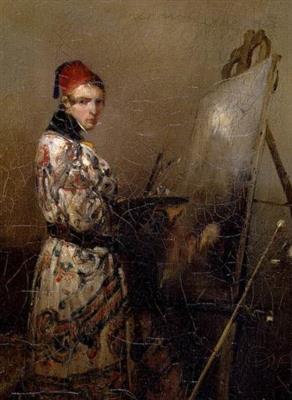
Biography
Born in Paris in 1803[9]","author":null,"year":null,"publisher":null,"type":"wikipedia","url":"https://en.wikipedia.org/wiki/Alexandre-Gabriel_Decamps","used_for":"biography, birth dates, death dates, identifiers, movement attribution, nationality"}">[6], he travelled to Asia Minor early in his career, returning with enough firsthand material to transform the French[6] Orientalist tradition. His Salon debut with Souvenir de la Turquie d'Asie in 1831[6] established his reputation at once. Unlike Delacroix, whose Eastern subjects were largely assembled from studio props, Decamps painted from direct observation, and the difference was felt. The heavy impasto and dramatic chiaroscuro of his Turkish subjects, combined with light effects that seemed to contemporaries almost physically luminous, gave his canvases an intensity no studio confection could achieve.
His reputation peaked with La Défaite des Cimbres at the 1834[6] Salon, an oil on canvas measuring 51 3/16 by 76 3/4 inches, now in the Louvre. After this, Decamps received all the critical recognition available to a contemporary artist. Yet monumental commissions never followed, a source of lasting bitterness: he wrote later that neither the State nor any wealthy patron thought to commission large-scale work from him.
His most ambitious late statement was the Histoire de Samson series, nine drawings in charcoal, pastel, and gouache shown at the 1845[6] Salon. Derived partly from engravings by François Verdier and saturated with study of Raphael and Rembrandt, the series drew an extraordinary critical response. Baudelaire wrote that Decamps had produced a Raphael and a Poussin in one breath, while Théophile Thoré placed him alongside Delacroix at the summit of the French[9]","author":null,"year":null,"publisher":null,"type":"wikipedia","url":"https://en.wikipedia.org/wiki/Alexandre-Gabriel_Decamps","used_for":"biography, birth dates, death dates, identifiers, movement attribution, nationality"}">[6] school. Decamps died in 1860[6], leaving the scholar Dewey Mosby to argue in a 1977 catalogue raisonné that his approach had paved the way for experiments with artistic sources later carried out by Manet, Cézanne, and Van Gogh.
Timeline
- 1803Born in Paris, France
- 1831Salon debut with Souvenir de la Turquie d'Asie, established reputation.
- 1834Reputation peaked with La Défaite des Cimbres at the Salon.
- 1845Histoire de Samson series shown at the Salon, drew critical response.
- 1860Died in France
Notable Works
Tap to view larger.
Where to See Alexandre-Gabriel Decamps
4 museums worldwide.
-
 4 works
Cooper Gallery
Barnsley, United Kingdom
Mon–Sat 10:00–16:00, closed Sundays and Bank Holidays · Free
-
3 works
The Mesdag Collection
The Hague, Netherlands
Wed–Sun 10:00–17:00, closed Mon–Tue
-
1 works
Museum of Fine Arts of Reims
Reims, France
-
1 works
Williamson Art Gallery and Museum
Birkenhead, United Kingdom
Mon–Thu 10:00–17:00, Fri 10:00–21:00, Sat 10:00–17:00, closed Sundays · Free


Next stop
Browse the movements →
Every movement in the collection, from the Renaissance to Pop art.
Related Artists




Frequently Asked Questions
What is Alexandre-Gabriel Decamps's most famous work?
Alexandre-Gabriel Decamps[9] is known as a superb genre painter, draughtsman, and printmaker. His most famous painting, *La Défaite des Cimbres*, was exhibited at the Salon of 1834[6]. This work brought him considerable recognition during his lifetime. Later in his career, around 1844-45, Decamps created a series of nine drawings illustrating events from the life of Samson. These drawings represent a shift in his artistic direction, reaffirming his desire to be a great history painter. The series includes scenes such as *The Sacrifice of Manoa*, *Samson Killing the Lion*, *Samson Destroying the Fields of the Philistines*, and *Samson Defeating the Philistines with the Jawbone of an Ass*. Other drawings in the History of Samson series are *Samson Carrying the Doors of Gaza*, *Samson and Dalilah*, *Samson Taken Prisoner*, *Samson Turning the Mill*, and *Samson Destroying the Temple*. These drawings were displayed at the Salon of 1845 and were well-received by critics. Some considered the series to be among the finest works produced by Decamps.What should I know about Alexandre-Gabriel Decamps's prints?
Alexandre-Gabriel Decamps[9] (1803[6]-1860[6]) was a French[6] painter, printmaker, and draughtsman, celebrated for his Orientalist scenes and genre works. While Decamps is perhaps best known for his paintings, his prints offer another avenue into his artistic vision. Decamps created lithographs and etchings, often reproducing his painted compositions for wider distribution. These prints allowed collectors to acquire versions of his popular works at a lower price than original paintings. His prints share similar subjects with his paintings, including scenes of everyday life in the Middle East, historical events, and animal studies. Some artists, such as Watteau and Ingres, were aware that many people preferred their drawings to their paintings. Similarly, Decamps's prints may appeal to those who appreciate his style but seek a more accessible medium. The prints after paintings from Jullienne’s collection have been reproduced and studied.What style or movement did Alexandre-Gabriel Decamps belong to?
Alexandre-Gabriel Decamps[9] is associated with the Orientalist movement. Orientalism[6] gained momentum in the 19th century, spurred by events such as the Greek struggle for independence and French[6] involvement in Algeria. This led many artists to visit the East, resulting in a surge of artworks depicting Eastern scenes at the Salons (official art exhibitions sponsored by the French Royal Academy). Decamps was among the artists who travelled to the East, bringing the region to life for audiences through his art. Théophile Gautier noted that Decamps' paintings seemed to capture light itself, rather than just colour. His Souvenir de la Turquie d’Asie, shown at the Salon of 1831[6], was said to possess such a powerful illusion that reality itself might seem inferior in comparison. Decamps' approach, termed an 'Orient d’intention', set him apart from contemporaries such as Prosper Marilhat, who was admired for the clarity and accuracy of his depictions.What techniques or materials did Alexandre-Gabriel Decamps use?
Alexandre-Gabriel Decamps[9] (1803[6]-1860[6]) was a French[6] painter, printmaker and draughtsman associated with the Orientalist movement. He is known for his genre paintings, scenes of daily life, and historical subjects. Decamps's early training was with the painter Abel de Pujol. He also studied with several other artists, including Alexandre-Denis Abel de Pujol, but he was largely self-taught. He worked in a variety of media, including oil paint, watercolour, lithography, and etching. His painting style is characterised by strong colour contrasts and dramatic lighting effects. He often used thick impasto, a technique in which paint is applied to the surface in heavy layers. This gives his paintings a textured, sculptural quality. Decamps was one of the first French artists to travel to the Middle East. He visited Turkey, Greece, and other countries in the region, and he brought back a wealth of sketches and studies that he used as the basis for his paintings. His experiences in the East had a significant effect on his artistic style. He developed a taste for exotic subjects and dramatic compositions.What was Alexandre-Gabriel Decamps known for?
Alexandre-Gabriel Decamps[9], a 19th-century French[6] artist, is known for his contributions to Orientalism[6], a genre that captured the imagination of European audiences. His paintings brought the East to life for the public, depicting scenes and subjects from Northern Africa and the Middle East. Decamps's work stood out because he painted from material gathered *sur motif*, giving his pieces an immediacy that set them apart. Théophile Gautier observed that Decamps painted with light, capturing the sun on canvas even when the weather was dull. His painting *Souvenir de la Turquie d’Asie* (Salon of 1831[6]) was said to possess such a powerful illusion that reality itself seemed inferior. Beyond Orientalism, Decamps aspired to be a history painter. One notable example is his *History of Samson* series of drawings from the 1840s. The series is based on engravings by Francois Verdier.When did Alexandre-Gabriel Decamps live and work?
Alexandre-Gabriel Decamps[9] was born in 1803[6] and died in 1860[6]. He was a French[6] painter, draughtsman, and printmaker. In 1834[6], Decamps exhibited La Défaite des Cimbres at the Salon. By 1840, his ambition had decreased, and his style became repetitive, perhaps because he was not commissioned to decorate any large public buildings. Around 1844-1845[6], Decamps's inspiration returned. He wrote from Chailly that he was absorbed in his work and pleased with his progress. He was particularly happy with two versions of Turcs Passant un Gué; one was in the collection of Marquis Maison (now at Chantilly, Musée Condé), and the other was in progress (now at the Wallace Collection, London). The two versions were completely different, indicating a move away from his previous lackadaisical approach. Decamps lived near Fontainebleau at this time. He had friends in the area and enjoyed sports with his wife, Angelina Imbert. He also visited his maternal relatives at Courbéton, near Montéreau-Faut-Yonne. Commissions from Marquis Maison and Charles Perrier also contributed to his happiness. Delacroix's presence at Champrosay, near Fontainebleau, may have rekindled Decamps's ambition.Where can I see Alexandre-Gabriel Decamps's work?
Alexandre-Gabriel Decamps[9]'s works can be found in several museums. In France, his art is held at the Musée du Louvre, Musée d’Orsay, and Musée de l’Orangerie, all in Paris. Other French[6] museums include the Musée des Beaux-Arts in Nantes, Musée Fabre in Montpellier, and Musée Condé in Chantilly. Outside of France, Decamps's pieces are displayed in Belgium at the Musées Royaux des Beaux-Arts de Belgique in Brussels and the Koninklijk Museum voor Schone Kunsten in Antwerp. His work is also available to view at the Art Gallery of New South Wales in Sydney, Australia, and the Narodni Galerie in Prague, Czech Republic. Other locations include the Museo del Prado in Madrid, the National Gallery of Victoria in Melbourne, and the Pushkin Museum of Fine Arts in Moscow.Where was Alexandre-Gabriel Decamps from?
Alexandre-Gabriel Decamps[9] was born in Paris in 1803[6]. He remained in France throughout his life, dying in 1860[6] in Courbevoie, near Paris, after being thrown from a horse. Decamps received his artistic training in Paris. He travelled extensively in the Near East, particularly in the 1820s. These travels had a considerable effect on his artistic output. He is considered one of the main figures in the French[6] Orientalist movement. Orientalism[6] was a 19th-century genre of painting that took the Near East as its subject. Other French Orientalist painters included Eugène Delacroix and Jean-Léon Gérôme. Decamps's paintings often depicted scenes of daily life in the Near East, such as markets, battles, or landscapes. He also painted historical and biblical scenes. His work is characterised by its realism, its use of light and shadow, and its attention to detail. He was one of the first French painters to paint genre scenes of everyday life.Who did Alexandre-Gabriel Decamps influence?
Alexandre-Gabriel Decamps[9]'s influence can be seen in the work of several artists who followed him. His style, particularly his approach to Orientalist subjects, affected painters such as Eugène Fromentin. Fromentin, like Decamps, travelled to North Africa and the Middle East, drawing inspiration from the region's culture and light. Decamps's influence extended to artists who did not directly imitate his subject matter. His innovative use of light and shadow, as well as his loose brushwork, impacted the development of Impressionism. Eugène Delacroix admired Decamps, although it is difficult to claim direct influence. Théodore Rousseau was a close friend, and the two artists influenced each other. Decamps's genre paintings and scenes of everyday life also paved the way for later Realist painters. His ability to capture the essence of a scene with apparent ease inspired many to explore similar themes.Who influenced Alexandre-Gabriel Decamps?
Alexandre-Gabriel Decamps[9] (1803[6]-1860[6]) developed his artistic style through varied influences and experiences. Early in his career, Decamps studied with Alexandre Abel de Pujol, but he was largely self-taught. His travels in the 1820s to Switzerland, Southern France, and, most importantly, the Near East (especially Turkey) had a considerable impact. These travels provided him with first-hand observations of light, colour, and culture that informed his later paintings. The "Orientalist" subject matter and his approach to light can be seen as a counterpoint to the more academic and classical styles that dominated French[6] art at the time. Some critics have suggested Eugène Delacroix as an influence, particularly in Decamps's use of colour and dramatic composition. However, Decamps's style remained distinct. He favoured genre scenes and animal paintings, often with a sense of realism and anecdotal detail. His interest in capturing the everyday life and character of the people and animals he depicted set him apart from other artists of his time.Who was Alexandre-Gabriel Decamps?
Alexandre-Gabriel Decamps[9] (1803[6]-1860[6]) was a French[6] artist, celebrated as a painter, draughtsman, and printmaker. He aspired to create art in what was called the grand manner. He achieved significant recognition early in his career, particularly after exhibiting his painting La Défaite des Cimbres at the Salon of 1834[6]. However, some sources suggest that by 1840 his artistic ambition waned somewhat, possibly because he was not given commissions for large-scale decorations in public buildings. Around 1844, Decamps seemingly rediscovered his earlier inspiration. During this period, he worked on pieces such as Turcs Passant un Gué, with two versions of the work created. One is now held at the Musée Condé in Chantilly, and the other is in the Wallace Collection, London. Decamps also embarked on a series of nine drawings illustrating events from the life of Samson. These drawings, based on engravings by Francois Verdier, represent a notable shift in his artistic direction during the 1840s, reaffirming his desire to be recognised as a great history painter. The series was displayed at the Salon of 1845, and received praise from critics.
Sources
Editorial draws on the following primary and tertiary references for Alexandre-Gabriel Decamps.
- [1] museum The Mesdag Collection Used for: museum holdings.
- [2] museum Museum of Fine Arts of Reims Used for: museum holdings.
- [3] museum Cooper Gallery Used for: museum holdings.
- [4] museum Williamson Art Gallery and Museum Used for: museum holdings.
- [5] academic Encyclopaedia Britannica Editors, Alexandre Decamps Used for: biography.
- [6] wikipedia Wikipedia: Alexandre-Gabriel Decamps Used for: biography, birth dates, death dates, identifiers, movement attribution, nationality.
- [7] book Art, the ape of nature : studies in honor of H. W. Janson Used for: biography.
- [8] book Rosales Rodríguez, Agnieszka,Michałowicz, Klaudyna, In the Footsteps of the Old Masters Used for: biography.
- [9] museum Alexandre-Gabriel Decamps Used for: museum holdings.
- [10] museum The Experts Used for: notable works.
- [11] museum The Turkish Patrol Used for: notable works.
- [12] museum Young Woman Seated at a Table, Holding a Candle Used for: notable works.
Editorial overseen by Solis Prints. Sources verified 2026-09-22. Click a source for details, or hover over [N] in the page above to preview.
Editorial standardsMethodologyCorrectionsAI disclosureAbout the editorial team