



Alfred Dehodencq
- Orientalism
Alfred Dehodencq spent ten years in Morocco at a time when almost no foreign artist had done so, and the experience defined both his career and his reputation. Arriving in 1853[1], he immersed himself in the life of the country's Jewish communities, producing a body of work on Moroccan Jewish customs and ritual that was unlike anything being painted in Paris at the time.
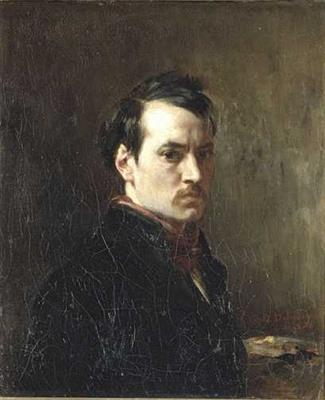
Biography
He was born in Paris in 1822[1] and trained at the Ecole des Beaux-Arts under Leon Cogniet. During the 1848[1] revolution, a wound to his right arm forced him to adapt to painting with his left hand, a constraint he apparently overcame without lasting damage to his output. Sent to Spain to convalesce, he stayed for five years, spending long hours with the work of Velazquez and Goya, both of whom left a permanent mark on his tonal range and his approach to figure painting.
From Spain he moved to Morocco in 1853[1]. His biographer Gabriel Seailles claimed Dehodencq witnessed a public execution in Tangiers, and this event lay behind his most discussed series: multiple paintings of "Execution of a Jewess in Morocco" (c. 1860s), linked by scholars to the 1834 case of Sol Hachuel. He married in Cadiz in 1857 and fathered five children, three of whom died young; his surviving son Edmond debuted at the Paris Salon at eleven.
Awarded the Legion d'honneur in 1870[1], Dehodencq called himself "the Last of the Romantics." He died by suicide in Paris on 2 January 1882[1]. Works are held at the Musee d'Orsay, the Israel Museum, and the National Gallery in Washington, D.C.
Timeline
- 1822Born in Paris, France
- 1848Wounded in right arm during revolution, learned to paint with left hand.
- 1853Moved to Morocco
- 1857Married in Cadiz, Spain
- 1860Painted series "Execution of a Jewess in Morocco"
- 1870Awarded the Legion d'honneur
- 1882Died by suicide in Paris, France
Notable Works
Tap to view larger.
Next stop
Browse the movements →
Every movement in the collection, from the Renaissance to Pop art.
Related Artists



Frequently Asked Questions
What is Alfred Dehodencq known for?
Alfred Dehodencq is known for his paintings of Moroccan Jewish customs and rituals. His most discussed series is multiple paintings of "Execution of a Jewess in Morocco" (c. 1860s), linked to the 1834[1] case of Sol Hachuel.What should I know about Alfred Dehodencq's prints?
Alfred Dehodencq was a French[1] Orientalist painter who lived from 1822[1] to 1882[1]. When considering his prints, it is helpful to understand print terminology. A 'vintage print' is a photograph printed around the time the negative was taken. A 'period print' is one made within roughly 10 to 15 years after the image was shot. An 'old print' refers to photographs printed more than 15 years after the shot, while a 'modern print' is a recent print from the original negative. An 'original print' is one made by the artist or under their supervision. Finally, a 'facsimile' is a print made by re-photographing a print or using the original negative, with print base and processing as close as possible to the reference print, generally a vintage print. These terms can help to evaluate and describe prints of Dehodencq's work.What style or movement did Alfred Dehodencq belong to?
Alfred Dehodencq is associated with the Orientalist movement, which gained momentum in the 19th century. This interest in the East was spurred by events such as the Greek struggle for independence and, earlier, Napoleon's Egyptian campaign. These events captured the imagination of French[1] artists and the public. Orientalism[1], in painting, provided an escape from the industrialising Northern European world. It offered scenes of exoticism, combining savagery and sensuality that proved attractive to the 19th-century art world. Many artists made the trip to places such as Algeria, resulting in Salon exhibitions being filled with art inspired by these voyages. The opening of the Suez Canal in 1869[1] made travel to the East more accessible. This led to later Orientalist pictures becoming less anecdotal, as the public grew more accustomed to these once-mysterious lands. In 1893, the Société des Peintres Orientalistes was formed, with Jean-Léon Gérôme as honorary president.What techniques or materials did Alfred Dehodencq use?
Information regarding Alfred Dehodencq's specific techniques is scarce. However, we can discuss the general practices of nineteenth-century French[1] painters. Painters in France typically followed a sequence. First, they made drawings. Then, they outlined the composition on prepared canvas. Modelling was indicated, often with a reddish-brown "sauce". Local colour, light, and shade were applied. This initial sketch was then elaborated upon, using a full range of tones. The final painting stage refined this process further. Some artists sought to recapture the techniques of earlier masters like Titian, Rubens, and Rembrandt. This involved investigating ancient tempera techniques and the oil techniques used by Jan van Eyck. The choice of materials determined the nature of the work. Some painters even incorporated plaster or granular raw material into their paint mixtures to achieve desired effects.What was Alfred Dehodencq known for?
Alfred Dehodencq was a French[1] artist known for his Orientalist paintings. The Orientalist movement became popular in France following the Greek struggle for independence. Interest in scenes with Algerian backgrounds grew after the French campaign in Algeria from 1830[1]. Many artists visited Algeria, and the Salons were filled with art from these voyages. Orientalism[1] in the nineteenth century was geographically limited. China was mostly closed to European travellers. Japan opened to Western traders in 1856, which led to japonisme in European painting, a separate movement from academic Orientalism. For artists exhibiting at the Salon, the East began in Spain, recalling its Moorish past, and in Greece, with its Turkish remains after independence in 1824. Some artists who never visited the East created their own visions of these lands to meet the demand for the style.When did Alfred Dehodencq live and work?
Alfred Dehodencq was active as a painter in France during the mid-19th century. In 1853[1], he began copying works at the Louvre. Between 1855 and 1856, he trained briefly at the École des Beaux-Arts. He also apprenticed as a porcelain painter from 1856 to 1857, while also drawing caricatures. During this period, he met Manet. In 1859, his painting *The Absinthe Drinker* was rejected at the Salon. He opened a teaching studio in Fontaine, Doubs, in 1862. He exhibited a race scene at the Salon in 1865. In 1870, Dehodencq joined the National Guard. He was included in the Impressionist group exhibition in April 1886, along with Cassatt, Degas, and others.Where can I see Alfred Dehodencq's work?
Alfred Dehodencq's works can be viewed in several museums across Europe and North America. In France, notable locations include the Musée des Arts Décoratifs in Paris, as well as the Musée des Beaux-Arts in Nancy. Spain also holds collections of his art; visit the Museo Art Nouveau y Art Déco in Salamanca, and the Museu d’Art Modern (MNAC) in Barcelona. Other European museums with collections include the Brangwyn Museum in Bruges, Belgium, and the Museu Calouste Gulbenkian in Lisbon, Portugal. In the United Kingdom, you might find his pieces at the Brighton Museum & Art Gallery, the Manchester Art Gallery, the National Museums of Scotland (Royal Museum) in Edinburgh, or the Victoria & Albert Museum in London. For those in North America, consider visiting the Metropolitan Museum of Art in New York, the Los Angeles County Museum of Art (LACMA), the Minneapolis Institute of Arts, or the Royal Ontario Museum in Toronto.Where was Alfred Dehodencq from?
Alfred Dehodencq was French[1]. Several leading Parisian department stores, notably Galeries Lafayette and Au Printemps, played an essential role in the promotion of Art Deco taste. In these shops, fashionable clients could shop for couture and accessories on one floor and be presented with the latest interior concepts by leading designers on another, all arranged interiors. France led the way in Art Deco. The atelier run by Henri Deglane hosted the greatest number of Americans but mostly produced tradition-bound designers, such as Francis Burrall Hoffman, David Adler, and Archibald Manning Brown. The chart also indicates whom, among older French students, a North American newcomer could look up to for advice and continue to “follow” upon his return.Who did Alfred Dehodencq influence?
It is difficult to identify specific artists who were directly influenced by Alfred Dehodencq. However, during the summer of 1905, the painter Alfred Maurer, along with sculptor Mahonri Young, played a role in introducing some Americans to new artistic ideas. While Leo and Gertrude Stein were in Florence, Maurer and Young took visitors to see artwork. Maurer reported that they "shocked some Americans the other day with them." By the early 20th century, artists such as Signac and Henri de Toulouse-Lautrec had been encouraged by the work of Henri Rousseau. Later, around 1908, Picasso bought Rousseau's *Portrait of Yadwigha*, and held a banquet in his studio to honour the painter. By 1909, both Léger and Delaunay were friends with Rousseau, and frequented his musical evenings. The critic Vauxcelles reviewed Rousseau's work favourably around this time, marking a shift in how his art was received.Who influenced Alfred Dehodencq?
Alfred Dehodencq belonged to a generation that admired Eugène Delacroix and Théodore Chassériau. Gustave Moreau, who taught most of the Fauves, also had an impact on various aspects of Post-Impressionism. Joris-Karl Huysmans, a novelist and art critic, is largely known for two works published in the 1890s, A Rebours and La-bas. These became important to the younger generation of writers and painters, especially the Symbolists. Puvis de Chavannes, who studied under Delacroix and Couture, dedicated himself to mural and decorative painting. He favored placid mythological and symbolic subjects, and was admired by younger artists. These figures, each with their unique approach to art and literature, influenced the artistic climate in which Dehodencq worked.Who was Alfred Dehodencq?
Alfred Dehodencq (1822[1]-1882[1]) was a French[1] painter. Paul Durand-Ruel (1831[1]-1922[1]), an art dealer, represented the Impressionists, and made a contribution to their recognition. Other dealers, such as Georges Petit (1835-1900), were Durand-Ruel's rivals. Many artists found support from friends and patrons, who offered financial assistance. Collectors such as Georges de Bellio (1828-1894), a Romanian doctor, and Paul-Ferdinand Gachet (1828-1909), a French doctor, purchased Impressionist works. Victor Choquet (1821-1891), a customs officer, invested his savings in paintings by artists such as Delacroix, Cézanne, Monet, Renoir, Manet, Pissarro and Sisley. Jean-Baptiste Faure (1830-1914), a singer and composer, bought works from Durand-Ruel and the artists themselves. Eugène Murer (1846-1906), a restaurant owner, hosted dinners for the painters. Ernest Hoschedé (1838-1890), owner of a department store, collected paintings and organised auctions; after his bankruptcy, Monet assisted him.Why are Alfred Dehodencq's works important today?
Alfred Dehodencq (1822[1]-1882[1]) was a French[1] Orientalist painter known for his depictions of scenes from North Africa and Spain. His importance today lies in his contribution to the Orientalist movement, which offered European audiences a glimpse into the cultures and daily life of the Middle East and North Africa during the 19th century. Dehodencq's paintings are valued for their ethnographic detail and dramatic compositions. He moved away from earlier, more idealised depictions of the Orient, and instead presented scenes with greater realism. His work provides insight into the social dynamics, religious practices, and cultural traditions of the regions he portrayed. Although Orientalism[1] has been critiqued for its potential to exoticise or misrepresent non-Western cultures, Dehodencq's art remains significant as a visual record of a specific historical period and a reflection of European perceptions of the 'Orient'.
Sources
Editorial draws on the following primary and tertiary references for Alfred Dehodencq.
- [1] wikipedia Wikipedia: Alfred Dehodencq Used for: biography, birth dates, death dates, identifiers, movement attribution, nationality.
- [2] book Harding, James, Artistes pompiers : French academic art in the 19th century Used for: biography.
- [3] book Neoclassicism and romanticism : architecture, sculpture, painting, drawings, 1750-1848 Used for: biography.
Editorial overseen by Solis Prints. Sources verified 2026-09-22. Click a source for details, or hover over [N] in the page above to preview.
Editorial standardsMethodologyCorrectionsAI disclosureAbout the editorial team