

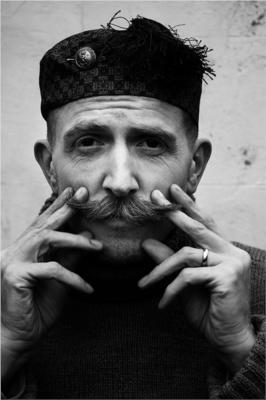
Billy Childish
- contemporary art
Billy Childish was expelled from Saint Martin's School of Art in 1982 for refusing to paint in the manner the school required. He had already produced some 600 drawings during six months as an apprentice stonemason at Chatham Dockyard; Saint Martin's could not offer him more than it took away. The expulsion freed him to develop a practice of unusual scope and productivity.
Biography
Born Steven John Hamper in Chatham, Kent, in 1959[1], Childish works in oil on large canvases with a speed and directness that refuses to smooth over the marks of its own making. The figures are raw, the brushwork gestural, the palette unsubtle by choice. He co-founded the Stuckist movement in 1999 with Charles Thomson, though he left the following year. His relationship with Tracey Emin, briefly his partner in the early 1980s, became part of the cultural record when she included his name in Everyone I Have Ever Slept With 1963-1995[1] (1995).
Alongside painting, Childish has released well over 100 records across bands including Thee Milkshakes, Thee Mighty Caesars and Thee Headcoats, and published more than 40 collections of poetry since 1981. Kurt Cobain cited him as an influence; Kylie Minogue named an album after one of his books. A major retrospective at the ICA London in 2010 established the institutional case for his work. He has shown with Lehmann Maupin in New York and neugerriemschneider in Berlin.
Timeline
- 1959Born Steven John Hamper in Chatham, Kent.
- 1981Published his first poetry collection.
- 1982Expelled from Saint Martin's School of Art for refusing to conform to the school's artistic style, at 23.
- 1995Tracey Emin included Childish's name in her artwork "Everyone I Have Ever Slept With 1963-1995".
- 1999Co-founded the Stuckist movement with Charles Thomson.
- 2000Left the Stuckist movement one year after co-founding it.
- 2010A major retrospective of his work was held at the ICA London.
Notable Works
Tap to view larger.
Next stop
Browse the movements →
Every movement in the collection, from the Renaissance to Pop art.
Related Artists



Frequently Asked Questions
What is Billy Childish known for?
Billy Childish is known for his painting, his involvement in bands such as Thee Milkshakes, Thee Mighty Caesars and Thee Headcoats, and his poetry. He also co-founded the Stuckist movement in 1999, though he left the following year.What is Billy Childish's most famous work?
Billy Childish is a prolific artist, so singling out one work as his "most famous" is difficult. He is better known for his overall output and diverse practice than for one specific, iconic piece. Childish co-founded the Stuckists art movement in 1999, which advocates figurative painting as opposed to conceptual art. His paintings often feature bold, expressionistic brushwork and deal with personal themes, such as childhood, addiction, and spiritual searching. He often paints self-portraits and scenes from his life. Beyond painting, Childish is a musician and writer, having published numerous novels, poems, and musical recordings. His creative output spans several disciplines, making him a multifaceted artist. His art is characterised by a raw, direct style, rejecting art-world conventions. He embraces amateurism, valuing sincerity over technical skill. Childish's work can be seen as a reaction against mainstream culture, promoting individual expression and artistic freedom.What should I know about Billy Childish's prints?
Billy Childish is known for his prolific output of woodcut prints. Printmaking is an unregulated activity, but there are some conventions that most artists follow. These conventions add value if followed. Typically, each print in an edition is marked in pencil along the bottom margin. On the left, the print number is written above the edition size (for example, 1/25). The title of the print is written in the centre, and the artist's signature appears on the right. The artist decides the edition size, as the woodblock can produce many prints if cared for. Thomas Bewick's wood engraving of Newcastle was printed 900,000 times. Other notations can appear on a print. "A/P" indicates an artist's proof, identical to the edition, and usually limited to 10% of the total. "T/P" signifies early proofs made while the artist is still working on the block. "V2" (or V3, etc.) denotes a variant edition, where colours differ, or blocks are added or removed. "V/E" signifies a variable edition, where part of the print is constant, but hand-colouring or other unpredictable elements are added. "Hors de Commerce" describes a print identical to the edition but not for sale.What style or movement did Billy Childish belong to?
Billy Childish is associated with the Stuckist art movement, which he co-founded in 1999 with Charles Thomson and other artists. The Stuckists advocate for figurative painting as opposed to what they see as the conceptualism and careerism of the mainstream contemporary art[1] world. Childish's own art encompasses a range of media, including painting, drawing, and poetry. His style is often characterised by its raw, expressive quality and its engagement with personal and autobiographical themes. He has also been associated with outsider art due to his self-taught approach and his rejection of formal artistic training. While the Stuckists share a common interest in representational art, Childish's individual style is distinctive. His work often incorporates elements of expressionism and punk aesthetics. He has also drawn inspiration from a variety of sources, including literature, music, and personal experiences. He remains a central figure in the Stuckist movement.What techniques or materials did Billy Childish use?
Billy Childish employs a wide array of materials in his artistic practice. He is known to use house paint, primarily due to its connection to his childhood memories of his father painting. Childish favours acrylics for their quick-drying properties, which suit his impatient nature. Beyond acrylics, he incorporates oil sticks, pastels, ink, charcoal, graphite, photo collage, spray paint, coffee, tea bags, paper, cardboard, ply, and canvas into his works. He often works towards a specific theme for exhibitions, drawing inspiration from books and images related to the subject. Living in a rural area, he frequently depicts horses and cattle, although he avoids literal copying of photos or models. Instead, he allows these images to influence his marks without dictating them. Childish builds his own timber panels and does some framing.What was Billy Childish known for?
Billy Childish is known for his prolific output and do-it-yourself ethos across various artistic disciplines. Born in 1959[1], he is a painter, writer, musician and poet. Childish's art often features bold, expressionistic brushwork and raw, unrefined imagery. His paintings frequently depict personal subjects, such as landscapes and self-portraits, as well as historical and literary themes. As a writer, Childish has published numerous novels, poems and pamphlets, often exploring themes of alienation, personal struggle and social commentary. Musically, he has been involved in many bands, including The Milkshakes and Thee Headcoats, contributing to the garage rock scene. Childish's work is characterised by its directness, emotional honesty and rejection of mainstream art world conventions. He co-founded the Stuckists art movement in 1999, which opposes conceptual art and promotes figurative painting as a means of personal expression. His diverse creative activities and anti-establishment stance have established him as a significant figure in contemporary art[1] and culture.When did Billy Childish live and work?
Billy Childish was born Steven John Hamper in Chatham, Kent, in 1959[1]. He later adopted the name Billy Childish. Largely self-taught as a painter, writer, and musician, Childish left secondary school at 16 and worked as an apprentice stonemason at Chatham Dockyard. He was dismissed after a year for writing poetry. He then attended Saint Martin's School of Art in London, but was expelled. Since the late 1970s, Childish has produced a substantial body of work encompassing painting, drawing, photography, poetry, and music. He is associated with several musical groups, including The Pop Rivets, Thee Milkshakes, and The Musicians of the British[1] Empire (MBE). Childish's art often explores themes of autobiography, social commentary, and personal mythology. His paintings frequently feature bold, expressive brushwork and a deliberately naive style. He continues to live and work in Britain.Where can I see Billy Childish's work?
Billy Childish's artworks have been exhibited in a variety of locations, from established galleries to more unconventional spaces. Major institutions that have held solo exhibitions of his work include the Institute of Contemporary Arts (ICA) in London. Childish had a show there in 2010. He also had a solo exhibition at the White Columns gallery in New York. Commercial galleries that represent or have represented Childish include L-13 Light Industrial Workshop, which is closely associated with his work and publishes books and prints. Carl Freedman Gallery has also exhibited his paintings. Beyond these spaces, Childish's art has appeared in smaller, independent galleries and project spaces, reflecting his do-it-yourself ethos and his engagement with alternative art scenes. His work can sometimes be found in group shows focusing on outsider art, expressionism, or artists associated with the Stuckist movement, which he co-founded. To find current exhibitions, consulting gallery websites or art listings is advisable.Where was Billy Childish from?
Billy Childish was born in Chatham, Kent, in 1959[1]. His given name was Steven John Hamper. Chatham is a Medway town in Kent, South East England. Childish is known for his prolific output of art, music, and writing, often characterised by a raw and direct style. His work frequently explores themes related to his personal experiences and observations of the world around him. He has remained connected to the Medway area throughout his life, and it has influenced his artistic output. As a teenager, Childish was a dockyard apprentice in Chatham. He was dismissed from the dockyard after submitting drawings to the staff magazine that were deemed offensive. He has lived and worked in various locations in the Medway towns. He attended Saint Martin's School of Art, but was expelled.Who did Billy Childish influence?
It is difficult to specify exactly who Billy Childish influenced. The influence of Dada, an early twentieth-century art movement with some thematic links to Childish's work, is hard to pin down with certainty. The "anti-art" orientation of Dada had an impact on later generations. The term Neo-Dada emerged in the late 1950s; however, some artists to whom the label was applied, such as Daniel Spoerri, considered it derogatory. Dada's humour and sharp edges can be glimpsed in unexpected places, such as the Marx Brothers' film *Duck Soup* (1933). Comedy troupes such as Monty Python have an affinity with the Dada spirit, but it is hard to say whether this is legacy or direct influence, given that Dada was historically remote by the 1960s. Figures such as Damien Hirst and Takashi Murakami have been inspired by Pop Art's investigations into the connections between business and art. Julian Opie's cartoon-like figures owe a debt to Lichtenstein. Elizabeth Peyton, inspired in part by Hockney, paints pop stars.Who influenced Billy Childish?
Billy Childish's influences are wide-ranging. Eduardo Paolozzi, a Pop artist, drew inspiration from Kurt Schwitters, a German artist who made collages from American magazines, comics, and everyday objects found in refuse. Paolozzi's collages have a more contemporary tone than Schwitters's earlier work. Paolozzi's work anticipated key elements of Pop Art: an interest in commercial images, an awareness of the connection between commerce and sex in mass media, an obsession with advertising, an interest in brand names, film stars, comic book characters, and the use of collage to replicate modern life. Paolozzi may have been drawn to Henry Ford's statement in a 1916 interview with the *Chicago Tribune*: "History is more or less bunk. It’s tradition. We don’t want tradition. We want to live in the present." Paolozzi felt that this attitude could be applied to fine art.Who was Billy Childish?
Billy Childish (born Steven John Hamper, 1959[1]) is a British[1] artist, writer, and musician. He is known for his prolific output and his rejection of mainstream art world trends. Childish's art often incorporates raw, expressive brushwork and emotionally charged subject matter. His paintings frequently depict scenes from his personal life, as well as historical and literary figures. He is associated with a number of artistic movements, including Stuckism, which he co-founded in 1999 with Charles Thomson and others, promoting figurative painting as opposed to conceptual art. In addition to his visual art, Childish has published numerous books of poetry and prose. He has also been involved in various musical projects, most notably as the leader of the bands The Milkshakes, Thee Headcoats, and The Buff Medways. His diverse creative activities reflect a DIY aesthetic and a rejection of commercialism.
Sources
Editorial draws on the following primary and tertiary references for Billy Childish.
- [1] wikipedia Wikipedia: Billy Childish Used for: biography, birth dates, death dates, identifiers, movement attribution, nationality.
- [2] book guggenheim-australianvision00wald Used for: biography.
- [3] book guggenheim-richardhamilton00hami Used for: biography.
- [4] book Sooke, Alistair, Pop Art Una storia a colori Used for: biography, stylistic analysis.
Editorial overseen by Solis Prints. Sources verified 2026-10-07. Click a source for details, or hover over [N] in the page above to preview.
Editorial standardsMethodologyCorrectionsAI disclosureAbout the editorial team