



Barkley L. Hendricks
- contemporary art
When Yocks (1975[1]) sold at Sotheby's in May 2019 for $3.72 million, it confirmed what the paintings had been saying for decades: Barkley Hendricks understood portraiture as an act of reclamation. Born in Nicetown-Tioga, Philadelphia in April 1945[1], he trained at the Pennsylvania Academy of the Fine Arts and then at Yale, where Walker Evans was among his tutors. His breakthrough came in the late 1960s and 1970s with a series of large-scale oil portraits of Black men and women rendered with exactness and composure against near-monochromatic grounds.
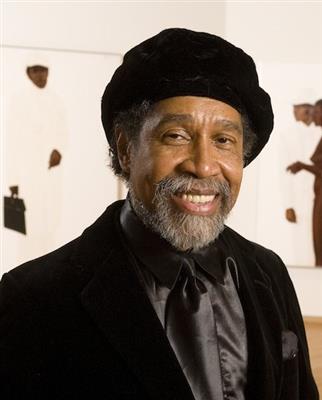
Biography
The figures in these paintings look back at the viewer with complete self-possession. The format, often close to life-size, borrows from European old-master convention and redirects it entirely. Works such as Lawdy Mama (1969[1]), What's Going On (1974), and Brilliantly Endowed (1977) are technically assured and politically alert without being didactic. That last painting was a pointed response to critic Hilton Kramer, who had used the phrase 'brilliantly endowed' in a 1977 review without quite meaning it as a compliment; Hendricks took the phrase back on his own terms.
He taught studio art at Connecticut College from 1972[1] until his retirement in 2010, and between 1984 and 2002 stepped back from portraiture to concentrate on landscape and photography, including portraits of Miles Davis and Dexter Gordon. The 2008 retrospective Birth of the Cool at the Nasher Museum of Art, Duke University, reconnected a new generation with the earlier work and established his place in the genealogy of contemporary American[1] figurative painting. Kehinde Wiley, Amy Sherald, and Rashid Johnson have all acknowledged his influence. He died in New London, Connecticut, in April 2017[1].
Timeline
- 1945Born in Nicetown-Tioga, Philadelphia, in April.
- 1969Painted "Lawdy Mama".
- 1972Began teaching studio art at Connecticut College.
- 1974Painted "What's Going On".
- 1975Painted "Yocks".
- 1977Painted "Brilliantly Endowed" as a response to a critic's comment.
- 1984Shifted focus from portraiture to photography and works depicting landscapes.
- 2008The retrospective "Birth of the Cool" opened at the Nasher Museum of Art, Duke University.
- 2010Retired from teaching at Connecticut College.
- 2017Died in New London, Connecticut, in April, aged 72.
Notable Works
Tap to view larger.
Next stop
Browse the movements →
Every movement in the collection, from the Renaissance to Pop art.
Related Artists


Frequently Asked Questions
What is Barkley L. Hendricks known for?
Barkley L. Hendricks is known for his large-scale oil portraits of Black men and women, rendered with exactness and composure against near-monochromatic grounds. His portraits, often close to life-size, borrow from European old-master convention and redirect it entirely.What is Barkley L. Hendricks's most famous work?
While it is difficult to name one single "most famous" work, Hendricks's 1969[1] painting "Lawdy Mama" is among his best-known pieces. It is an oil and enamel on canvas portrait of a woman in a black dress with gold jewellery, set against a shimmering gold leaf background. Hendricks is celebrated for his life-sized portraits of people of colour, often set against minimalist backgrounds. He approached his subjects on the streets of New York, Philadelphia, and other cities. He asked them to pose for photographs, from which he would later create his paintings. His work often challenges conventional notions of portraiture, race, and representation. Hendricks combined elements of realism, surrealism, and pop art. He created striking images that captured the individuality and style of his subjects. His paintings often exude a sense of cool confidence and self-possession. They reflect the subjects' own sense of identity.What should I know about Barkley L. Hendricks's prints?
When considering Barkley L. Hendricks's prints, it is helpful to understand the distinction between an original print and a reproduction. An original print is conceived and executed solely as a print, often in a numbered edition, and signed by the artist. Each print in the edition is an original, created from a plate, stone, screen, or block made for that purpose. There is no single original from which copies are made; instead, each print is individually inked and pulled. Reproductions, on the other hand, are copies of artworks originally created in another medium, such as painting or watercolour, and are usually made using photo-mechanical means. Numbering and signing a reproduction does not transform it into an original print. The pricing of original prints is influenced by factors such as the edition size, the artist's reputation, the image's popularity, and the materials used. Plates for original prints are made by hand and can only withstand a limited amount of use, which restricts the number of prints that can be pulled. Some publishers further limit the number of impressions to increase the print's value, with editions ranging from as few as 250 to as many as 1,000.What style or movement did Barkley L. Hendricks belong to?
Barkley L. Hendricks is associated with contemporary art[1], specifically art produced by African Americans that gained prominence in the decades after 1980[1]. This movement marks a significant development, as people of African descent were rarely the subjects of art made by European and American[1] artists, except in marginal or demeaning roles. Black artists were often omitted from Western art histories until recently. Hendricks's work, along with that of Jean-Michel Basquiat, Faith Ringgold, and others, addresses social and political issues such as ethnic, religious, and national identity. These artists reject modernist formalist doctrines, embracing art's persuasive power to communicate with a broad audience. Hendricks, like other contemporary artists, makes personal and group identity a focus, reflecting the multicultural diversity of the world today.What techniques or materials did Barkley L. Hendricks use?
Barkley L. Hendricks was known for his portraits, often of people of colour, set against monochrome backgrounds. He typically worked with acrylic paint on canvas. Hendricks's process involved careful preparation. He began with photographs of his subjects, using these as a reference for detailed drawings. These drawings served as the foundation for his paintings, allowing him to capture precise likenesses and poses. He employed a smooth, almost photorealistic style, achieved through careful blending and layering of acrylics. This technique allowed him to create subtle gradations of tone and colour, giving his figures a sense of depth and presence. Hendricks often applied a final layer of acrylic gloss medium or varnish to his finished paintings. This saturated the colours and gave the surface a uniform sheen.What was Barkley L. Hendricks known for?
Barkley L. Hendricks, born in Philadelphia in 1945[1], was an American[1] painter and photographer. He is best known for his life-sized, realist portraits of people of colour, often set against monochrome backgrounds. Hendricks's subjects, frequently drawn from the streets of New York and Philadelphia, are depicted with a remarkable sense of presence and self-assurance. His approach combined elements of realism, surrealism, and pop art, creating a style that was uniquely his own. He paid close attention to the clothing and accessories of his subjects, using fashion as a means of expressing identity and individuality. Hendricks aimed to counter the historical absence of people of African descent in Western art. His work challenged conventional representations and celebrated the everyday beauty and style of his sitters. Through his portraits, Hendricks offered a powerful and dignified representation of black identity, making him an important figure in contemporary art[1]. He died in 2017[1].When did Barkley L. Hendricks live and work?
Barkley L. Hendricks (1945[1]-2017[1]) was an American[1] painter and photographer, best known for his life-sized portraits of people of colour. Born in Philadelphia, Pennsylvania, Hendricks received his Bachelor of Fine Arts in 1967[1] and his Master of Fine Arts in 1969, both from Tyler School of Art at Temple University. He also studied at the Pennsylvania Academy of the Fine Arts (1960-1963[1]) and spent a year abroad studying in Florence, Italy (1966-1967). Hendricks taught painting and drawing at Connecticut College, in New London, from 1972 until his retirement in 2010. His work is associated with the Black Arts Movement and with 1970s conceptual portraiture. He died in New London, Connecticut, at the age of 72.Where can I see Barkley L. Hendricks's work?
Barkley L. Hendricks's paintings and portraiture can be viewed in several locations. In New York City, visit the Metropolitan Museum of Art, the Museum of Modern Art, the Solomon R. Guggenheim Museum, or the Whitney Museum of American[1] Art. Other locations in the United States include the Albright-Knox Art Gallery (Buffalo, New York), the Philadelphia Museum of Art, the Carnegie Museum of Art (Pittsburgh), the National Gallery of Art (Washington, DC), the National Museum of American Art (Washington, DC), the Phillips Collection (Washington, DC), the University of Iowa Museum of Art (Iowa City), the University of Nebraska Art Galleries (Lincoln), the University Art Museum (Albuquerque), the University of Texas at Austin, the Walker Art Center (Minneapolis), the Los Angeles County Museum of Art, the Minneapolis Institute of Arts, the Virginia Museum of Fine Arts (Richmond), and the Wolfsonian at Florida International University (Miami Beach). In the UK, Hendricks's work can be seen at the Manchester Art Gallery and the Victoria & Albert Museum (London).Where was Barkley L. Hendricks from?
Barkley L. Hendricks was born in Philadelphia, Pennsylvania, in 1945[1]. He grew up in the city and spent much of his life in Connecticut. Hendricks received his formal art training at the Pennsylvania Academy of the Fine Arts in Philadelphia, where he studied from 1963[1] to 1967. He furthered his education with a Bachelor of Fine Arts degree and a Master of Arts degree from Yale University in New Haven, Connecticut, attending from 1967 to 1969, and then 1970 to 1972. After his studies, Hendricks remained connected to Connecticut. He began teaching photography and painting at Connecticut College in New London in 1972. He continued teaching at the college for more than thirty years; he retired as a professor emeritus. Hendricks lived in New London with his wife Susan until his death in 2017[1].Who did Barkley L. Hendricks influence?
Barkley L. Hendricks's artwork and approach had an impact on numerous artists. His portraits, particularly his use of scale and his focus on individual style, influenced a subsequent generation. Contemporary artists such as Kehinde Wiley and Mickalene Thomas have acknowledged Hendricks's importance to their own practices. Wiley, known for his large-scale portraits of Black subjects in poses drawn from Western art history, shares Hendricks's interest in representing Black figures with dignity and presence. Thomas, who creates mixed-media works that often incorporate rhinestones and bold patterns, also echoes Hendricks's celebration of Black beauty and self-expression. Hendricks's influence extends beyond portraiture. His attention to detail, his use of colour, and his willingness to challenge conventional representations of race and identity have resonated with artists working in a variety of media. His work has encouraged other artists to explore the complexities of Black identity in their own way.How did Barkley L. Hendricks die?
Barkley L. Hendricks died in 2017[1] at the age of 72.
Sources
Editorial draws on the following primary and tertiary references for Barkley L. Hendricks.
- [1] wikipedia Wikipedia: Barkley L. Hendricks Used for: biography, birth dates, death dates, identifiers, movement attribution, nationality.
- [2] book McGraw-Hill, Art In Focus Used for: stylistic analysis.
- [3] book Susie Hodge, Artists and Their Pets Used for: biography.
- [4] book DTPMac17, oi-iv Used for: stylistic analysis.
- [5] book Jordana Moore Saggese, Reading Basquiat: Exploring Ambivalence in American Art Used for: biography.
Editorial overseen by Solis Prints. Sources verified 2026-09-30. Click a source for details, or hover over [N] in the page above to preview.
Editorial standardsMethodologyCorrectionsAI disclosureAbout the editorial team