



Antonio Bueno
- contemporary art
Antonio Bueno and his twin brother Xavier arrived in Italy from Spain as children and became two of the most distinctive figurative painters in post-war Florence. Antonio's work, combining elements of Magic Realism with Pop Art and an obsessive attention to the female figure, earned him both admirers and controversy throughout his career.
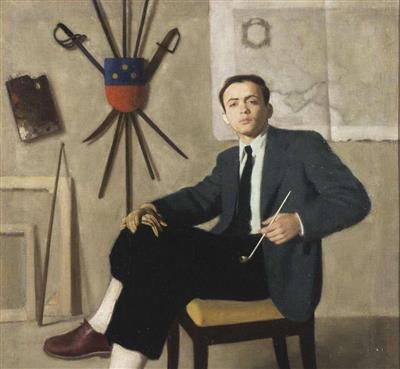
Biography
Born in Madrid in 1918[1], Bueno moved to Italy with his family and studied in Geneva and Florence. He and Xavier exhibited together early, though their styles diverged as they matured. Antonio developed an increasingly provocative figurative style drawing on advertising imagery, fashion, and eroticism.
His paintings of women, rendered with hyperrealistic polish and placed in ambiguous narrative contexts, generated debate about their relationship to feminist and Pop Art concerns. The technique is meticulous: smooth surfaces, controlled colour, and a commercial sheen that deliberately blurs the line between fine art and advertising.
Bueno exhibited across Italy and internationally. His twin brother Xavier, who worked in a more classical figurative style, survived him. Antonio died in Fiesole in 1984[1].
Timeline
- 1918Born in Madrid, Spain.
- 1918Moved to Italy with his family as a child.
- 1984Died in Fiesole, Italy, at 66.
Notable Works
Tap to view larger.
Next stop
Browse the movements →
Every movement in the collection, from the Renaissance to Pop art.
Related Artists



Frequently Asked Questions
What is Antonio Bueno known for?
Antonio Bueno is known for his work combining Magic Realism with Pop Art. He paid obsessive attention to the female figure in his paintings.What should I know about Antonio Bueno's prints?
Antonio Bueno's prints are often produced as limited editions. This means that a set number of prints are made, and each is numbered (e.g., 35/100, where 100 is the total and 35 is the print's individual number). Some artists also create artist's proofs, marked AP. Traditionally, these are signed and numbered in pencil. The edition claim is written as a pair of numbers on the left bottom margin of the print; it consists of a print number and an edition number written as a group with a short separating line between them. The print number is written above or to the left, the edition size is written below or to the right. The title of the print is written in the middle of the bottom margin of the print. The signature (and/or chop mark) is on the right of the bottom margin of the print. Edition descriptions are always signed in pencil. An original print is conceived and executed solely as a print, usually in a numbered edition, and signed by the artist. Each print in the edition is an original, printed from a plate, stone, screen, block or other matrix created for that purpose. There is no one original print from which copies are made; each print is inked and pulled individually. A reproduction is a copy of a work of art conceived by the artist in another medium (painting, watercolour, etc.).What style or movement did Antonio Bueno belong to?
Antonio Bueno is associated with the Figura Solare movement. This is not a clearly defined movement with a programme or manifesto. Instead, it describes the work of certain artists. These artists moved away from the historicist paradigm, recovering a primary aesthetic sense. They focused on "the beautiful", understood as the coordination of shapes and colours, and the splendour of the image, a cornerstone of Mediaeval art. This separates it from modern art, which is based on "style". Figura Solare is not exempt from historicity. It manifests a historical sense in prophetic terms, showing a new path revealed through the beautiful unity of sense. The concept includes only a few artists, but others could be included.What techniques or materials did Antonio Bueno use?
Antonio Bueno was a painter who employed traditional materials. Painters through the ages have used varied materials, such as natural pigments in fresco, egg tempera, watercolour, and oil. Contemporary materials include acrylics, household emulsions, and mixed media. Knowledge of oil-painting techniques affects our understanding of the artwork. Oil can be applied thickly in impasto or thinly in glazes. Brushwork may be fine or thickly applied with a palette knife. Painters use a variety of painting materials, such as natural and chemical pigment in fresco, egg tempera, watercolour and oil. More contemporary materials include acrylics, household emulsions and ‘mixed media’: a range of different materials all in one work. Technical knowledge informs art history. It is necessary to understand the techniques and processes used by artists.What was Antonio Bueno known for?
Antonio Bueno (1918[1]-1984[1]) was an Italian[1] painter of Spanish origin, known for his figurative work. Born in Berlin, he spent his childhood in Spain and then lived in Paris before settling in Italy. His early artistic education took place in Paris. Bueno developed a distinctive style characterised by smooth surfaces and simplified forms. He often depicted portraits, particularly of children and women, with a focus on their faces. These figures are frequently set against neutral backgrounds, giving them a somewhat iconic quality. His paintings often possess a slightly melancholic or dreamlike atmosphere. Although he experimented with abstract art early in his career, he returned to figurative painting. He became associated with a revival of interest in traditional artistic techniques. His work gained popularity for its accessibility and charm, appealing to a broad audience beyond the established art world.When did Antonio Bueno live and work?
Antonio Bueno was born in 1918[1] in Buenos Aires, Argentina. His family relocated to Florence, Italy, in 1926[1]. Bueno's artistic training began at an early age. He started his studies at the Academy of Fine Arts in Florence, where he honed his skills in painting and drawing. His early work showed an interest in portraiture and figurative art, often depicting people with a touch of humour. During the Second World War, Bueno lived in Pisa. After the war, in 1946, he moved back to Florence. There, he co-founded the art group "Modern Art," becoming a central figure in the city's artistic scene. In the 1950s, Bueno's style evolved, incorporating elements of surrealism and pop art. He became known for his distinctive portraits, characterised by their simplified forms, bright colours, and playful compositions. His subjects often included children, women, and historical figures, rendered with a whimsical sensibility. Bueno continued to live and work in Florence until his death in 1984[1], leaving behind a collection of work that is celebrated for its originality and charm.Where can I see Antonio Bueno's work?
While it is difficult to say which galleries and museums currently hold work by Antonio Bueno, many museums with collections of Art Deco and Art Nouveau art are listed here. These include, in Spain, the Museo Art Nouveau y Art Deco (Salamanca) and the Museu d’Art Modern (Barcelona). In Portugal, the Museu Calouste Gulbenkian (Lisbon) may be of interest. In France, you might try the Musée des Arts Décoratifs (Paris), the Musée des Beaux-Arts (Nancy), or the Musée de l’Ecole de Nancy. In Belgium, there is the Brangwyn Museum (Brugge) and the Clockarium Museum (Brussels). In the United Kingdom, collections can be viewed at the Brighton Museum & Art Gallery, the Geffrye Museum (London), the Manchester Art Gallery, the National Museums of Scotland (Edinburgh), and the Victoria & Albert Museum (London). In the United States, you could try the Charles Hosmer Morse Museum of American Art (Winter Park, Florida), the Los Angeles County Museum of Art, the Metropolitan Museum of Art (New York), the Minneapolis Institute of Arts, the Museum of Modern Art (New York), the Virginia Museum of Fine Arts (Richmond), or the Wolfsonian at Florida International University (Miami Beach).Who did Antonio Bueno influence?
It is difficult to say with certainty who Antonio Bueno influenced. Assessing influence is complex; it involves analysing the artistic styles and techniques of subsequent artists to identify similarities or direct references to Bueno's work. It also requires examining historical records, critical reviews, and artists' statements. This can help establish a clear line of influence. Without this information, any claims about Bueno's influence would be speculative. One can say that artists are responsive to the styles of other artists. For example, the way Velázquez started painting in the 1630s was not simply a variation on the examples of Rubens and Titian. His late masterpiece, The Spinners, was largely made to proclaim himself as a worthy successor to the tradition established by Titian and continued by Rubens. Velázquez was an impressionable artist late in his career and must have been just as impressionable as a young man; Velázquez surely did not develop his distinctive naturalism without artistic models.Who influenced Antonio Bueno?
It is difficult to say with certainty who influenced Antonio Bueno, as sources do not directly address this question. However, artistic influence can be understood as a process of imitation, variation, and improvement. Art theory recognises different approaches that pupils use when following a model. These include close copying for technical study; creating a variant to show comprehension of structure and style; and producing a version that surpasses the original. This process assumes competition between the artist and their source. One can look to Spanish artists and movements contemporary to Bueno for possible influences. These include the avant-garde movement in Spain, as well as artists working in abstraction and naturalism. Publications and exhibition catalogues from the period may provide further information about the artistic environment in which Bueno worked.Who was Antonio Bueno?
Antonio Bueno (1918[1]-1984[1]) was a painter born in Berlin, of Spanish parents. He spent his childhood moving around Europe, living in Spain, Switzerland, and Italy. Bueno's artistic career began in the post-Second World War period. He is best known for his figurative work, particularly portraits. These often featured children or young women, rendered with smooth surfaces and simplified forms. His style has been described as both naive and surreal, sometimes recalling the work of the Italian[1] metaphysical painters. Although he was born in Germany and had Spanish heritage, Bueno spent much of his life in Italy, especially Florence. He became associated with the Florentine art scene. His work gained international recognition, and he exhibited widely during his lifetime. Bueno's art is held in numerous public and private collections.Why are Antonio Bueno's works important today?
Antonio Bueno (1918[1]-1984[1]) was an Italian[1] painter of Spanish heritage, known for his figurative work. He is best known for portraits, especially those of children, rendered in a naive style. Bueno's art gained attention for its accessible and appealing aesthetic. His paintings often feature simplified forms, clear lines and a distinctive approach to colour. This made his work popular among a wide audience. While Bueno's style might not align with avant-garde movements, his art provides a connection to mid-20th-century figurative painting. His portraits offer a glimpse into the artistic trends and cultural interests of his time. Interest in his work continues because of its charm and its reflection of a particular era in art history.What was Antonio Bueno's art style?
Antonio Bueno developed a provocative figurative style, drawing on advertising imagery, fashion, and eroticism. His technique involved smooth surfaces, controlled colour, and a commercial sheen.
Sources
Editorial draws on the following primary and tertiary references for Antonio Bueno.
- [1] wikipedia Wikipedia: Antonio Bueno Used for: biography, birth dates, death dates, identifiers, movement attribution, nationality.
- [2] book guggenheim-beforepicassoaft00swee Used for: biography.
- [3] book guggenheim-berriarei00bilb Used for: biography.
- [4] book guggenheim-guhe00solo Used for: biography.
Editorial overseen by Solis Prints. Sources verified 2026-10-15. Click a source for details, or hover over [N] in the page above to preview.
Editorial standardsMethodologyCorrectionsAI disclosureAbout the editorial team