



Bernard Van Orley
- portrait
His contemporaries called Bernard van Orley the Raphael of the North, a compliment he earned without ever setting foot in Italy. Raphael's cartoon designs arrived in Brussels in 1517[3] to be woven into hangings, and Van Orley, who supervised the project, absorbed the Roman Renaissance idiom directly from them. This made Brussels his classroom at a time when most northern painters seeking Italian composition had to travel south.
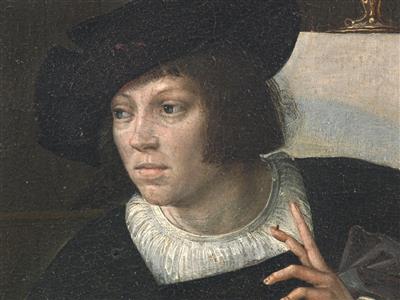
Biography
Born in Brussels around 1488, Van Orley trained under his father Valentin, also a painter. By 1518[3] he held the position of court painter to Margaret of Austria, regent of the Netherlands and the most powerful patron north of the Alps. When Margaret died in 1530 her successor Mary of Hungary retained him in the same role. His portraits of the Habsburg circle are considered his most focused work: the Portrait of Doctor Georges de Zelle (1519, Musees Royaux, Brussels) and the Portrait of Charles V (c.1516, Museum of Fine Arts, Budapest) operate with a quiet Eyckian precision that his altarpieces sometimes sacrifice to decorative ambition.
His most celebrated painting is the Altarpiece of the Ordeals of Job (1521[3], Musees Royaux, Brussels), commissioned by Margaret of Austria as a gift for Antoine de Lalaing. Van Orley inscribed it with his name, the date, and the motto Elx syne tyt Orley (meaning "Everything in its own time"), a claim of authorial identity unusual in Flemish panel painting. The central panel depicts the Destruction of the Children of Job, a subject without precedent in northern art, combining Boschian turbulence with foreshortened figures drawn from Raphael.
Weaving was where his decorative instincts worked most effectively. The Hunts of Maximilian series and the Battle of Pavia cycle (1531[3]), designed for Charles V, are among the finest woven hangings of the period; Raphael's narrative idiom translated more naturally to that horizontal format than to panel painting. Van Orley sat at the transition between the medieval painter-craftsman and the Renaissance artist as intellectual director, inventing compositions and overseeing workshops rather than applying paint himself.
Timeline
- 1487Born in Brussels. His father, Valentin van Orley, was also a painter.
- 1517Supervised the weaving of Raphael's cartoon designs into hangings in Brussels.
- 1518Appointed court painter to Margaret of Austria, regent of the Netherlands.
- 1519Painted "Portrait of Doctor Georges de Zelle".
- 1521Painted "Altarpiece of the Ordeals of Job", commissioned by Margaret of Austria.
- 1530Retained as court painter by Mary of Hungary after Margaret of Austria's death.
- 1531Designed the Battle of Pavia cycle for Charles V.
- 1541Died at the age of 54.
Notable Works
Tap to view larger.
Next stop
Browse the movements →
Every movement in the collection, from the Renaissance to Pop art.
Related Artists
Frequently Asked Questions
What is Bernard Van Orley known for?
Bernard van Orley is known for his portraits of the Habsburg circle, which are considered his most focused work. He is also known for designing woven hangings, such as the Hunts of Maximilian series and the Battle of Pavia cycle, which are considered among the finest of the period.Who was Bernard Van Orley?
Bernard van Orley was a painter from Brussels who was active during the Northern Renaissance. His contemporaries called him the Raphael of the North, which he earned without travelling to Italy; he absorbed the Roman Renaissance style from Raphael's cartoon designs when they arrived in Brussels to be woven into hangings.What was Bernard Van Orley's art style?
Bernard van Orley's portraits operated with a quiet Eyckian precision, though his altarpieces sometimes sacrificed this for decorative ambition. His most celebrated painting, the Altarpiece of the Ordeals of Job, combines Boschian turbulence with foreshortened figures drawn from Raphael. One portrait[3] of Charles V is stated in terms of late 15th-century portrayals, with an added tendency toward flatness of form.How did Bernard Van Orley die?
Bernard Van Orley died in 1541[3] at the age of 54.
Sources
Editorial draws on the following primary and tertiary references for Bernard Van Orley.
- [1] museum Vlaamse Kunstcollectie Used for: museum holdings.
- [2] academic Encyclopaedia Britannica Editors, Bernard van Orley | Flemish Renaissance, Tapestries, Altarpieces Used for: biography.
- [3] wikipedia Wikipedia: Bernard Van Orley Used for: biography, birth dates, death dates, identifiers, movement attribution, nationality.
- [4] book guggenheim-claesold00olde Used for: stylistic analysis.
- [5] book guggenheim-roylich00wald Used for: stylistic analysis.
- [6] book Cuttler, Charles D, Northern painting from Pucelle to Bruegel: fourteenth, fifteenth, and sixteenth centuries Used for: biography.
- [7] book Charles D. Cuttler, Northern Painting From Pucelle to Bruegel Fourteenth, Fifteenth, and Sixteenth Centuries Used for: biography.
- [8] book Snyder, James, 1928-1990, Northern Renaissance art : painting, sculpture, the graphic arts from 1350 to 1575 Used for: biography.
- [9] book Russian art of the avant-garde : theory and criticism, 1902-1934, with 105 illustrations Used for: stylistic analysis.
- [10] museum Bernard van Orley - The Martyrdom of Saint John the Baptist Used for: museum holdings.
- [11] museum Bernard van Orley - Virgin and Child with Angels Used for: museum holdings.
- [12] museum Designed by Bernard van Orley - The Last Supper Used for: notable works.
Editorial overseen by Solis Prints. Sources verified 2026-09-19. Click a source for details, or hover over [N] in the page above to preview.
Editorial standardsMethodologyCorrectionsAI disclosureAbout the editorial team