



About Eleanor Fortescue-Brickdale
British · 1872–1945
British[1] Pre-Raphaelite painter and illustrator known for Arthurian watercolours and her long tenure at the Byam Shaw School of Art.
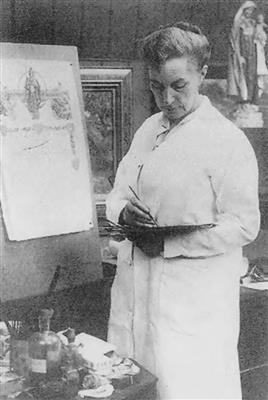
Museums5
Countries2
Most worksBirmingham Museum and Art Gallery, Birmingham · 2 works
Loading map…
Where to see Eleanor Fortescue-Brickdale
Ranked by works you can see in person.
-
2 works
Birmingham Museum and Art Gallery
Birmingham, United Kingdom
-
1 works
Walker Art Gallery
Liverpool, United Kingdom


-
1 works
Lady Lever Art Gallery
Port Sunlight, United Kingdom
-
1 works
Musée d'Orsay
Paris, France
-
1 works
National Trust
Swindon, United Kingdom


Frequently Asked Questions
Where can I see Eleanor Fortescue-Brickdale's work?
Eleanor Fortescue-Brickdale's work can be viewed at several museums. Within the United Kingdom, these include the Brighton Museum & Art Gallery (located in the Royal Pavilion Gardens), the Geffrye Museum (Kingsland Road, London), the Manchester Art Gallery (Mosley Street), the National Museums of Scotland (Royal Museum, Chambers Street, Edinburgh), and the Victoria & Albert Museum (Cromwell Road, London). In the United States, her art may be seen at the Charles Hosmer Morse Museum of American Art (Winter Park, Florida), the Los Angeles County Museum of Art (LACMA), the Metropolitan Museum of Art (New York), the Minneapolis Institute of Arts, the Museum of Modern Art (New York), and the Virginia Museum of Fine Arts (Richmond). Her work is also available at the Royal Ontario Museum in Toronto, Canada.What should I know about Eleanor Fortescue-Brickdale's prints?
Eleanor Fortescue-Brickdale was not among the central figures of the Pre-Raphaelite movement; however, she was an associate. Prints connected to the Pre-Raphaelites fall into a few categories. These include etchings done by the artist, reproductive engravings (or etchings) made by professional engravers, and wood-engraved book illustrations. These were drawn by the artist on the block (or on paper, then transferred), before being engraved by professional wood engravers. Wood engraving involved a skilled draughtsman who prepared a smooth wood block; they would draw on it in pencil or ink. Some artists made preliminary chalk sketches, then transferred the design to wood, reworking the surfaces with ink. Engravers worked in reverse; black lines were left standing, and white areas cut away. The original drawings were thus destroyed by the cutting. Once the block was cut, it was printed carefully. Collectors should seek early proof images, as they are the clearest and most accurate.Why are Eleanor Fortescue-Brickdale's works important today?
Eleanor Fortescue-Brickdale's work is relevant because of a renewed interest in women artists of the late 19th and early 20th centuries. Often side-lined in favour of their male counterparts, these women are now being recognised for their contributions to art movements, such as the Arts and Crafts. The Women's Guild of Arts, established in 1907[1], became a prestigious organisation after women were denied entry to the Art Workers' Guild due to their sex. Many women involved in the Arts and Crafts movement sought to break down hierarchical notions of individual exceptionality, and instead channelled energies into collaborations. Fortescue-Brickdale's paintings often depict scenes from literature, mythology, and early English history. These subjects were popular at the time, and her style connects to a sentimentality for a pre-industrial world. While her artworks may not be overtly political, they offer a window into the artistic and cultural values of her era. The battles fought by women artists to democratise the arts, balance married life and work, and fight for a living wage continue to be major topics of discussion today.What techniques or materials did Eleanor Fortescue-Brickdale use?
Eleanor Fortescue-Brickdale was a painter and illustrator working in the late nineteenth and early twentieth centuries. She is associated with the later Pre-Raphaelite movement. Fortescue-Brickdale favoured watercolour, often on prepared paper or vellum. Her training at the Crystal Palace School of Art provided her with a solid foundation in draughtsmanship, which is evident in her precise linework and attention to detail. She also worked in oil paint, although less frequently. Her method involved layering translucent washes of colour to create luminosity and depth. This approach is similar to that of earlier Pre-Raphaelite painters, such as John Everett Millais and William Holman Hunt, who also experimented with watercolour techniques to achieve jewel-like effects. Fortescue-Brickdale's illustrations often incorporated gold leaf and other decorative elements, further connecting her work to the aesthetic of the Arts and Crafts movement. She exhibited at the Royal Academy and the Dowdeswell Gallery.Who did Eleanor Fortescue-Brickdale influence?
Eleanor Fortescue-Brickdale's artistic impact is subtle; she did not have direct students or a school of followers. However, she participated in the late flowering of Pre-Raphaelitism, and her work shares stylistic features with illustrators such as Arthur Hughes, Laurence Housman, and Charles Ricketts. These artists took Pre-Raphaelite illustration into new areas of invention. Housman found particular inspiration in Hughes's illustrations for George MacDonald's *At the Back of the North Wind* (1871), noting how Hughes captured a child's perspective through exaggerating scale and light. Hughes's work also delighted Christina Rossetti, who chose him to illustrate her book of poems *Sing Song: A Nursery Rhyme Book* (1872[1]). His 120 'cuts' for the book were carefully drawn in pencil, then in pen and ink, for the engraver to follow. Rossetti declared them a success, stating, 'There is no man living who would have done my sister’s book so divinely well.'Who influenced Eleanor Fortescue-Brickdale?
Eleanor Fortescue-Brickdale's artistic development occurred during a period when the Pre-Raphaelite Brotherhood's ideas were circulating widely. The Pre-Raphaelites, including Millais, Holman Hunt, and Rossetti, looked to prints for inspiration and instruction. Hunt copied prints as a child and studied them at the British[1] Museum. Millais based his earliest works on prints and was known for his ability to visualise scenes in detail before painting them. Burne-Jones, though not a prolific illustrator, also initially emulated the Pre-Raphaelites. Rossetti greatly influenced him. Early on, Burne-Jones borrowed from illustrators such as Cruikshank, ‘Dickie’ Doyle, John Leech, Edward Corbould, and even Turner. He later adopted the Pre-Raphaelite idea of illustrations as independent works of art. The Pre-Raphaelites sought a new perfection in art, rejecting what they saw as inane prettiness and a lack of vigour in contemporary art. They aimed for an undying appeal to the hearts of living men. Their emphasis on naturalism and detailed observation encouraged artists to move away from conventional academic styles.What is Eleanor Fortescue-Brickdale's most famous work?
Eleanor Fortescue-Brickdale was a painter and illustrator associated with the later Pre-Raphaelite movement. Although she produced a large body of work in varied media, she is perhaps best known for her oil painting *The Forerunner*, completed in 1920[1]. Fortescue-Brickdale studied at the Crystal Palace School of Art, and later at the Royal Academy Schools. She exhibited regularly at the Royal Academy, as well as with the Society of Watercolour Painters. Her style often featured historical or literary themes, with a strong emphasis on narrative and character. Among her influences were the works of Alfred Tennyson and William Shakespeare; many of her paintings depict scenes or characters from their poems and plays. She also worked as a book illustrator, providing images for editions of Tennyson's poems and other publications.What style or movement did Eleanor Fortescue-Brickdale belong to?
Eleanor Fortescue-Brickdale (1872[1]-1945[1]) is usually associated with the second wave of Pre-Raphaelite painters. This group included Frederic Leighton, John William Waterhouse, Marie Spartali Stillman, Simeon Solomon, and Evelyn De Morgan. They commonly depicted Arthurian and medieval themes, often featuring idealised female figures and a theme of elevated, spiritual love. These later Pre-Raphaelites followed the example of William Morris and Edward Burne-Jones. They had discovered the earlier generation through John Ruskin's writings. The Pre-Raphaelites initially faced criticism for rejecting conventional painting techniques. Instead of strong contrasts and a dominant light source, they favoured even lighting and rich colours. They also paid close attention to detail, incorporating symbolic objects related to biblical themes, Victorian literature, or Romantic poetry. They aimed to emulate the detailed description and luminous colours of pre-Raphael art, using thin layers of oil paint on a wet white ground to achieve this luminosity.
Sources
Where to See guide aggregates verified holdings of Eleanor Fortescue-Brickdale's works across the following collections.
- [1] wikipedia Wikipedia: Eleanor Fortescue-Brickdale Used for: biography.
- [2] book Howard Simon, 500 Years of Illustration Used for: biography, stylistic analysis.
- [3] book Beard, Lee, 1973- author, Butler, Adam, author; Van Cleave, Claire, author; Fortenberry, Diane, author; Stirling, Susan, author, Beard, Lee, 1973- author, Butler, Adam, author; Van Cleave, Claire, author; Fortenberry, Diane, author; Stirling, Susan, author - The Art Book_ New Edition, Mini Format Used for: biography.
- [4] book Getty, Getty - Julia Margaret Cameron Complete Photographs Used for: biography, stylistic analysis.
- [5] book Masterpieces of western art : a history of art in 900 individual studies from the Gothic to the present day Used for: biography.
- [6] book Engen, Rodney K, Pre-Raphaelite prints : the graphic art of Millais, Holman Hunt, Rossetti and their followers Used for: biography, stylistic analysis.
Editorial overseen by Solis Prints. Sources verified 2026-08-29. Click a source for details, or hover over [N] in the page above to preview.
Editorial standardsMethodologyCorrectionsAI disclosureAbout the editorial team