



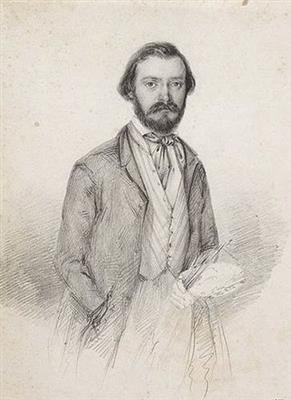
About Domenico Induno
Kingdom of Lombardy–Venetia · 1815–1878
Milanese painter and Risorgimento patriot whose genre scenes and historical canvases documented the human cost of Italian unification.
Museums4
Countries2
Largest reported holdingGallerie d'Italia – Milano, Milan · 11 recorded works
Loading map…
Where to see Domenico Induno
Collection holdings are reported here; current display varies. Check with each museum before visiting.
-
 11 recorded works
Gallerie d'Italia – Milano
Milan, Italy
-
 2 recorded works
Galleria d'arte moderna di Milano
Milan, Italy
-
1 recorded work
National Museum of Fine Arts, Argentina
Buenos Aires, Argentina
Also here (6)
-
1 recorded work
Pinacoteca di Brera
Milan, Italy


Frequently Asked Questions
Where can I see Domenico Induno's work?
Domenico Induno's works can be viewed in several museum collections. In Italy, these include the Biblioteca Ambrosiana in Milan, Museo Archeologico, and Museo Correr e Quadreria Correr in Venice. Other Italian museums that hold his pieces are the Museo della Cattedrale in Monopoli, Museo Regionale in Messina, and Pinacoteca Provinciale in Bari. His art is also held at the Tesoro della Cattedrale di San Andrea a Veroli. Outside of Italy, Induno's work is on display at the Israel Museum in Jerusalem and the Museum of the Studium Biblicum Franciscanum, also in Jerusalem. Additional locations include the Archivio della Badia, Monastery of Monte Cassino, Biblioteca Nazionale Marciana in Venice, and Congregazione Armena Mechitarista, also in Venice. These institutions provide opportunities to appreciate Induno's artistic contributions.What should I know about Domenico Induno's prints?
When considering Domenico Induno's prints, it's useful to understand some basic terminology. A 'vintage print' is one made around the same time as the negative. A 'period print' is made within 10 to 15 years of the shot. Anything printed later is simply an 'old print', as opposed to a 'modern print' created recently from the original negative. An 'original print' is made by the artist or under their supervision. A 'facsimile' is a reproduction that attempts to match the original print's materials and processing as closely as possible. The market considers a print 'original' if the artist conceived it as a print and executed it solely as a print, usually in a numbered and signed edition. Each print is individually inked and pulled, making it a 'multi-original'. A reproduction, on the other hand, is a copy of a work initially created in another medium, such as painting or watercolour, and reproduced via photomechanical means. The intent behind the print determines its status; an original print aims to be a unique artistic statement, while a reproduction seeks to replicate an existing image.Why are Domenico Induno's works important today?
Domenico Induno (1815[3]-1878[3]) was an Italian painter and patriot. He is remembered for his genre scenes and historical subjects, often depicting episodes from the Risorgimento, the 19th-century unification of Italy. Induno's importance lies in his contribution to Italian art during a period of significant political and social change. His paintings offer insights into the daily lives of ordinary people, as well as the patriotic fervour that swept through Italy during the Risorgimento. Works such as "Triste presentimento" (1859[3]) capture the emotional atmosphere of the time. He participated in the artistic debates of his era, aligning himself with the Realist movement. Realism sought to portray subjects with accuracy and objectivity. This approach is evident in Induno's attention to detail and his focus on contemporary life. Induno's art provides valuable documentation of Italian society in the 19th century. His paintings are appreciated for their historical and cultural value, offering a glimpse into a formative period in Italian history. They are held in major Italian collections, including the Galleria d'Arte Moderna in Milan.What techniques or materials did Domenico Induno use?
Domenico Induno (1815[3]-1878[3]) was an Italian painter and patriot. He is known for genre scenes and historical subjects, often depicting everyday life. Induno's early training was at the Accademia di Brera in Milan. He initially worked in the Romantic style, but later developed a more realistic approach. His brother, Gerolamo Induno, was also a painter, and the two shared some stylistic similarities. He favoured oil paint on canvas, using careful detail to create realistic depictions. Some sources mention his use of watercolour, although oil paintings are more common in museum collections. He often depicted scenes of Italian life, with attention to costumes and settings. His paintings often feature small figures and anecdotal details. Induno's technique involved careful observation and accurate representation. His paintings are characterised by their naturalism and attention to detail. He aimed to capture the realities of Italian society in his art.Who did Domenico Induno influence?
Domenico Induno's artistic influence is not well documented. Domenico Tintoretto, son of Jacopo Tintoretto, perpetuated his father's style into the seventeenth century. Pallucchini has studied Domenico Tintoretto's influence on later Venetian painters. Domenico Tintoretto's style, particularly his use of lighting, showed greater realism than his father's. This realism, with a sharp focus on detail, has been compared to Annibale Carracci. Domenico Tintoretto's work established a tone for portraiture in Venice for many years, emphasising physical properties of sitters and their costumes. Giovanni Bellini's late style inspired a generation of Venetian painters, including students who moved away from his idiom but worked within the boundaries Bellini's art marked. Bellini's concepts about the figure, pictorial composition, portraiture, and nature influenced Venetian artists throughout the sixteenth century.Who influenced Domenico Induno?
Domenico Induno's artistic development involved several influences. He was part of the Accademia Ambrosiana in Milan, where he encountered Giulio Cesare Procaccini. Procaccini's style is evident in Induno's earlier work, for example, *Miracle of St Martha* (1636). Later, Induno showed an interest in Anthony van Dyck and Guido Reni. Because of the Reni-esque elements in his art, he became known in Milan as the Guido Lombardo (Lombard Guido). Some art historians have suggested Bartolomé Esteban Murillo also influenced Induno, though there is no firm evidence they came into contact. Van Dyck's impact is visible in two portraits by Nuvolone from the late 1640s: *Portrait of a Gentleman in Armour* and *Portrait of a Lady*. These works feature full-length figures, elegantly dressed, set off by a raised curtain, similar to portraits Van Dyck made during his time in Genoa. The classicism of the Bolognese School, especially Reni, appears in Nuvolone’s *Joseph and the Wife of Potiphar* (circa 1640). The figures are refined, with porcelain-like complexions, and their gestures are mannered.What is Domenico Induno's most famous work?
Domenico Induno (1815[3]-1878[3]) was an Italian painter and patriot. He is best known for genre scenes and historical subjects, often depicting episodes from the Risorgimento, the 19th-century movement for Italian unification. It is difficult to identify one single "most famous" work, as popularity and recognition can shift over time and vary by audience. However, several of his paintings are particularly well regarded. *The Mower's Meal* (Il pasto del falciatore) is a notable example of his genre scenes. It presents an intimate view of peasant life. Another popular work is *The Evicted* (Gli sfrattati), which portrays the plight of a family being forced from their home. This painting is admired for its social commentary and emotional impact. Induno's paintings often combined realistic details with sentimental narratives, a style that appealed to a broad public during his lifetime. His art provides insights into the social and political climate of 19th-century Italy.What style or movement did Domenico Induno belong to?
Domenico Induno (1815[3]-1878[3]) was an Italian painter associated with the Romantic movement, but his work also anticipates aspects of Realism. He is best known for genre scenes depicting everyday life, often with sentimental or anecdotal elements. Induno's early training was at the Brera Academy in Milan, where he was influenced by the academic tradition. However, he moved away from grand historical subjects, preferring to paint scenes of ordinary people, particularly those from the lower classes. His paintings often possess a narrative quality, inviting viewers to imagine the stories behind the depicted moments. While Induno's focus on contemporary life aligns him with Realist painters, his work retains a sense of idealisation and emotional engagement characteristic of Romanticism. He did not engage in the social critique that became a hallmark of later Realist art. His style is marked by careful attention to detail, a delicate touch, and a sensitivity to the nuances of human emotion.
Sources
Where to See guide aggregates verified holdings of Domenico Induno's works across the following collections.
- [1] museum Gallerie d'Italia – Milano Used for: museum holdings.
- [2] museum Galleria d'arte moderna di Milano Used for: museum holdings.
- [3] wikipedia Wikipedia: Domenico Induno Used for: biography.
- [4] book Lilian H. Zirpolo, Historical Dictionary of Baroque Art and Architecture Used for: biography, stylistic analysis.
- [5] book Braun, Emily, 1957-; Asor Rosa, Alberto; Royal Academy of Arts (Great Britain), Italian art in the 20th century : painting and sculpture, 1900-1988 Used for: biography, stylistic analysis.
- [6] book Museum of Fine Arts, Houston, Italian paintings XIV-XVI centuries in the Museum of Fine Arts, Houston Used for: biography.
- [7] book Masterpieces of western art : a history of art in 900 individual studies from the Gothic to the present day Used for: biography, stylistic analysis.
- [8] book Feltman, Jennifer M.; Thompson, Sarah; , The Long Lives of Medieval Art and Architecture Used for: biography.
Editorial overseen by Solis Prints. Sources verified 2026-09-30. Click a source for details, or hover over [N] in the page above to preview.
Editorial standardsMethodologyCorrectionsAI disclosureAbout the editorial team