



About Cornelis Cort
Dutch · 1533–1578
- landscape painting
Sixteenth-century Dutch[1] engraver who lived in Titian's household and brought Italian Renaissance masterpieces to northern print collectors.
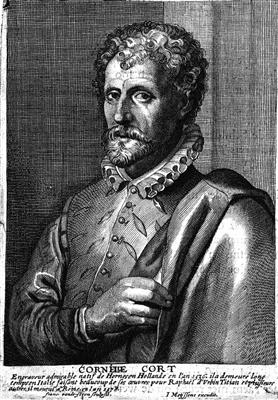
Museums4
Countries3
Most worksMuseum Boijmans Van Beuningen, Rotterdam · 45 works
Loading map…
Where to see Cornelis Cort
Ranked by works you can see in person.
-
45 works
Museum Boijmans Van Beuningen
Rotterdam, Netherlands
-
18 works
National Gallery of Art
Washington D.C., United States


-
1 works
Groeningemuseum
Bruges, Belgium
-
1 works
Museum of Fine Arts Ghent (MSK)
Ghent, Belgium


Own a piece of it
Cornelis Cort prints
Hand-finished archival prints from Cornelis Cort's body of work.
 Holy Family with the Cat - Cornelis Cort
From £28.00
Holy Family with the Cat - Cornelis Cort
From £28.00
 Coronation of the Virgin - Cornelis Cort
From £28.00
Coronation of the Virgin - Cornelis Cort
From £28.00
 Lamentation - Cornelis Cort
From £28.00
Lamentation - Cornelis Cort
From £28.00
 Saint Peter Receiving the Keys - Cornelis Cort
From £28.00
Saint Peter Receiving the Keys - Cornelis Cort
From £28.00
 Rogero Liberating Angelica from the Dragon - Cornelis Cort
From £28.00
Rogero Liberating Angelica from the Dragon - Cornelis Cort
From £28.00
 Saint Mary Magdalen - Cornelis Cort
From £28.00
Saint Mary Magdalen - Cornelis Cort
From £28.00
 Dispute of the Sacrament - Cornelis Cort
From £28.00
Dispute of the Sacrament - Cornelis Cort
From £28.00
 Diana and Callisto - Cornelis Cort
From £28.00
Diana and Callisto - Cornelis Cort
From £28.00
Can't travel? Bring Cornelis Cort home.
See all Cornelis Cort prints →Frequently Asked Questions
Where can I see Cornelis Cort's work?
Cornelis Cort (1533[1]-1578[1]) was a Dutch[1] printmaker and draughtsman. Although not a painter, his engravings after works by artists such as Titian and Raphael were widely distributed. As prints are relatively portable, Cort's works can be found in numerous collections. The British Museum holds a substantial collection of prints by Cornelis Cort. These include biblical scenes, such as his 1567[1] engraving of the 'Annunciation', after Taddeo Zuccaro. The museum also possesses Cort's series of the 'Seven Planets' after designs by Dirck Barendsz, dating from 1566. Other significant collections include the Rijksmuseum in Amsterdam, which has a wide selection of Cort's engravings. The Metropolitan Museum of Art in New York also has a number of his prints, including portraits and religious subjects. The Los Angeles County Museum of Art (LACMA) holds impressions of Cort's prints after Titian, such as 'The Martyrdom of Saint Lawrence'. These various collections provide opportunities to study Cort's skill as an engraver and the dissemination of Italian Renaissance art through prints.What should I know about Cornelis Cort's prints?
Cornelis Cort was a Dutch[1] engraver and printmaker active in the 16th century. He is known for his skill in engraving and for reproducing works by other artists, making their compositions more widely accessible. In 1560[1], Cort created a series of engravings, published by Hieronymus Cock, that included "Patience", "Memory", "Temperance", "Chastity", "Concord", "Perseverance", "Intelligence", and "Magnanimity". A preparatory drawing for "Memory" is attributed to a workshop and is now held in Berlin, Kupferstichkabinett. A preparatory drawing for "Magnanimity" is also attributed to a workshop and is now in a private collection in Italy. Other notable prints by Cort include "Hercules and the Pygmies" from 1562, also published by Hieronymus Cock; it is based on an ekphrasis of Philostratus. In 1564, he created "The Immortal Rewards of Virtue". In 1565, Cort engraved "The Story of Pluto and Proserpina", published by Gerard de Jode, and "The Liberal Arts".Why are Cornelis Cort's works important today?
Cornelis Cort (1533[1]-1578[1]) was a Dutch[1] printmaker and draughtsman. He is important because of his skill as an engraver and for the distribution of his prints throughout Europe. Cort's engravings after works by artists like Raphael, Titian, and Federico Barocci helped circulate their designs. Born in Hoorn, Netherlands, Cort likely trained with Dirck Volckertsz. Coornhert in Haarlem. By 1565[1], he was in Venice, where he worked with Titian. He produced prints after Titian's paintings, increasing their accessibility. These engravings are not mere copies; they are interpretations that demonstrate Cort's technical ability. In the late 1560s, Cort moved to Rome. There, he collaborated with artists such as Federico Zuccari and Barocci. His Roman period saw the production of religious and mythological subjects. These engravings were widely distributed and influenced other printmakers. Cort's style is characterised by a clear, controlled burin technique and an ability to translate the textures and tones of paintings into the graphic medium of engraving. His prints offer valuable insight into the art of the period and the dissemination of artistic ideas.What techniques or materials did Cornelis Cort use?
Cornelis Cort (born in Hoorn, Holland, in 1533[1]; died in Rome in 1578[1]) was a Dutch[1] printmaker and draughtsman. He is known for his reproductive engravings, translating the works of other artists into print form. Cort primarily worked with copper plates, using burins to create lines and tonal variations. His technique involved a combination of precise, controlled lines and more expressive, 자유로운 strokes to capture the textures and forms of the original paintings. He was skilled at rendering tonal contrasts, using hatching and cross-hatching to create shadows and highlights. Cort's prints often display a clarity and detail that made his work highly sought after. Cort's engravings after Titian were particularly celebrated and helped to disseminate the Venetian master's compositions throughout Europe. His prints were not mere copies; they were interpretations that showcased his technical skill and artistic sensibility. Cort's influence extended to subsequent generations of printmakers, who emulated his style and techniques.Who did Cornelis Cort influence?
Cornelis Cort, a Dutch[1] printmaker, had considerable influence on the development of engraving. His technical skill and distribution of his prints across Europe meant many artists encountered his style. Hendrik Goltzius is one artist who felt Cort's impact. Goltzius, also a Dutch engraver, initially imitated Cort's style before developing his own manner. Italian artists were also affected. Cort worked in Italy for about twelve years, and his style was absorbed by local printmakers. Agostino Carracci, a member of the Carracci family of artists, is considered to have been influenced by Cort's technique. Carracci's engravings share similarities with Cort's approach to line and form. Cort's impact extended beyond individual artists. His prints helped disseminate artistic ideas and styles throughout Europe. His work contributed to the growth of printmaking as a means of artistic expression and communication.Who influenced Cornelis Cort?
Cornelis Cort, a Dutch[1] printmaker and draughtsman, was born in Hoorn, around 1533[1]. He died in Rome in 1578[1]. Cort's early style was influenced by the work of Hieronymus Bosch and the Mannerist painter Frans Floris. His technique developed through his association with leading Italian artists. He arrived in Venice and worked with Titian, producing engravings of Titian's paintings. These prints helped to disseminate Titian's compositions throughout Europe. Cort's engravings after Titian include "The Penitent Magdalene", "Tarquin and Lucretia", and "The Death of Actaeon". Later, Cort moved to Rome, where he collaborated with Federico Barocci and the brothers Taddeo and Federico Zuccari. He engraved works by these artists, further refining his style and contributing to the spread of their artistic ideas. His time in Italy was formative, exposing him to the Italian Renaissance style and allowing him to work alongside some of its most important figures.What style or movement did Cornelis Cort belong to?
Cornelis Cort (1533[1]-1578[1]) was a Dutch[1] engraver and printmaker. He worked during the late Renaissance, a period that saw a renewed interest in classical art and learning. Cort's style is often associated with Northern Mannerism, which was popular in the Netherlands and other parts of Northern Europe during the 16th century. Mannerism was characterised by its emphasis on elegance, stylisation, and technical skill. It often featured elongated figures, exaggerated poses, and complex compositions. Cort's engravings after works by artists such as Raphael, Titian, and Federico Barocci helped to disseminate the Italian Renaissance style throughout Europe. He also produced original prints of religious and mythological subjects. Although he was influenced by Italian art, Cort's work retained a distinct Northern European character, reflecting the artistic traditions of his homeland.What was Cornelis Cort known for?
Cornelis Cort, who was active from about 1685 to 1723, specialised in still life painting. He is known for work that possesses a refined simplicity. Cort lived and worked in Middelburg and Zierikzee. Other Dutch[1] artists of the era include Aelbert Cuyp (1620-1691[1]), who was born and worked in Dordrecht. Cuyp's father was Jacob Gerritsz. Cuyp, with whom he studied. Aelbert Cuyp’s output shows a breadth of vision and conception. Carel Fabritius (1622-1654) was a pupil of Rembrandt in Amsterdam in the early 1640s. He died in Delft as a result of a powder explosion. Govert Flinck (1615-1660) also studied with Rembrandt in Amsterdam. He painted historical compositions and portraits. Aert de Gelder (1645-1727) was another Rembrandt pupil, studying with him for six years. Jan van Goyen (1596-1656) spent his working life in Leyden and The Hague. He studied with Esaias van de Velde, and travelled in the Netherlands and abroad. Frans Hals (1580/81-1666) moved from Flanders to Haarlem, where he studied with Karel van Mander. He created single and group portraits.
Sources
Where to See guide aggregates verified holdings of Cornelis Cort's works across the following collections.
- [1] wikipedia Wikipedia: Cornelis Cort Used for: biography.
- [2] book J. Bruyn, B. Haak, S. H. Levie, P. J. J. van Thiel, E. van de Wetering (auth.), A Corpus of Rembrandt Paintings _ Volume II_ 1631–1634 Used for: stylistic analysis.
- [3] book Lilian H. Zirpolo, Historical Dictionary of Baroque Art and Architecture Used for: biography.
- [4] book Masterpieces of western art : a history of art in 900 individual studies from the Gothic to the present day Used for: biography.
- [5] book Cuttler, Charles D, Northern painting from Pucelle to Bruegel: fourteenth, fifteenth, and sixteenth centuries Used for: biography.
- [6] book John Michael Montias, Vermeer and His Milieu _ A Web of Social History Used for: biography.
- [7] book John Michael Montias, Vermeer and His Milieu _ A Web of Social History Used for: biography, stylistic analysis.
- [8] book John Michael Montias, Vermeer and His Milieu _ A Web of Social History Used for: biography, stylistic analysis.
Editorial overseen by Solis Prints. Sources verified 2026-08-29. Click a source for details, or hover over [N] in the page above to preview.
Editorial standardsMethodologyCorrectionsAI disclosureAbout the editorial team