



About Charles Wilbert White
- Harlem Renaissance
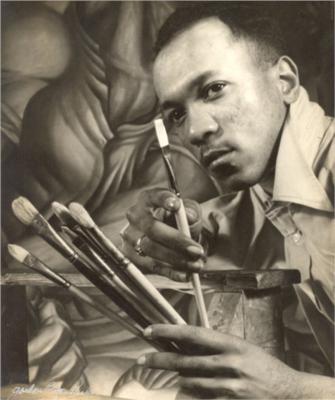
Chicago-born African American[1] artist whose WPA murals and prints made him a defining figure in the visual representation of Black history in twentieth-century America.
Where to see Charles Wilbert White
Collection holdings are reported here; current display varies. Check with each museum before visiting.
-
9 recorded works
Metropolitan Museum of Art
New York City, United States
-
2 recorded works
National Gallery of Art
Washington D.C., United States


-
1 recorded work
Groeningemuseum
Bruges, Belgium
-
1 recorded work
The Nelson-Atkins Museum of Art
Kansas City, United States
-
1 recorded work
Art Institute of Chicago
Chicago, United States
-
1 recorded work
Los Angeles County Museum of Art
Los Angeles, United States
-
1 recorded work
Saint Louis Art Museum
St. Louis, United States


Frequently Asked Questions
What should I know about Charles Wilbert White's prints?
Charles Wilbert White was an American[1] artist known for his prints, often created as limited editions. These are original images conceived as prints and executed solely as prints. Each one is individually inked and pulled, making it a multi-original medium. The artist decides the number of prints in the edition. Prints are usually numbered to provide an accounting for the number in the edition; for example, 12/25 indicates that it is print number 12 of an edition of 25. The numbering of prints is a relatively recent convention. Early prints were not always numbered or signed; in some cases, the artist signed the plate or stone itself, rather than each individual print. The value of a print depends on factors such as the artist's reputation, the image's popularity, the paper quality, the ink, and the printing process. Some publishers limit the number of impressions to increase a print's value. The edition claim is typically written as a pair of numbers on the bottom left margin of the print, the title in the middle, and the signature on the right. These descriptions are always signed in pencil.Why are Charles Wilbert White's works important today?
Charles Wilbert White (1918[1]-1979[1]) is important because of his powerful depictions of African Americans. His art provides a counterpoint to stereotypical representations. White aimed to portray the dignity and humanity of his subjects, often ordinary people, during the mid-20th century. White's style combines realism with social commentary. His drawings, prints, and paintings often addressed themes of racial injustice, oppression, and the struggles of working-class communities. The figures in his artworks are rendered with sensitivity, showing their strength and resilience. His work gained prominence during the Civil Rights Movement. It offered a visual narrative that resonated with the era's calls for equality and social change. White's art continues to be relevant. It prompts conversations about race, identity, and the ongoing pursuit of social justice. His images serve as historical records and as sources of inspiration for contemporary artists and activists.What techniques or materials did Charles Wilbert White use?
Charles Wilbert White was best known for his drawings, lithographs, and murals that depicted African Americans. White often worked in black and white, using a combination of charcoal, ink, and wash techniques on paper. He was known to build up tone and texture through layering and blending. This created a sense of depth and volume in his figures. He also produced oil paintings, often on canvas or board. His painting technique involved careful underpainting, followed by layers of glazing to achieve luminosity and subtle colour variations. White sometimes incorporated egg tempera into his oil paint, which gave the surface a distinctive matte finish. In his murals, White employed fresco techniques, applying pigments to wet plaster. This required careful planning and execution, as the colours would become permanent as the plaster dried.Who did Charles Wilbert White influence?
It is difficult to identify specific individuals who were directly influenced by Charles Wilbert White. However, one can examine the influence of similar figures and movements. Arthur H. Mackmurdo, for instance, was inspired by John Ruskin and William Morris. Mackmurdo's theories, like those in *The Germ*, concerned ethics in art and the artist's social responsibility. *The Germ* then paved the way for periodicals such as *The Yellow Book* and *The Savoy*. In California, artists such as Donna Schuster were inspired to paint in a bolder manner, to focus on distorted forms, and to use more intense colours. Modernism in Southern California was limited to a small circle that included Mabel Alvarez and Edouard Vysekal. Henrietta Shore, recalling the work of Robert Henri, produced semi-abstract still lifes. Shore and Georgia O’Keeffe exhibited together in New York in 1923[1].Who influenced Charles Wilbert White?
Charles Wilbert White's artistic development occurred in stages. His mother introduced him and his brother to nude life drawing classes in 1963[1]; he was thirteen. She wanted her children to appreciate the beauty of the human figure. This early education instilled in him a reverence for the human form, which inspired him to become a professional artist. In the late 1960s and early 1970s, White focused on drawing and painting birds and animals, largely ignoring other subjects. His brother, Robert, challenged him, asserting that no great artist is worth their salt unless they could draw the human figure. This prompted White to attend another life drawing class in the mid-1970s, after which he never looked back, dedicating himself to mastering figure drawing.What is Charles Wilbert White's most famous work?
Charles Wilbert White is well known for his socially conscious art, particularly his depictions of African Americans. While he produced many significant works throughout his career, 1953[1]'s *Awakening* is often cited as his most famous. White worked in a style of social realism; *Awakening* shows a Black woman emerging from shadowy figures. The figure symbolises the potential of Black people during the Civil Rights Movement. The work is a charcoal drawing, a medium White favoured for its expressive possibilities and accessibility. He often used black and white to create striking contrasts and emphasise the dignity of his subjects. White aimed to use his art as a tool for social change, promoting equality and justice.What style or movement did Charles Wilbert White belong to?
Charles Wilbert White's artistic practice is linked to social realism and the Black Arts Movement. These affiliations reflect his focus on depicting African American[1] life, culture, and history. During the Harlem Renaissance[1], many African American artists moved away from Euro-American traditions. They began to make the subject of race and the power of its presentation as important as formal innovation. White's work aligns with this approach, prioritising racial identity and experience. The Harlem Renaissance saw writers and artists promote African American cultural achievements. They aimed to cultivate pride and encourage racial tolerance. Artists like Aaron Douglas incorporated motifs from African sculpture into their work. Douglas used Synthetic Cubism to represent African American cultural memories. Similarly, White used his art to portray the collective spirit and forward movement of black communities.What was Charles Wilbert White known for?
Charles Wilbert White was an African American[1] artist known for his contributions to the art and culture of the United States. During the 1920s, a significant movement known as the Harlem Renaissance[1] emerged in Harlem, New York. This movement arose from the migration of African Americans from the Southern plantations to the industrial cities of the North, where they fought for civil rights. The Harlem Renaissance encompassed a wide array of artistic styles, celebrating the identity of Black Americans, their survival of slavery, and their African heritage. Writers and editors Alain Locke and Charles Johnson spearheaded the Harlem Renaissance, which aimed to promote African American cultural achievements and cultivate racial tolerance. The movement included writers such as Langston Hughes, Countee Cullen, and Zora Neale Hurston; musicians such as Duke Ellington, Bessie Smith, and Louis Armstrong; photographers such as James Van Der Zee; and painters and sculptors such as Meta Warrick Fuller and Augusta Savage.
Sources
Where to See guide aggregates verified holdings of Charles Wilbert White's works across the following collections.
- [1] wikipedia Wikipedia: Charles Wilbert White Used for: biography.
- [2] book Howard Simon, 500 Years of Illustration Used for: biography.
- [3] book guggenheim-philipguston00gust Used for: biography.
- [4] book Masterpieces of western art : a history of art in 900 individual studies from the Gothic to the present day Used for: biography.
- [5] book Pre-Raphaelitism and the Pre-Raphaelite Brotherhood (2 Volumes) Used for: biography.
- [6] book Landauer, Susan, The not-so-still life : a century of California painting and sculpture Used for: biography.
Editorial overseen by Solis Prints. Sources verified 2026-10-14. Click a source for details, or hover over [N] in the page above to preview.
Editorial standardsMethodologyCorrectionsAI disclosureAbout the editorial team