



Takashi Murakami
- Superflat
- Contemporary
Takashi Murakami's smiling flowers are recognisable at a glance. They belong to a larger body of work that brings Japanese painting into conversation with cartoon characters and commercial culture. His Superflat theory gives that combination a name, connecting the surface of an image with the way art moves between a museum and everyday life.
.jpg?width=800)
Biography
Early life and training
Born in Tokyo in 1962, Murakami completed his doctorate at Tokyo University of the Arts in 1993. His training was in nihonga, or traditional Japanese painting. His later career includes curating exhibitions as well as making his own work. His studio identifies Superflat, Coloriage and Little Boy as a connected sequence of exhibitions; Little Boy brought that project to Japan Society in New York.
What Superflat means
Superflat links the flatness of Japanese visual forms with a cultural argument. Murakami connects older painting and ukiyo-e prints to anime and kawaii, the visual language of cuteness. The exhibition he curated in 2000 brought those connections together. The idea also asks what happens when the distinction between fine art and consumer culture becomes less clear. A character can appear in a painting and on a mass-produced object, retaining its identity as it moves between them.

Mr. DOB and the cartoon face
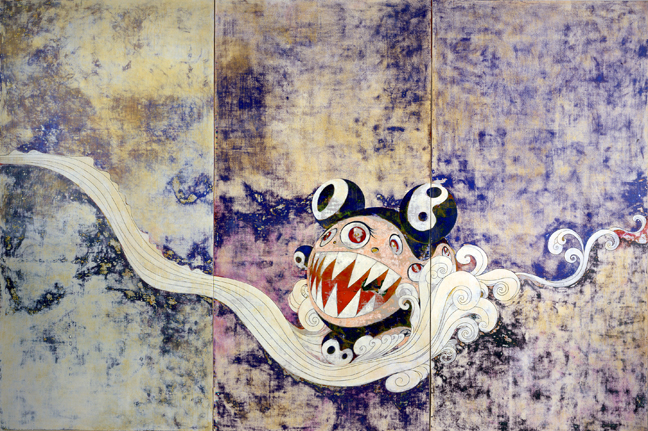
Mr. DOB is a recurring character and an alter ego for Murakami. His appearance changes from one work to another. In 727, the rounded ears and sharp teeth combine a familiar cartoon outline with a more unsettling expression. The letters in the character's head spell out his name. MoMA connects DOB to anime and manga, while its account of 727 also points to older Japanese painting techniques. The same work therefore offers two ways in: a recognisable character and an art-historical reference.
Flowers beyond the smile
The smiling flower is one of Murakami's recurring characters. Its meaning depends on the work around it. Gagosian describes his figures as a way to approach subjects including violence and fantasy. Reading every flower as a simple message of happiness misses that wider context.
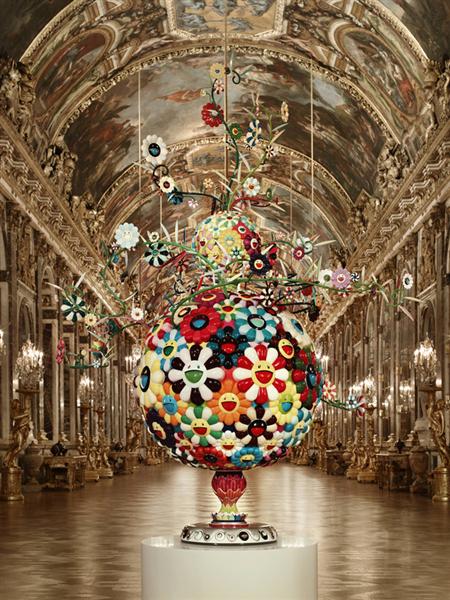
Flower Matango (b) also shows that the flower motif is not confined to a printed surface. Made between 2001 and 2006, this sculpture in The Broad's collection is about four metres high. Its materials include fibreglass and resin, with painted and lacquered surfaces. Looking at the scale and materials gives a more concrete understanding of Murakami's work than treating all his flowers as the same image.
Banner artwork images © Takashi Murakami / Kaikai Kiki Co., Ltd., via WikiArt
Works to start with
727, 1996. In this three-panel painting, Mr. DOB rides a wave across a mottled background. MoMA describes a surface built up and scraped back through about twenty layers of paint. The wave recalls Hokusai, while the panel arrangement suggests a folding screen. It is a useful starting point for seeing how Murakami combines historical forms with a contemporary character.
DOB in the Strange Forest (Blue DOB), 1999. The Broad's interpretation connects this scene to Alice's encounter with the caterpillar in Alice in Wonderland. DOB stands among mushrooms, with an appearance that can seem both curious and frightened. The museum compares his cartoon outline with Mickey Mouse and Sonic the Hedgehog. Those recognisable elements make the unfamiliar setting easier to enter.
In the Land of the Dead, Stepping on the Tail of a Rainbow, 2014. This 82-foot-long painting belongs to Murakami's response to the 2011 Tōhoku earthquake and tsunami and the Fukushima nuclear disaster. The Cleveland Museum of Art places it within a continuing investigation of crisis and its aftermath. The title also became the title of a museum exhibition.
Shōtoku Taishi at Sixteen, 2025. Murakami made this homage after finding a historical painting of Shōtoku in the Cleveland Museum of Art's Japanese collection. The museum now records Murakami's painting as a gift from the artist and Kaikai Kiki. This offers a recent example of his interest in remaking historical images.
Cleveland Museum of Art exhibition account
Cleveland Museum of Art object record
The studio behind the work
Kaikai Kiki grew from Murakami's Hiropon Factory into a company that produces artwork and manages artists. Its own history describes that transition around his 2001 exhibition at the Museum of Contemporary Art Tokyo. The company also operates galleries. This organisation helps explain how Murakami's practice extends beyond the work of one person in a studio.
His official biography lists recent projects alongside the earlier Superflat exhibitions. They include Mononoke Kyoto in 2024 and Learning from Hiroshige in New York in 2025. Both extend his engagement with Japanese visual history beyond the early Superflat exhibitions.
Museum collections in the United States
MoMA in New York holds 727. The Broad in Los Angeles holds several Murakami works, including Flower Matango (b) and DOB in the Strange Forest (Blue DOB). The Cleveland Museum of Art records Shōtoku Taishi at Sixteen in its collection. A collection record establishes a holding; it does not guarantee that the work is in a gallery on the day of your visit. Check the museum's current display information before travelling.
Timeline
- 1962Born in Tokyo
- 1993Completed a doctorate at Tokyo University of the Arts
- 2000Curated the Superflat exhibition
- 2001Hiropon Factory developed into Kaikai Kiki
- 2024Mononoke Kyoto exhibition
- 2025Learning from Hiroshige exhibition in New York
Notable Works
Tap to view larger.
Next stop
Browse the movements →
Every movement in the collection, from the Renaissance to Pop art.
Related Artists
_%E2%80%93_LOC.jpg)


Frequently Asked Questions
Is Takashi Murakami still alive?
Murakami is a living Japanese artist, born in Tokyo in 1962. His official studio biography records recent projects, including Mononoke Kyoto in 2024 and Learning from Hiroshige in 2025.What does Mr. DOB mean?
MoMA explains that DOB contracts the Japanese expression dobojite, meaning why. The character is a recurring alter ego whose appearance changes between works.What does Superflat mean?
Superflat connects flat Japanese visual forms with a cultural argument about the distinction between fine art and consumer culture. Murakami brought these ideas together in the exhibition he curated in 2000.What is Takashi Murakami known for?
Murakami is known for Superflat, the recurring character Mr. DOB and smiling flower motifs. His work connects Japanese visual traditions with anime and consumer culture.What materials does Takashi Murakami use?
The materials depend on the work. MoMA records 727 as acrylic on canvas mounted on board. The Broad records Flower Matango (b) as a sculpture made with fibreglass, resin, oil paint, lacquer, acrylic plates and iron.Which US museums hold Takashi Murakami's work?
MoMA holds 727, The Broad holds several Murakami works, and the Cleveland Museum of Art records Shōtoku Taishi at Sixteen in its collection. A holding does not guarantee that a work is currently on display; check the museum's object record before visiting.
Sources
Editorial draws on the following primary and tertiary references for Takashi Murakami.
- [1] curated_kb Gagosian artist biography Used for: movement attribution, stylistic analysis.
- [2] other Kaikai Kiki artist biography Used for: biography, birth dates, exhibition history, nationality.
- [3] museum MoMA: 727, 1996 Used for: museum holdings, notable works, technique.
- [4] museum The Broad: Flower Matango (b) Used for: museum holdings, notable works, technique.
- [5] museum The Broad: Blue DOB interpretation Used for: notable works, stylistic analysis.
- [6] museum Cleveland Museum of Art: Murakami exhibition account Used for: exhibition history, notable works.
- [7] museum Cleveland Museum of Art: Shōtoku Taishi at Sixteen Used for: museum holdings, notable works.
- [8] other Kaikai Kiki company history Used for: biography.
- [9] museum The Broad artist collection Used for: museum holdings.
Editorial overseen by Solis Prints. Sources verified 2026-10-01. Click a source for details, or hover over [N] in the page above to preview.
Editorial standardsMethodologyCorrectionsAI disclosureAbout the editorial team