



Luc Tuymans
- Contemporary
- Figurative
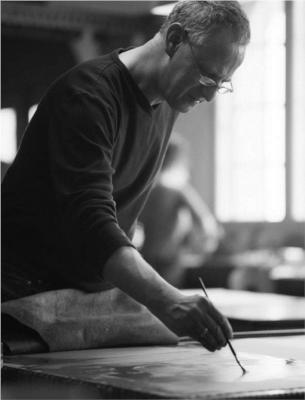
Luc Tuymans, a Belgian painter born in 1958, paused his artistic practice for several years in the early 1980s. From 1982 to 1985, he dedicated himself to studying film history, a period that deeply influenced his subsequent approach to painting. This break allowed him to consider how images operate, how they are constructed, and how they can evoke memory or unease.
Biography
Upon returning to painting, Tuymans developed a distinctive, muted style. He often works with a restricted palette, creating images that appear bleached or faded. His canvases, frequently smaller in scale, present figurative subjects that can feel both familiar and disquieting. This deliberate restraint in colour and composition defines much of his output.
Tuymans frequently draws source material from photographs, often those found or obscure, rather than well-known images. He reinterprets these visual fragments, sometimes distorting or simplifying them. His subjects range from historical events, such as the Holocaust or Belgian colonialism, to everyday objects and portraits. He approaches these topics with a quiet, almost unsettling objectivity.
His work has been exhibited widely since the late 1980s, including a major retrospective at Tate Modern in London in 2004. Tuymans has consistently explored themes of collective memory, history, and the way images shape our understanding of the world. His paintings invite close looking, prompting viewers to consider the implications of what they see.
Timeline
- 1958Born in Belgium.
- 1980Paused his artistic practice for several years in the early 1980s.
- 1980Developed a distinctive, muted style.
- 1980Draws source material from photographs.
- 1980Explores themes of collective memory, history.
- 1980Subjects range from historical events to everyday objects.
- 1980Approaches topics with a quiet, unsettling objectivity.
- 1980Work has been exhibited widely since the late 1980s.
- 1982Began studying film history.
- 1985Returned to painting after studying film.
- 2004Major retrospective at Tate Modern in London.
Notable Works
Tap to view larger.
Where to See Luc Tuymans
1 museum worldwide.
-
 27 works
Stedelijk Museum voor Actuele Kunst
Ghent, Belgium
Tue–Fri 9:30–17:30, Sat–Sun 10:00–18:00, closed Mondays; open until 22:00 on the first Thursday of the month · €17 adults
Next stop
Contemporary →
Explore the artists and ideas of Contemporary.
Related Artists


.jpg)

_%E2%80%93_LOC.jpg)
Frequently Asked Questions
What is Luc Tuymans known for?
Luc Tuymans is known for his painting of Patrice Lumumba, the first legally elected prime minister of the former Belgian Congo. The Belgium-born artist painted the portrait after investigations into his own country's past.What should I know about Luc Tuymans's prints?
Luc Tuymans is a Belgian artist known for his paintings and prints that engage with themes of history, memory, and authenticity. Born in 1958, he gained recognition in the 1990s for his distinctive style: using muted colours and seemingly detached imagery. Tuymans's prints often originate from his paintings, but they are not mere reproductions. He uses printmaking techniques, such as screen printing and etching, to further abstract and manipulate the original images. This process results in works that have a unique character, separate from the paintings they reference. His prints often feature a limited colour palette, contributing to their unsettling atmosphere. Recurring subjects include historical events, everyday objects, and images drawn from mass media. Tuymans's work prompts reflection on how images shape our understanding of the world.What style or movement did Luc Tuymans belong to?
Luc Tuymans, born in Mortsel, Belgium, in 1958, is associated with the resurgence of figurative painting in Europe during the 1980s. This movement moved away from the purely abstract, but it did not simply return to traditional representation. Instead, artists explored the power of images and how meaning is conveyed. Tuymans, like Gerhard Richter, often uses pre-existing images, such as newspaper photographs, as source material for his paintings. His work analyses the role of images in shaping histories and memories. For example, his painting *Lumumba* (2000) is based on a photograph of Patrice Lumumba, the assassinated prime minister of the former Belgian Congo. Tuymans painted it from memory, creating a distance between the painting and the photograph's perceived objectivity. His faded colours and unsettling compositions, such as *Gas Chamber* (1986), derived from an image of a concentration camp, further contribute to the conceptual nature of his work.What techniques or materials did Luc Tuymans use?
Luc Tuymans, born in Mortsel, Belgium, in 1958, is known for oil paintings created from memory of pre-existing images. His work often engages with historical and political subjects; for example, his 2000 painting *Lumumba* addresses Belgium's involvement in the assassination of Patrice Lumumba, the first prime minister of the Democratic Republic of the Congo. Tuymans's technique involves a subtle distancing from the source photograph. Rather than directly copying the image, he paints from memory, which introduces a layer of subjectivity and questions the perceived objectivity of photographs. Oil paint consists of pigments, a binding agent (oil), and a drier. Transparent mixes are applied in layers of glazing to model shapes, light, and depth. The artist mixes standard oil paint with a medium of wax and turpentine, keeping the medium warm on a hot plate. The mixture is applied to the canvas with a brush and worked with a painting spatula and knife.What was Luc Tuymans known for?
Luc Tuymans, born in Mortsel, Belgium, in 1958, is known for his contributions to contemporary European painting. He gained recognition in the 1980s, a period when painting experienced a resurgence. Tuymans, like others, moved toward conceptual approaches, often using pre-existing images from newspapers and photographs as source material. This was a departure from painting directly from life. His work explores how images shape meaning and power. For instance, his 1986 painting, Gas Chamber, depicts a nondescript room with faded colours; only the title reveals its unsettling connection to concentration camps. Similarly, Lumumba (2000) is a portrait of Patrice Lumumba, the assassinated Congolese leader. Tuymans painted it from memory rather than directly copying the photograph, creating a distance that questions the objectivity of images and their role in shaping historical narratives.When did Luc Tuymans live and work?
Luc Tuymans is a contemporary Belgian artist who was born in 1958 in Mortsel, near Antwerp. He continues to live and work in Antwerp. Tuymans is considered one of the most influential painters working today; he is known for a distinctive style of figurative painting that often engages with difficult or sensitive historical subjects. Tuymans came to prominence in the 1980s, a time when painting was often declared dead by the art world. His work helped revive interest in the medium, proving its continued relevance for exploring complex themes. Tuymans's art often grapples with questions of memory, history, and the power of images. His paintings are characterised by a muted colour palette, a sense of flatness, and a focus on specific details.Where can I see Luc Tuymans's work?
Luc Tuymans's art has been exhibited in many major museums internationally. These include the Musée d’Art Moderne de la Ville de Paris; the National Gallery of Art, Washington DC; the Tate Modern, London; and the Museum of Modern Art, New York. Other museums that hold works by artists of a similar style or period include: the Musée du Louvre, Paris, which possesses work by Leonardo da Vinci, Raphael, Caravaggio, Vermeer, Delacroix, Géricault, Veronese, Poussin, Mantegna, Ingres, David and Chardin; the Metropolitan Museum of Art, New York, which holds work by Gauguin, Homer, Robert Campin, Caravaggio, El Greco and Dürer; and the National Gallery, London, which contains work by Holbein, Titian, Seurat, Rubens, van Gogh, van Eyck, della Francesca, da Vinci, Steenwyck and Mantegna. Many other museums hold work by significant modern artists; these include the Solomon R. Guggenheim Museum, New York; the Art Institute of Chicago; the Philadelphia Museum of Art, Pennsylvania; and the Frick Collection, New York.Where was Luc Tuymans from?
Luc Tuymans is from Antwerp, a city in Belgium. Antwerp is a port city with a long history as an international trading centre. Its location has meant that it has passed through Spanish, Austrian, French, and Dutch control. Antwerp is a culturally heterogeneous region, and its resurgence as an international trading centre came in the latter half of the nineteenth century. This was fueled by the spoils of Belgium's colonial empire. Large-scale industrialised growth, funded by the Marshall Plan, followed the Second World War. Today, Antwerp is one of the busiest ports in the world and an international design capital. Antwerp has many historical landmarks, such as the Koninklijk fine arts museum, the Groenplaats, and the Onze Lieve Vrouwekathedraal.Who did Luc Tuymans influence?
Luc Tuymans, born in Belgium in 1958, is associated with a conceptual approach to painting. He is one of several artists who began using existing images from newspapers, photographs, and other sources, rather than painting directly from life. This interest in the power of images and how meaning is conveyed became more widespread in European painting from the 1980s onward. Tuymans's paintings often deal with difficult subject matter. For example, his 1986 painting, Gas Chamber, is derived from an image of a concentration camp. Similarly, the South African artist Marlene Dumas also uses source material such as newspaper photographs of dead bodies, diseased faces, and political prisoners. Tuymans has also engaged with his nation's colonial past, as seen in his painting Lumumba (2000), which addresses the Belgian government's role in the assassination of Patrice Lumumba. Like Gerhard Richter, Tuymans explores how photographs can be turned into surfaces for painting.Who influenced Luc Tuymans?
Luc Tuymans's influences are not directly addressed in the reference passages. However, the passages discuss the artistic influences on Frans Floris (1519/20-1570), a Netherlandish painter. Floris was influenced by Lambert Lombard, with whom he had a close relationship. Lombard introduced Floris to an intellectual approach to art, as well as a circle of young artists interested in the history of Netherlandish art and its relationship to the Italian Renaissance. Lombard's interests included numismatics, philosophy, ancient history, archaeology, and philology. Lombard studied the prints of Dürer, and he commended Dürer's treatise to his pupils. Lombard also studied early treatises by Vitruvius, Alberti, Pomponius Gauricus, Luca Pacioli, Francesco Lancilotto, and Sebastiano Serlio in Italy, in addition to Jean Pèlerin and Geoffroy Tory in France. These texts shaped Lombard’s approach to proportion and harmony, as well as his interest in teaching.Why are Luc Tuymans's works important today?
Luc Tuymans, born in Mortsel, Belgium, in 1958, is important because his paintings explore how images shape both history and memory. His work often begins with pre-existing photographs; however, he paints from memory rather than directly copying the source. This creates a subtle distance between the painting and the photograph's perceived objectivity. Tuymans's approach questions the power of images and how meaning is conveyed. For example, his 2000 painting *Lumumba*, now at the Museum of Modern Art, depicts Patrice Lumumba, the assassinated prime minister of the Belgian Congo. Tuymans painted the portrait after investigations into Belgium's involvement in Lumumba's overthrow. The painting's ambiguity perhaps reflects the hidden events of the colonial past. Similarly, his 1986 work *Gas Chamber* derives from a concentration camp image. The faded colours and nondescript setting gain potency once the viewer realises its source. Tuymans's art prompts reflection on difficult historical material and the role of images in understanding these events.What was Luc Tuymans's art style?
Tuymans's art style is conceptual, taking inspiration from flat newspaper images. He was inspired by Gerhard Richter, who used found images as a starting point for his paintings.
Sources
Editorial draws on the following primary and tertiary references for Luc Tuymans.
- [1] museum Stedelijk Museum voor Actuele Kunst Used for: museum holdings.
- [2] book Charlotte Mullins, A Little History of Art Used for: biography.
- [3] book Beard, Lee, 1973- author, Butler, Adam, author; Van Cleave, Claire, author; Fortenberry, Diane, author; Stirling, Susan, author, Beard, Lee, 1973- author, Butler, Adam, author; Van Cleave, Claire, author; Fortenberry, Diane, author; Stirling, Susan, author - The Art Book_ New Edition, Mini Format Used for: biography.
- [4] book Masterpieces of western art : a history of art in 900 individual studies from the Gothic to the present day Used for: biography.
Editorial overseen by Solis Prints. Sources verified 2026-09-22. Click a source for details, or hover over [N] in the page above to preview.
Editorial standardsMethodologyCorrectionsAI disclosureAbout the editorial team