

Mark Bradford
- Contemporary
- Abstract
Mark Bradford spent years working as a hairdresser in his mother's salon in South Central Los Angeles. This early experience, a daily interaction with community and materials, deeply shaped his later artistic practice. He did not pursue formal art education until his late twenties.
Biography
Born in 1961, Bradford eventually enrolled at the California Institute of the Arts, earning his MFA in 1997. It was during this period that he began to experiment with collage and found materials. He often uses salvaged paper, billboard posters, and salon "end papers", which are used to protect hair during perms. These everyday items become the building blocks of his large-format abstract works.
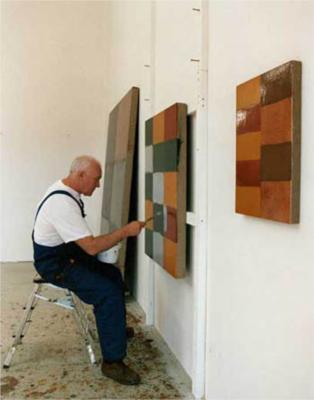
Bradford's technique involves layering these papers, then sanding, tearing, and scraping them away. This process creates dense surfaces that resemble urban decay or geological strata. His art speaks to cartography, social structures, and the lived experience of city environments. The layers reflect histories embedded within the urban fabric.
Beyond his studio work, Bradford is known for his community involvement. In 2017, he represented the United States at the Venice Biennale with his exhibition "Tomorrow Is Another Day." He also co-founded Art + Practice, an arts and education foundation in Leimert Park, Los Angeles, which supports local artists and provides educational opportunities.
Timeline
- 1961Born in Los Angeles, California
- 1997Earned MFA from the California Institute of the Arts
- 2017Represented the United States at the Venice Biennale
- 2017Co-founded Art + Practice in Leimert Park, Los Angeles
Notable Works
Tap to view larger.
Next stop
Contemporary →
Explore the artists and ideas of Contemporary.
Related Artists

_%E2%80%93_LOC.jpg)


Frequently Asked Questions
What is Mark Bradford known for?
Mark Bradford is known for his large-format abstract works constructed from salvaged paper, billboard posters, and salon "end papers". His art also speaks to cartography, social structures, and the lived experience of city environments.What is Mark Bradford's most famous work?
It is difficult to name one single "most famous" work by Mark Bradford, as his notability arises from a body of work and his distinctive approach to abstraction. Bradford is known for large-scale abstract works that incorporate materials from urban environments, such as billboards and posters. His process involves layering these materials and then excavating or sanding through them to create textured surfaces. These works often allude to the social and political landscapes of urban America. His work has been exhibited widely, including at the Venice Biennale (2017), where he represented the United States. While individual pieces might gain attention at specific exhibitions, his overall contribution to contemporary abstraction, combined with his material choices and social commentary, has established his position in the art world.What should I know about Mark Bradford's prints?
Mark Bradford, born in 1961, is an American artist known for his large-scale abstract works. He often incorporates found materials and techniques that allude to his personal history and the urban environment. Bradford's printmaking extends his exploration of layering and excavation. He frequently uses paper, which he manipulates through collage, tearing, and sanding. These processes create textured surfaces with allusions to city maps or palimpsests. His prints often contain social commentary, engaging with themes of race, class, and gender. For example, some prints incorporate billboard advertisements or posters found in his neighbourhood. These elements become embedded within the abstract composition, adding layers of meaning. Bradford's printing methods vary. Some are screenprints, while others combine techniques. The prints share visual similarities with his larger mixed-media pieces, but they also offer a more accessible entry point to his art. His work can be found in major museum collections, and his prints are popular among collectors interested in contemporary abstraction with a conceptual edge.What style or movement did Mark Bradford belong to?
Mark Bradford is usually described as a contemporary urban artist. However, this is a broad term, and it can be difficult to connect his work to any single, established style. Bradford's art is abstract, but with added dimensions that defy easy categorisation. Some see connections between Bradford and Abstract Expressionism, a movement that shifted the Western art world to New York City after the Second World War. Abstract Expressionism, which includes artists such as Willem de Kooning and Mark Rothko, features large, abstract paintings and bold brushstrokes. Subjectivity and gesture were important, as was the theme of human impulse. While Bradford's work shares some qualities with Abstract Expressionism, it also moves beyond it, engaging with social and political issues in a way that aligns with contemporary art's broader concerns.What techniques or materials did Mark Bradford use?
Mark Bradford is known for his mixed-media abstract works. He often incorporates materials sourced from urban environments, such as discarded posters, billboards, and advertising flyers. Bradford employs a distinctive decollage technique, building up layers of paper on canvas. He then sands, tears, and scrapes away sections to reveal underlying strata. This process creates textured surfaces with allusive, fragmented imagery. Paint, gel medium, and caulk are also integrated into his process. These add further dimension and complexity to the surfaces. Bradford has also experimented with using bleach to alter the colours and textures of the paper. His approach is both additive and subtractive, reflecting themes of history, memory, and social commentary. The use of found materials connects his work to specific places and communities. The layering and excavation allude to the passage of time and the accumulation of experience.What was Mark Bradford known for?
Mark Bradford is known for his large-scale abstract works that incorporate found materials. Born in 1961 in Los Angeles, he often uses paper, string, and caulk to construct collages and mixed-media paintings. Bradford's work engages with social and political issues, particularly those affecting marginalised communities. His pieces frequently reference the urban environment of Los Angeles, drawing inspiration from billboards, posters, and street detritus. He transforms these materials into complex, layered compositions that explore themes of race, class, and identity. His method involves building up surfaces with paper, then tearing, sanding, and scraping away layers to reveal underlying colours and textures. This process mirrors the way urban landscapes evolve, with layers of history and experience accumulating over time. Bradford's art offers a commentary on contemporary society, using abstraction to address complex issues.When did Mark Bradford live and work?
Mark Bradford was born in Los Angeles, California, in 1961. He continues to live and work in Los Angeles. Bradford's artistic practice emerged in the early 2000s. His large-scale abstract works often incorporate found materials, such as billboard paper and discarded posters, sourced from the urban environment of Los Angeles. These materials are layered, collaged, and excavated to create surfaces that reflect the social and political issues affecting the communities around him. His work engages with themes of race, class, gender, and the AIDS epidemic. Bradford represented the United States at the 2017 Venice Biennale, with a project entitled 'Tomorrow is Another Day'. He has had major exhibitions at institutions such as the Hammer Museum in Los Angeles, the Rose Art Museum at Brandeis University, and the Baltimore Museum of Art.Where can I see Mark Bradford's work?
Mark Bradford's work can be viewed in several prominent museums. In New York City, you can see his pieces at the Metropolitan Museum of Art, the Museum of Modern Art (MoMA), and the Whitney Museum of American Art. Other locations in the United States include the Los Angeles County Museum of Art (LACMA) and the Minneapolis Institute of Arts. Outside the United States, the Royal Ontario Museum in Toronto, Canada, also holds works that may be of interest. These institutions often rotate their collections, so checking their websites for current exhibitions is advisable before planning a visit. Additionally, the Sean Kelly Gallery has displayed Bradford's art; checking their exhibition schedule may provide further opportunities to view his work.Where was Mark Bradford from?
Mark Bradford is an African-American artist. Another African-American artist, Martin Puryear, followed Bradford in representing the United States at the Venice Biennale. Yinka Shonibare, another British-Nigerian artist born in London in 1962, moved to Lagos, Nigeria, with his family when he was three years old. As an adult, Shonibare explored the relationship between the United Kingdom and Africa in his art. He returned to Britain at seventeen to take his A Levels. Shonibare enrolled at Wimbledon College of Art but contracted transverse myelitis. This rare illness affected his spinal cord, resulting in paralysis from the neck down. He now lives and works in East London and has another studio in Peckham, south-east London.Who did Mark Bradford influence?
It is difficult to say precisely who Mark Bradford influenced. However, some connections can be drawn between Bradford and earlier artists. Jean-Michel Basquiat cited Franz Kline, Robert Rauschenberg, and Cy Twombly as inspirational. Basquiat's work has been repeatedly juxtaposed with that of Julian Schnabel, Jean Dubuffet, Joan Miró, and Twombly. Twombly purposefully placed himself at the end of a line of modernists, including Manet and Picasso. The last artist before him to resuscitate the theme of Olympia was Dubuffet, in 1950. The prevalence of textiles and recycled materials in the work of studio artists from Africa may be read as a reflection of the persistence of expectations, which now manifest as a subtle subtext within the large and diverse field of contemporary African art.Who influenced Mark Bradford?
Mark Bradford has cited a number of artists as important to his development. Among these are abstract expressionists such as Clyfford Still, Joan Mitchell, and Willem de Kooning. These mid-20th-century figures inform Bradford's large-scale works. Bradford also acknowledges the impact of Mike Kelley, a Los Angeles artist whose work often incorporated elements of pop culture and personal history. Kelley's influence can be seen in Bradford's use of found materials and his exploration of social issues. Another important influence is Robert Rauschenberg, who combined painting and sculpture using non-traditional materials. Rauschenberg's experiments with collage and assemblage resonate with Bradford's own techniques. These artists, among others, have helped shape Bradford's artistic vision. His unique approach involves layering paper and other materials to create textured surfaces.Who was Mark Bradford?
Mark Bradford was born in 1961 in Los Angeles. He continues to live and work there. In 2017, Bradford was the first African-American artist to represent the United States at the Venice Biennale with a solo exhibition. Bradford is known for his large-scale abstract paintings and collage works, often made from everyday materials. These include discarded paper, billboards, and advertisements. His work addresses social and political issues, such as race, class, and urban life. One example is Big Bling, a twelve-metre-high sculpture that he installed in Madison Square Park in New York in 2016. From a distance, the work looked like a giant animal grazing on the lawn. However, a huge shackle on the sculpture's head recalled the handcuffs used on slave ships, and the wooden frame of the body was covered with wire mesh fence, which is used to exclude people.
Sources
Editorial draws on the following primary and tertiary references for Mark Bradford.
- [1] museum Art Institute of Chicago Used for: museum holdings.
- [2] book guggenheim-newhorizonsiname00denn Used for: biography.
- [3] book guggenheim-transfsi00wald Used for: biography.
- [4] book Landauer, Susan, The not-so-still life : a century of California painting and sculpture Used for: biography.
Editorial overseen by Solis Prints. Sources verified 2026-10-16. Click a source for details, or hover over [N] in the page above to preview.
Editorial standardsMethodologyCorrectionsAI disclosureAbout the editorial team