



Graham Sutherland
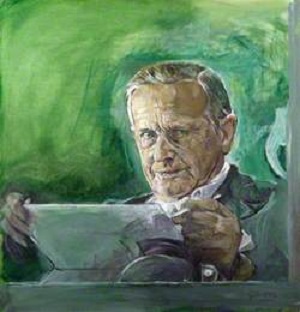
- portrait
Sutherland started as an apprentice railway engineer at the Midland Railway locomotive works in Derby. He quit after one year to study art at Goldsmiths. His early income came from etching and printmaking, influenced by Samuel Palmer. The Wall Street Crash of 1929 destroyed his American print market overnight.
Biography
In 1934 he visited Pembrokeshire for the first time, and the landscape transformed his work. He was appointed an official war artist in the Second World War, painting bomb damage, tin mines, limestone quarries, and the furnaces of steel production. He designed the seventy-eight-foot tapestry Christ in Glory for the rebuilt Coventry Cathedral in 1962, then the largest tapestry in the world.
His portrait subjects tended to hate the results. Somerset Maugham's portrait was said to make him look like the madam of a brothel. Lord Beaverbrook called his own portrait both an outrage and a masterpiece. The most famous portrait, commissioned by both Houses of Parliament for Winston Churchill's eightieth birthday, fared worst. Churchill called it filthy and malignant, and said it made him look like a down-and-out drunk picked out of the gutter in the Strand. Clementine Churchill had the painting broken into pieces and incinerated within a year of receiving it.
Timeline
- 1942Painted "Study for Illustration for 'Poems, 1937–1942' by David Gascoyne".
- 1944Painted "The Marshalling Yard at Trappes, France. Damage Done by RAF".
- 1945Painted "Flying Bomb Depot. The Caverns, Saint Leu D'Esserent, 14 January 1945".
- 1961Painted "Christ Appearing to Mary Magdalen (Noli Me Tangere)".
- 1975Painted "Road to Porthclais with Setting Sun".
Notable Works
Tap to view larger.
Where to See Graham Sutherland
19 museums worldwide.
-
 33 works
National Museum Cardiff
Cardiff, United Kingdom
Tue–Sun 10:00–17:00, closed Mondays · Free
-
 71 works
National Gallery of Art
Washington D.C., United States
Mon–Sat 10:00–17:00, Sun 11:00–18:00 · Free
-
-
9 works
National Gallery
London, United Kingdom
Daily 10:00–18:00 (Fri until 21:00) · Free
-
 8 works
National Portrait Gallery
London, United Kingdom
Sun-Thu 10:30-18:00, Fri-Sat 10:30-21:00 · Free
-


Next stop
Browse the movements →
Every movement in the collection, from the Renaissance to Pop art.
Graham Sutherland prints
Hand-finished archival prints from Graham Sutherland's body of work.


Related Artists

Take Graham Sutherland home.
See all Graham Sutherland prints →Frequently Asked Questions
How did graham sutherland die?
Graham Sutherland died in 1980 at the age of 77.What is Graham Sutherland's most famous work?
It is difficult to name a single work as Graham Sutherland's most famous. He worked in a variety of media and genres, including painting, printmaking, and design. Sutherland is known for his abstract and semi-abstract depictions of nature, often focusing on the organic forms and textures of the British countryside. His designs for the new Coventry Cathedral are also notable. Sutherland created a large artwork of Christ in Glory, which was installed in the rebuilt cathedral in 1962. He also produced a number of portraits, including those of Somerset Maugham and Winston Churchill. The Churchill portrait was presented to the Houses of Parliament in 1954; however, it was later destroyed by Clementine Churchill because she disliked it.What should I know about Graham Sutherland's prints?
Graham Sutherland was a painter, draughtsman, and printmaker. His prints, like those of many artists, have become a way to reach a wider audience due to their greater availability and comparatively lower cost. The practice of making prints dates back centuries, with early examples found in ancient Egypt and China. As paper became more accessible in Europe around the end of the 14th century, printmaking began to grow. Originally, prints were primarily functional, serving purposes such as book illustrations and religious icons. However, artists such as Dürer, Rembrandt, and Goya elevated printmaking to a high-art form. During the late 19th century, prints gained recognition as a major artistic medium. Artists started signing their prints to distinguish them from reproductions, which also confirmed the print's authenticity. Edition sizes were often limited and numbered; this allowed the artist to control the number of works on the market and prevent prints from being produced after the matrix had deteriorated. Each print in a limited edition is considered an original, created from a plate, stone, or block made specifically for that edition. The artist typically decides on the number of prints in the edition.What style or movement did Graham Sutherland belong to?
Graham Sutherland is usually associated with Neo-Romanticism, a British art movement of the 1930s and 1940s. This movement involved a nostalgic and pastoral vision of the British countryside, often tinged with a sense of melancholy or unease. Sutherland's early work, particularly his etchings, shows the influence of Samuel Palmer and Romanticism. His paintings of the 1930s, such as those of Pembrokeshire, Wales, demonstrate an engagement with natural forms, but also a move towards abstraction. These works are characterised by their emotional intensity and imaginative response to the landscape. During the Second World War, Sutherland worked as an official war artist. He produced images of industrial subjects, such as tin mines and bomb damage. These works maintain a Neo-Romantic sensibility, finding beauty and drama in unexpected places. After the war, Sutherland's style evolved further, incorporating more abstract and symbolic elements. Although his style changed over time, his work remained connected to the British Neo-Romantic tradition.What was Graham Sutherland known for?
Graham Sutherland is known for his contributions to British modernism, particularly his semi-abstract paintings of the natural world. Although he worked in various media, including printmaking and textiles, he is perhaps best recognised for his paintings. During the Second World War, Sutherland served as an official war artist, documenting industrial scenes and bomb damage. These works often depicted the ravaged landscapes of wartime Britain, influencing his later style. After the war, Sutherland's work shifted towards more organic forms, drawing inspiration from the Pembrokeshire coast in Wales. He transformed natural elements, such as roots and plants, into near-abstract compositions. These works explored the underlying structures and sometimes menacing aspects of nature. Sutherland also accepted portrait commissions; his most famous, or perhaps infamous, portrait was that of Winston Churchill, presented to him in 1954. Churchill hated the portrait, and it was later destroyed.When did Graham Sutherland live and work?
Graham Sutherland (1903-1980) was a British artist known for his paintings, prints, and designs. He was born in London, and he studied at Goldsmiths College from 1921 to 1926, initially focusing on etching. During the 1930s, Sutherland became associated with a Neo-Romantic style, often depicting natural forms and the British countryside. His work took a turn during the Second World War, when he was an official war artist, recording bomb damage and industrial scenes. After the war, Sutherland's style became more abstract and expressive. He is particularly well-known for his religious commissions, most notably the Christ in Glory design for Coventry Cathedral (1951-1962). He also painted portraits, including the controversial one of Winston Churchill (1954). Sutherland spent considerable time working in France, and he died in Menton in 1980. His work can be found in major collections, such as the Tate and the National Museum of Wales.Where can I see Graham Sutherland's work?
Graham Sutherland's works can be viewed in several public collections. The National Museum of Wales in Cardiff holds a substantial collection of his pieces, including early works and those produced during his time as an official war artist. The Imperial War Museum in London also has a number of Sutherland's war paintings. These paintings document the effects of bombing on British cities and industrial sites during the Second World War. Other UK institutions holding his work include the Tate, the British Museum, and the Victoria and Albert Museum, all in London; the Whitworth Art Gallery in Manchester; and the Scottish National Gallery of Modern Art in Edinburgh. These collections include paintings, prints, and drawings. Outside the United Kingdom, Sutherland's art can be found in collections such as the Art Gallery of Ontario in Toronto, and the Museum of Modern Art in New York. These galleries offer opportunities to view a range of Sutherland's output, from his early romantic style to his later, more abstract pieces.Where was Graham Sutherland from?
Graham Sutherland was born in London on 24 August 1903. He remained in London for his art education, studying engraving at Goldsmiths' College of Art from 1921 to 1926. Sutherland began exhibiting his work at the Royal Academy, London, in 1923, and had his first solo exhibition in London at the Twenty-One Gallery in 1925. He was an associate of the Royal Society of Painter-Etchers and Engravers from 1925 until 1933. Sutherland also taught at the Chelsea School of Art in London from 1928 to 1939, before abandoning engraving for painting in the early 1930s. During World War II, from 1940 to 1945, he worked as a War Artist, completing numerous official commissions. Graham Sutherland died in London on 17 February 1980.Who did Graham Sutherland influence?
Graham Sutherland's impact on British art can be seen in the work of artists who explored abstraction and the natural world. His wartime paintings of bomb-damaged buildings and industrial sites, such as those in Swansea and Pembrokeshire, presented a new way of seeing the British countryside. Sutherland's influence is apparent in the work of artists like John Piper, whose paintings and drawings share a similar interest in the romantic and expressive qualities of architecture and nature. Both artists were commissioned to record aspects of wartime Britain, and their work shares a sense of melancholy and drama. Another artist who was affected by Sutherland is Reg Butler. Butler, like Sutherland, created sculptures that evoke organic forms. These forms suggest growth, decay, and the power of nature. Sutherland's exploration of religious themes, particularly his design for the rebuilt Coventry Cathedral, also had an impact on subsequent generations of artists working with ecclesiastical commissions. His focus on personal expression within these traditional contexts opened new avenues for artistic exploration.Who influenced Graham Sutherland?
Graham Sutherland's artistic development involved several influences. John D Graham, a Russian émigré, was an important source of knowledge regarding contemporary European art. Graham, who had met Picasso, André Breton, and others, willingly shared his insights with younger artists in America. Graham believed artists should progress through phases: apprenticeship to old masters, a search for one's path, and mature resolution. His ideas, more than his paintings, were fundamental to the development of artists such as Arshile Gorky during the 1930s. Gorky, like Graham, was initially dedicated to Cubism, specifically Picasso. Gorky systematically absorbed modern painting, moving from Cézanne to Picasso. He emulated Picasso's styles, including the Blue and Rose Periods and Synthetic Cubism. Gorky explored Synthetic Cubism, focusing on flat shapes, colour, and pigment. He simplified Cubist iconography, favouring classical motifs over everyday subjects.Who is graham sutherland?
Graham Sutherland was one of the leading British artists of the twentieth century. The landscape of western Wales, especially Pembrokeshire, was a revelation to him.Why are Graham Sutherland's works important today?
Graham Sutherland was a British artist known for his contributions to modernism and his unique vision. Sutherland's importance lies partly in his ability to transform ordinary subjects into powerful and evocative images. He found inspiration in the natural world, particularly the landscapes of Wales and the Pembrokeshire coast, and he translated these observations into semi-abstract forms. His wartime work as an official war artist also adds to his significance. Sutherland documented the effects of the Blitz, capturing the destruction and human cost of conflict. These works provide historical insight and emotional resonance. Sutherland's later career included significant religious commissions, most notably his design for the Christ in Glory design in Coventry Cathedral. This large-scale work demonstrates his ability to work across different media and scales. His art offers a lens through which to view the mid-20th century, its anxieties, and its artistic innovations.
Sources
Editorial draws on the following primary and tertiary references for Graham Sutherland.
- [1] museum Toledo Museum of Art Used for: museum holdings.
- [2] museum Buffalo AKG Art Museum Used for: museum holdings.
- [3] museum Government Art Collection Used for: museum holdings.
- [4] museum Ulster Museum Used for: museum holdings.
- [5] museum National Galleries Scotland Used for: museum holdings.
- [6] museum Glasgow Museums Resource Centre Used for: museum holdings.
- [7] book Beard, Lee, 1973- author, Butler, Adam, author; Van Cleave, Claire, author; Fortenberry, Diane, author; Stirling, Susan, author, Beard, Lee, 1973- author, Butler, Adam, author; Van Cleave, Claire, author; Fortenberry, Diane, author; Stirling, Susan, author - The Art Book_ New Edition, Mini Format Used for: biography.
- [8] book guggenheim-handboo00pegg Used for: biography.
- [9] book Masterpieces of western art : a history of art in 900 individual studies from the Gothic to the present day Used for: biography.
Editorial overseen by Solis Prints. Sources verified 2026-10-15. Click a source for details, or hover over [N] in the page above to preview.
Editorial standardsMethodologyCorrectionsAI disclosureAbout the editorial team