



Arthur Hacker
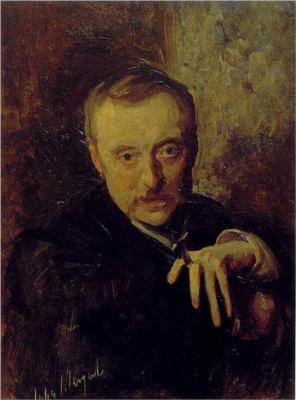
- portrait
Arthur Hacker occupied a slightly awkward position in late-Victorian British[1] painting: too accomplished to ignore, too academic to excite the reformers who dominated criticism by the end of his career. His election as a Royal Academician in 1910[1], after more than three decades of exhibiting, was recognition that had been a long time coming.
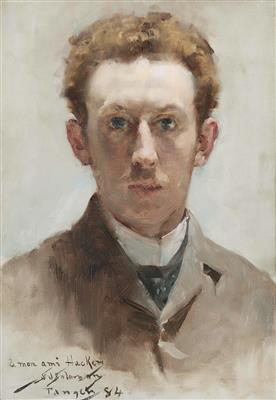
Biography
Born in St Pancras, London, on 25 September 1858[1], Hacker trained first at the Royal Academy Schools from 1876[1] to 1880, then moved to Paris to study under Leon Bonnat, the French academician who taught a generation of British[1] and American painters. Extensive travel in Spain and North Africa left a clear mark on his palette and his taste for warm, saturated interior light.
His most ambitious canvases drew on religious allegory and Arthurian legend. The Temptation of Sir Percival (Leeds City Art Gallery) and Pelagia and Philammon (Walker Art Gallery, Liverpool) show the grand narrative manner he pursued through the 1880s and 1890s. The Annunciation, now in Tate Britain, is among his best-known religious works. He was also a sought-after portraitist; the sculptor Edward Onslow Ford sat for a bust portrait[1] of him in 1894[1].
In 1902[1] he commissioned the architect Maxwell Ayrton to design his home, Hall Ingle at Heath End in Checkendon, Oxfordshire, which he decorated himself. Hacker died in Kensington on 12 November 1919[1] and was buried at Brookwood Cemetery.
Timeline
- 1858Born in St Pancras, London, on 25 September.
- 1876Began studies at the Royal Academy Schools, London, remaining until 1880.
- 1880Moved to Paris to study under Leon Bonnat.
- 1880Travelled extensively in Spain and North Africa.
- 1890Painted "The Temptation of Sir Percival".
- 1894The sculptor Edward Onslow Ford created a bust portrait of Hacker.
- 1900Painted "Pelagia and Philammon".
- 1902Commissioned Maxwell Ayrton to design his home, Hall Ingle, in Checkendon, Oxfordshire.
- 1910Elected as a Royal Academician.
- 1919Died in Kensington on 12 November and was buried at Brookwood Cemetery.
Notable Works
Tap to view larger.
Where to See Arthur Hacker
1 museum worldwide.
-
1 works
The Atkinson
Southport, United Kingdom
Next stop
Browse the movements →
Every movement in the collection, from the Renaissance to Pop art.
Related Artists


Frequently Asked Questions
What is Arthur Hacker known for?
Arthur Hacker is known for his ambitious canvases that drew on religious allegory and Arthurian legend. He was also a sought-after portraitist.What should I know about Arthur Hacker's prints?
Arthur Hacker (1858[1]-1919[1]) was a British[1] painter and illustrator, associated with the Newlyn School. Information about his prints is limited, but some general principles of print collecting and marketing may be useful. Original prints are conceived as prints, executed solely as prints, and usually issued in a numbered edition, signed by the artist. Each print in the edition is an original, printed individually from a plate, stone, screen, block, or other matrix created for that purpose. There is no single original print from which copies are made. A reproduction, though often called a print, is a copy of a work of art conceived in another medium, such as painting or watercolour. Reproductions are usually made by photomechanical means. Numbering and signing a reproduction does not change its essence; it remains a reproduction, not an original print. When buying prints, examine the colours to ensure high quality. Before entering the print market, it is helpful to understand the standard methods of signing and numbering editions. If you are creating a limited edition, with a specific number of prints, all prints should be numbered (for example, 35/100). The larger number is the total number of prints in the edition; the smaller number is the sequential number of the actual print.What style or movement did Arthur Hacker belong to?
Arthur Hacker (1858[1]-1919[1]) was active during a period of significant change in the art world, as movements such as Futurism began to question static representation. Futurists aimed to capture dynamism, embracing speed and motion as central themes. The drive to represent movement is not unique to the Futurist movement. As early as the Renaissance, artists explored ways to imply movement. Strong diagonals and open forms were used in the Baroque period to create dynamic effects, contrasting with the closed lines that accentuated repose in earlier Italian Renaissance painting. Later, techniques such as blur and stroboscopic effects were employed to convey motion. Photodynamism, developed prior to Futurism, used long exposure to create spectral blurs, capturing energy and rhythm. These methods reflect a broader interest in representing movement, which reached a peak in the early 20th century with the Futurist avant-garde.What was Arthur Hacker known for?
Arthur Hacker was an artist known for portraits. Two portraits of Arthur, Lord Grey de Wilton, exist from 1587. One is owned by Lord Tollemache at Helmingham Hall; the other is owned by the Duke of Beaufort at Badminton House. The Helmingham Hall portrait[1] is oil on panel, 39 by 30 1/4 inches, and shows a three-quarter-length view. Waterhouse identified the sitter as Lord Grey, the only Garter Knight who fits the age and date. The likeness matches the engraving of him in Marcus Gheeraerts I's *Garter Procession*. The painting is inscribed "1587/Æ te 50/DEVM COLO FORTVNA SPERNO". The Badminton House portrait is oil on panel, 40 by 30 inches, and also shows a three-quarter-length view. It was misidentified as Edward, 4th Earl of Worcester. It is nearly identical to the Helmingham portrait, except that the sitter does not wear a glove and carries a paper. The date was possibly painted out. The inscription reads "Æ te 50". The National Portrait Exhibition displayed it in 1866[1].When did Arthur Hacker live and work?
Arthur Hacker was born in London on 25 September 1858[1]. He died in London on 1 April 1919[1]. Hacker studied at the Royal Academy Schools from 1876[1] to 1880, winning a Landseer Scholarship in 1878. He also studied in Paris at the atelier of Léon Bonnat. Hacker travelled extensively in Spain and North Africa. Early in his career, he focused on social-realist and historical subjects. From the mid-1890s, he concentrated on portraits and subject pictures, often featuring female figures in classical or allegorical settings. Hacker exhibited frequently at the Royal Academy, becoming an Associate in 1893 and a full Academician in 1910. He also showed work at the New Gallery and other venues. Hacker taught at the Royal Academy Schools.Where can I see Arthur Hacker's work?
To view works by Arthur Hacker, you could start by looking at collections in the United Kingdom. The Brighton Museum & Art Gallery, Manchester Art Gallery, and the Victoria & Albert Museum in London hold pieces. The National Museums of Scotland, Royal Museum in Edinburgh also has art on display. Outside the UK, several museums across the United States feature collections of fine art. These include the Metropolitan Museum of Art in New York, the Los Angeles County Museum of Art (LACMA), the Minneapolis Institute of Arts, and the Virginia Museum of Fine Arts in Richmond. The Charles Hosmer Morse Museum of American Art in Winter Park, Florida, and the Wolfsonian in Miami Beach, Florida, also hold relevant collections. In Canada, the Royal Ontario Museum in Toronto may have works available to view.Who did Arthur Hacker influence?
Arthur Hacker's direct influence is difficult to trace, though he participated in a late-nineteenth-century revival of interest in wood-engraved illustration. This revival led to artists such as Laurence Housman and Charles Ricketts taking Pre-Raphaelite illustration in new directions. They became leading figures in the Private Press movement, producing limited editions of poetry and literature based upon the Pre-Raphaelite Brotherhood models of tasteful design and restrained decoration. Hacker's work also intersects with that of other Pre-Raphaelite-influenced artists who brought the style into the twentieth century through various printmaking methods. These include Sir Frank Dicksee and John William Waterhouse, whose subjects and styles echoed earlier Pre-Raphaelite themes and aesthetics. Arthur Hughes, a Pre-Raphaelite disciple, created illustrations for Christina Rossetti and George MacDonald, influencing children's fantasy illustration.Who influenced Arthur Hacker?
Arthur Hacker's artistic development reflects a blend of academic training and exposure to contemporary movements. Initially, he studied at the Royal Academy Schools, where he absorbed traditional techniques and principles. His early work shows the influence of Frederic Leighton, known for his classical subjects and polished style. Like Leighton, Hacker aimed for technical precision and idealised beauty in his paintings. However, Hacker also engaged with French academic realism. This is evident in his attention to detail, his naturalistic approach to figure painting, and his use of light and shadow to create depth and volume. Later in his career, Hacker's style evolved, incorporating elements of Impressionism. While he never fully embraced the movement, he adopted a lighter palette and looser brushwork, reflecting the influence of artists such as John Singer Sargent. Hacker's ability to synthesise diverse influences contributed to his success as a portrait[1] and figure painter.Who was Arthur Hacker?
Arthur Hacker (1858[1]-1919[1]) was a British[1] painter who achieved considerable recognition during his lifetime. He was born in London, and he studied at the Royal Academy Schools. Hacker's work encompassed a range of genres, including portraits, figure studies, and subject pictures. He travelled extensively, and his experiences in Spain and North Africa had an impact on his artistic style and subject matter. Hacker's paintings often display a concern with light and atmosphere. He was influenced by the work of painters such as Frank Dicksee and Lawrence Alma-Tadema. He exhibited regularly at the Royal Academy, and he became an Associate in 1893[1] and a Royal Academician in 1910. Examples of Hacker's work include "The Cloud" (1894), "Lilith" (1892), and "Annunciation" (1892). These paintings demonstrate his ability to combine academic technique with a more modern sensibility. While not considered a radical innovator, Hacker was a respected and successful artist who contributed to the artistic milieu of his time.Why are Arthur Hacker's works important today?
Arthur Hacker was a British[1] artist who achieved considerable recognition during his lifetime, particularly as a painter of genre scenes, portraits, and orientalist subjects. While his name may not be as widely recognised as some of his contemporaries, his works offer insight into the art world and social values of the late 19th and early 20th centuries. Hacker's paintings reflect the aesthetic preferences of his era. They provide valuable source material for understanding the period's artistic trends, such as academic painting and the influence of orientalism. His artistic choices, subject matter, and techniques help art historians categorise relationships between otherwise disparate things. The continued study of artists like Hacker allows for a broader and more nuanced understanding of art history. By examining artists who were successful in their time, it is possible to analyse the mechanisms of artistic reputation and the factors that contribute to the construction of art historical narratives. This approach acknowledges that art history is not simply a sequence of masterpieces but a complex field of cultural production and reception.What was Arthur Hacker's art style?
Extensive travel in Spain and North Africa influenced Arthur Hacker's art style, leaving a clear mark on his palette and his taste for warm, saturated interior light.When was Arthur Hacker born?
Arthur Hacker was born in 1858[1].
Sources
Editorial draws on the following primary and tertiary references for Arthur Hacker.
- [1] wikipedia Wikipedia: Arthur Hacker Used for: biography, birth dates, death dates, identifiers, movement attribution, nationality.
- [2] book Post-impressionism : cross-currents in European painting Used for: biography.
- [3] book Post-impressionism : cross-currents in European painting Used for: biography.
- [4] book Sickert, Walter, 1860-1942, Sickert, paintings Used for: biography.
Editorial overseen by Solis Prints. Sources verified 2026-09-30. Click a source for details, or hover over [N] in the page above to preview.
Editorial standardsMethodologyCorrectionsAI disclosureAbout the editorial team