



Émile Munier
- portrait
A painting Émile Munier completed in 1885[1] became one of the most reproduced images of the Victorian era. "Trois Amis" showed a plump girl on a bed, absorbed in play with a kitten and a small dog. Pears soap licensed it for advertising. American collectors queued for his work. He died ten years later, at fifty-five, having spent his career painting with a warmth that the French[1] academic establishment both rewarded and quietly condescended to.
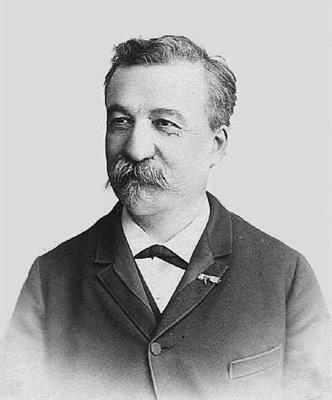
Biography
Munier came from working-class Paris: his father was an upholsterer at the Gobelins manufactory, his mother worked in a cashmere mill. He was trained first as a draftsman at Gobelins by Abel Lucas, then accepted into the studio of William-Adolphe Bouguereau, the most celebrated academic painter in France. The two became close friends. Bouguereau's influence is visible in Munier's smooth surfaces and idealized flesh, though Munier's scenes are smaller in ambition and more frankly sentimental in feeling.
He collected three medals from the Beaux-Arts during the 1860s, enough to establish a career exhibiting at the Salon. His subjects were almost always the same: young children, kittens, puppies, and the uncomplicated emotions they generated. In 1884[1] Jane Stanford commissioned a memorial painting for her deceased son, "Angel comforting his grieving mother", one of the few works where Munier reached beyond the domestic genre. His portraits and genre scenes were particularly sought after by American collectors, including the New Orleans patron Chapman H. Hyams.
Munier is rarely included in survey histories of French[1] art, partly because Bouguereau's shadow is so long, partly because sentiment itself fell out of critical fashion. His paintings remain among the more immediately legible products of the French academic tradition.
Timeline
- 1840Born in Paris; his father was an upholsterer at the Gobelins manufactory, and his mother worked in a cashmere mill.
- 1860Trained as a draftsman at Gobelins by Abel Lucas, before entering the studio of William-Adolphe Bouguereau.
- 1860Began collecting medals from the Beaux-Arts.
- 1884Commissioned by Jane Stanford to paint "Angel comforting his grieving mother", a memorial painting for her deceased son.
- 1885Completed the painting "Trois Amis", which became a widely reproduced image after being licensed for advertising by Pears soap.
- 1895Died at 55.
Notable Works
Tap to view larger.
Next stop
Browse the movements →
Every movement in the collection, from the Renaissance to Pop art.
Related Artists



Frequently Asked Questions
What is Émile Munier known for?
Émile Munier is known for his sentimental paintings of young children, kittens, and puppies. His 1885[1] painting "Trois Amis" became widely reproduced after Pears soap licensed it for advertising.What is Émile Munier's most famous work?
It is difficult to name one single work as Émile Munier's "most famous". He produced many paintings, mostly genre scenes of domestic life. His paintings often feature women and children in sentimental poses, reflecting popular tastes during the late 19th century. These works were widely reproduced as prints, further increasing his visibility. Without specific sales data or critical commentary to draw upon, it is hard to assess which enjoyed the greatest popularity during his lifetime, or which maintains the strongest reputation today. Many of his paintings share similar themes and styles, making it difficult to single out one as significantly more well-known than the others. Further research using period sources, such as exhibition catalogues and art journals, would be needed to determine which of Munier's works achieved the broadest recognition.What style or movement did Émile Munier belong to?
Émile Munier (1840[1]-1895[1]) is best known as an academic painter, sometimes placed within the late-period developments of the French[1] *pompiers* (fireman) style. This label refers to artists who maintained conservative, academic traditions during the rise of Impressionism and other avant-garde movements. Munier's style focused on genre scenes and portraits, often depicting idyllic scenes of peasant life or sentimental portrayals of women and children. His technique was characterised by smooth brushwork, careful attention to detail, and an emphasis on realistic representation, all hallmarks of academic training. While some art historians consider Munier a follower of William-Adolphe Bouguereau, it is important to note that the *pompiers* label covers a range of artists with varying approaches. Munier's work reflects a broader trend in late 19th-century art: a continuation of academic traditions in opposition to the emerging modern styles.What was Émile Munier known for?
Émile Munier (1840[1]-1895[1]) was a French[1] academic artist known for genre paintings and portraits. He studied at the École des Beaux-Arts. He was a pupil of William-Adolphe Bouguereau, who promoted an idealised, realist style. Munier's work often featured sentimental scenes of everyday life, particularly those involving children and families. These paintings proved popular with the bourgeoisie. He gained recognition in the late 19th century, exhibiting regularly at the Paris Salon. His style aligned with the academic tradition, focusing on technical skill and accessible subject matter. He secured a following among collectors, particularly in America. His paintings often depicted domestic interiors, rural settings, and scenes of maternal affection. His artistic output reflects the values and tastes of his time, appealing to a market that appreciated sentimentality and technical proficiency.When did Émile Munier live and work?
Émile Munier was born in Paris on 2 June 1840[1]. He is known for his academic genre paintings. Munier studied at the École des Beaux-Arts. He was a student of William Bouguereau, and he followed Bouguereau's artistic style closely. Munier exhibited at the Salon, the official art exhibition of the Académie des Beaux-Arts in Paris. He gained recognition for his paintings of women and children in domestic settings. Munier's paintings often depicted scenes of everyday life, with an emphasis on sentimental and idealised portrayals of childhood innocence and maternal love. He was popular among collectors during his lifetime, and his works can be found in museums and private collections today. He died 29 March 1895[1], in Paris.Where can I see Émile Munier's work?
Émile Munier's work can be viewed in several museums across Europe. In France, these include the Musée des Arts Décoratifs in Paris, the Musée d’Art et d’Industrie in Roubaix, the Musée de l’Ecole de Nancy, and the Musée des Beaux-Arts in Nancy. Other French[1] museums that hold works by artists of Munier's period include the Musée Toulouse-Lautrec in Albi, the Musée des Beaux-Arts in Besançon, the Musée des Beaux-Arts in Dijon, and the Musée de la Chartreuse in Douai. Further museums are the Musée de Peinture et de Sculpture in Grenoble, the Musée Crozatier in Le Puy, and the Musée des Beaux-Arts in Lille. Others are the Musée des Beaux-Arts in Nantes, the Musée des Beaux-Arts Jules Cheret in Nice, and the Musée Matisse in Nice. Also, the Musée des Beaux-Arts in Orléans, the Musée du Louvre in Paris, and the Musée Gustave Moreau in Paris. Plus, the Musée National d’Art Moderne, Centre Georges Pompidou in Paris, the Musée d’Orsay in Paris, and the Musée du Petit Palais in Paris. Finally, the Musée Rodin in Paris, the Musée des Beaux-Arts in Quimper, the Musée Saint-Denis in Reims, and the Musée des Beaux-Arts in Rennes. In Belgium, you can find his work at the Brangwyn Museum in Bruges and the Clockarium Museum in Brussels.Who did Émile Munier influence?
Émile Munier's artistic style aligned with academic painting; therefore, he did not directly influence avant-garde movements like Impressionism or Fauvism. However, academic painters maintained a presence in the art world, and their techniques were passed on to future generations through formal art education. Looking at other artists, Gustave Moreau, though part of an older generation, taught many of the Fauves at the École des Beaux-Arts. Moreau's emphasis on literary inspiration and ornate style had an impact on Post-Impressionism, even though he predated the movement itself. Similarly, Pierre Puvis de Chavannes, while untouched by Impressionism, was greatly admired by younger artists for his placid, mythological subjects. These examples show how artistic influence can occur across different styles and movements, even if not always direct or obvious.Who was Émile Munier?
Émile Munier (1840[1]-1895[1]) was a French[1] academic artist. He studied at the École des Beaux-Arts, where he became friendly with William-Adolphe Bouguereau (1825-1905[1]). Munier's style followed in the footsteps of Bouguereau, whose work he greatly admired. He left the École des Beaux-Arts and began exhibiting at the Paris Salon in the 1860s. His paintings often depicted domestic scenes, such as mothers with their children, and usually in rural settings. These sentimental themes made his work popular with middle-class collectors in France and America. His paintings, often executed in a highly realistic style, reflect the values and tastes of his time. Although he maintained an independent career, the artistic connection between Munier and Bouguereau remained strong throughout their lives.Why are Émile Munier's works important today?
Émile Munier was a French[1] academic artist who lived from 1840[1] to 1895[1]. He is known for his genre paintings, often depicting scenes of everyday life, particularly those featuring women and children. Munier's work provides insight into the values and aesthetics of the late 19th century. His paintings reflect the period's interest in sentimental and idealised representations of domesticity. This offers a glimpse into the social norms and cultural aspirations of the time. Munier's artistic training followed a traditional path. He studied at the École des Beaux-Arts, and he exhibited at the Paris Salon. His style is characterised by its technical skill, attention to detail, and smooth finish. Although he was not considered part of the avant-garde, his work was popular during his lifetime. He gained recognition for his ability to capture the charm and innocence of childhood. His paintings offer a contrast to the more experimental styles that emerged during the same period, such as Impressionism. This makes Munier's work a useful point of comparison for understanding the diverse range of artistic approaches that co-existed in 19th-century France.What was Émile Munier's art style?
Émile Munier's art style was influenced by William-Adolphe Bouguereau, which is visible in his smooth surfaces and idealised flesh. His paintings are considered products of the French[1] academic tradition.How did Émile Munier die?
Émile Munier died in 1895[1] at the age of 55.
Sources
Editorial draws on the following primary and tertiary references for Émile Munier.
- [1] wikipedia Wikipedia: Émile Munier Used for: biography, birth dates, death dates, identifiers, movement attribution, nationality.
- [2] book Watkins Jane (Ed.), Masterpieces of Impressionism and Post-Impressionism. The Annenberg Collection Used for: stylistic analysis.
- [3] book Watkins Jane (Ed.), Masterpieces of Impressionism and Post-Impressionism. The Annenberg Collection Used for: stylistic analysis.
- [4] book Watkins Jane (Ed.), Masterpieces of Impressionism and Post-Impressionism. The Annenberg Collection Used for: stylistic analysis.
- [5] book Nathalia Brodskaya, The Fauves Used for: biography.
- [6] book Bernard Denvir, World of Art_ Post-Impressionism Used for: biography.
- [7] book Bernard Denvir, World of Art_ Post-Impressionism Used for: biography.
- [8] book Bernard Denvir, World of Art_ Post-Impressionism Used for: biography.
Editorial overseen by Solis Prints. Sources verified 2026-09-30. Click a source for details, or hover over [N] in the page above to preview.
Editorial standardsMethodologyCorrectionsAI disclosureAbout the editorial team