



Else Alfelt
- COBRA
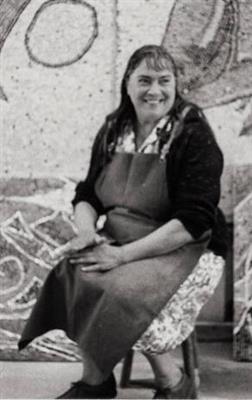
Else Alfelt came to painting without instruction and without encouragement. Born in Copenhagen in 1910[1], she was placed in an orphanage after her parents divorced and began painting around the age of twelve. When she applied to the Copenhagen Art Academy she was turned away, not for lack of talent, but reportedly because she already possessed the technical skills they taught. It was an unusual rejection that foreshadowed a career spent working largely outside official channels.
Biography
In the 1930s she joined Linien, the group that introduced Surrealism to Denmark, and during the German occupation she was part of Helhesten, a circle that used cultural activity as a form of resistance. She married the painter Carl-Henning Pedersen in the mid-1930s; at their most impoverished they repainted used canvases in order to keep working. In 1948[1] she became one of only two women among the founding members of CoBrA, the loose international movement that gathered artists from Copenhagen, Brussels, and Amsterdam around a shared rejection of geometric abstraction in favour of spontaneous, mythic imagery.
Alfelt's own paintings moved through spirals, mountains, and floating spheres toward what she described as "inner space", abstract forms with a meditative, almost cosmological quality. A journey to Japan in 1967[1] deepened that dimension. The trip produced a series of one hundred paintings titled Flower of the Universe, in which Zen Buddhist influences can be felt in the spare, contemplative handling.
She was awarded the Tagea Brandt Rejselegat in 1961[1]. She died in Copenhagen in 1974[1]. A museum devoted to her work and that of Pedersen was later established in Jutland, and a street in Copenhagen's Ørestad district bears her name.
Timeline
- 1910Born in Copenhagen. She was placed in an orphanage after her parents divorced.
- 1922Began painting around the age of twelve.
- 1930Joined Linien, a group that introduced Surrealism to Denmark, at 20.
- 1935Married the painter Carl-Henning Pedersen in the mid-1930s; they sometimes repainted used canvases due to poverty.
- 1948Became one of the founding members of CoBrA, an international movement of artists from Copenhagen, Brussels, and Amsterdam, at 38.
- 1961Awarded the Tagea Brandt Rejselegat at 51.
- 1967Journeyed to Japan, which influenced her work, at 57.
- 1967Produced a series of one hundred paintings titled "Flower of the Universe", influenced by Zen Buddhism, after her trip to Japan.
- 1974Died in Copenhagen at 64.
Notable Works
Tap to view larger.
Next stop
Browse the movements →
Every movement in the collection, from the Renaissance to Pop art.
Related Artists

.jpg)


Frequently Asked Questions
What is Else Alfelt known for?
Else Alfelt is known for paintings that moved through spirals, mountains, and floating spheres toward abstract forms with a meditative quality. Her journey to Japan in 1967[1] influenced a series of paintings titled Flower of the Universe, reflecting Zen Buddhist influences.What is Else Alfelt's most famous work?
It is difficult to name Else Alfelt's single "most famous work" definitively. Alfelt (1910[1]-1974[1]) was a Danish[1] artist known for her abstract paintings, particularly those exploring geometric forms and colour relationships. While no individual piece has achieved the level of broad public recognition that some other artists' works have, several pieces are recognised as significant within the context of her artistic output and reception. Her abstract compositions from the 1950s and 1960s, characterised by simple shapes and strong colours, are often cited as examples of her mature style. She was a member of the COBRA[1] group; her association with this movement also brought attention to her work. To identify a single "most famous" piece would require a quantitative measure of recognition, which is not readily available. However, her body of abstract paintings, especially those from her COBRA period, represents the core of her artistic contribution.What should I know about Else Alfelt's prints?
Else Alfelt was a Danish[1] artist who explored various media, and prints formed a part of her wider practice. Printmaking, like painting or sculpture, offers a medium for artists to express their ideas. Some artists focus on a single medium, while others work across many. Prints often invite close, individual viewing, encouraging a personal engagement with the artist's concepts. The artist determines the size of a print edition. Each print in an edition is considered an original, created from a plate, stone, screen, or block designed for that specific purpose. The artist individually inks and pulls each print. Numbering has become a common way of accounting for the number of prints in an edition; each print is given a specific number (for example, 12/25, meaning it is the 12th print in an edition of 25). The artist typically signs each print in pencil. Ultimately, the choice to create prints, and how they are made, depends on the artist's individual intent and artistic goals.What style or movement did Else Alfelt belong to?
Else Alfelt is associated with the CoBrA movement, which existed from 1948[1] to 1951. CoBrA took its name from the initials of the founders’ home cities: Copenhagen, Brussels, and Amsterdam. The group included artists such as Karel Appel, Asger Jorn, and Corneille. Christian Dotremont served as secretary. CoBrA artists aimed to promote spontaneity in art and challenge the artistic dominance of Paris. They drew inspiration from Surrealist automatism, allowing unconscious impulses to guide their work. They also admired the art of children, adopting a loose, expressive style. Animal imagery frequently appeared in CoBrA works, linked to the idea of instinctive creation. The group's political motivations and spontaneous approach have drawn comparisons to Abstract Expressionism. CoBrA artists often used bright colours and collaborated on murals and prints.What techniques or materials did Else Alfelt use?
Else Alfelt worked with several media throughout her career. Although best known as a painter, she also produced mosaics and watercolour pieces. In her paintings, Alfelt explored geometric forms and colour relationships. She often employed a limited palette, using colour to create a sense of depth and space. She favoured simplified shapes, such as triangles and circles, arranged in abstract compositions. Alfelt's mosaic work extended her interest in colour and form into a different medium. The inherent qualities of mosaic, with its small individual pieces, allowed her to build up complex patterns and textures. She also made use of watercolour techniques to create subtle washes of colour and atmospheric effects in some of her works. Her approach to art was characterised by a constant exploration of different materials and methods.What was Else Alfelt known for?
Else Alfelt (1910[1]-1974[1]) was a Danish[1] artist known for her abstract paintings and her involvement with the CoBrA movement. CoBrA, formed in 1948[1] by artists from Copenhagen, Brussels, and Amsterdam, sought to promote spontaneity in art, challenging the dominance of Paris. Alfelt joined the group later. Alfelt's work often featured geometric forms and symbolic colours. She developed a personal style of abstraction, exploring themes of light, space, and spirituality. Although associated with CoBrA's ideals of artistic freedom, her work remained distinct. CoBrA artists valued spontaneous painting, which is sometimes compared to Abstract Expressionism. The group's name came from combining the initials of Copenhagen, Brussels, and Amsterdam. The group was founded by Karel Appel, Jorn, Constant, Corneille, and Christian Dotremont.When did Else Alfelt live and work?
Else Alfelt was born in 1910[1] in Copenhagen. She died in 1974[1]. Alfelt was a Danish[1] artist known for her abstract paintings and her involvement with the COBRA[1] movement. In 1942[1], she met Carl-Henning Pedersen, also an artist; they married in 1936. Alfelt studied at the Royal Danish Academy of Fine Arts, in Copenhagen (1929-1935[1]). Her early work was influenced by expressionism; however, she soon developed her own abstract style, characterised by geometric shapes and symbolic colours. Alfelt's work often explored themes of spirituality, nature, and the human condition. She exhibited widely throughout her career, both in Denmark and internationally, gaining recognition for her unique contribution to abstract art. She is remembered as an important figure in Danish modernism.Where can I see Else Alfelt's work?
Else Alfelt's art can be viewed in several museum collections. These include the Aarhus Kunstmuseum in Denmark, and the Louisiana Museum of Modern Art, in Humlebaek, Denmark. Her work is also held at the Moderna Museet in Stockholm. Outside of Scandinavia, Alfelt's art has been collected by the Guggenheim Museum, New York, and The Metropolitan Museum of Art, also in New York. The Musée National d'Art Moderne, Centre Georges Pompidou, in Paris, also holds examples of her work. In the United States, you can find her work at The Art Institute of Chicago, and the Busch-Reisinger Museum, Harvard University, Cambridge, Massachusetts. Other European museums that have Alfelt's works include the Kunstmuseum Bern and the Kunstmuseum Luzern, both in Switzerland. These museums provide opportunities to experience Alfelt's artistic contributions.Who did Else Alfelt influence?
It is difficult to identify specific individuals directly influenced by Else Alfelt. Some observers have noted similarities between the work of Rosalie Gascoigne and several American minimalists, such as Carl Andre, Eva Hesse, Jasper Johns, and Agnes Martin. Gascoigne herself acknowledged the impact of Ellsworth Kelly, Morris Louis, and Cy Twombly. In Germany around 1900, Paula Modersohn-Becker absorbed lessons from Van Gogh and Gauguin during a stay in Paris. Her paintings moved away from naturalistic technique, but retained naturalist subject matter. German artists of this period struggled to reconcile idealism and naturalism. Some critics noted a superficial "international style" blurring national differences, although others perceived important distinctions between French and German art.Who influenced Else Alfelt?
Though sources do not directly address Else Alfelt's influences, they do provide some context for the artistic milieu she inhabited. The painter Paul Klee, who taught Annelise Else Frieda Fleischmann (later Anni Albers) at the Bauhaus from 1922[1], believed that people achieve their best when independent. Klee aimed to create his own style, devoid of preconceptions; he wanted to be "newborn, knowing nothing, absolutely nothing about Europe…to be almost primitive." Fleischmann considered Klee a superlative genius, especially due to his ability to combine abstract and geometric forms with natural and organic ones. Klee was friends with Wassily Kandinsky, who may also have had an impact. Jan Groth met Ernest and Sonja Ferlov Mancoba in 1967; he considered them his teachers. Sonja, a Danish[1] sculptor affiliated with the COBRA[1] group, impressed Groth with the continuity that connected her sculptures.Who was Else Alfelt?
Else Alfelt (1910[1]-1974[1]) was a Danish[1] artist working across painting, drawing, and graphic arts. She is associated with the COBRA[1] movement, an acronym for Copenhagen, Brussels, Amsterdam. This group, founded in 1948[1], included artists such as Appel, Constant, Corneille, Christian Dotremont, Jorn, and Joseph Noiret. Their unifying doctrine was complete freedom of expression, with emphasis on colour and brushwork. Alfelt's works often explored abstract forms and colour relationships. During the Second World War, Alfelt contributed to the magazine *Helhesten* (*The Hell Horse*), which, despite prevailing cultural confusion, managed to run until 1944. The magazine featured original lithographs and reproductions, covering a broad range of subjects. After the war, Danish artists renewed their international contacts, leading to a rich artistic environment. Alfelt's work contributed to this environment, and her influence can still be felt today.What was Else Alfelt's art style?
Alfelt's art style moved through spirals, mountains, and floating spheres toward what she described as "inner space". These abstract forms had a meditative, almost cosmological quality, and were later influenced by Zen Buddhist principles.
Sources
Editorial draws on the following primary and tertiary references for Else Alfelt.
- [1] wikipedia Wikipedia: Else Alfelt Used for: biography, birth dates, death dates, identifiers, movement attribution, nationality.
- [2] book guggenheim-annialbers00webe Used for: biography, stylistic analysis.
- [3] book guggenheim-guggenheimintern1960sven Used for: biography.
- [4] book guggenheim-guggenheimintern1964allo Used for: biography, stylistic analysis.
- [5] book guggenheim-northernvisionss03solo Used for: biography, stylistic analysis.
- [6] book Landauer, Susan, The not-so-still life : a century of California painting and sculpture Used for: biography.
Editorial overseen by Solis Prints. Sources verified 2026-09-30. Click a source for details, or hover over [N] in the page above to preview.
Editorial standardsMethodologyCorrectionsAI disclosureAbout the editorial team