


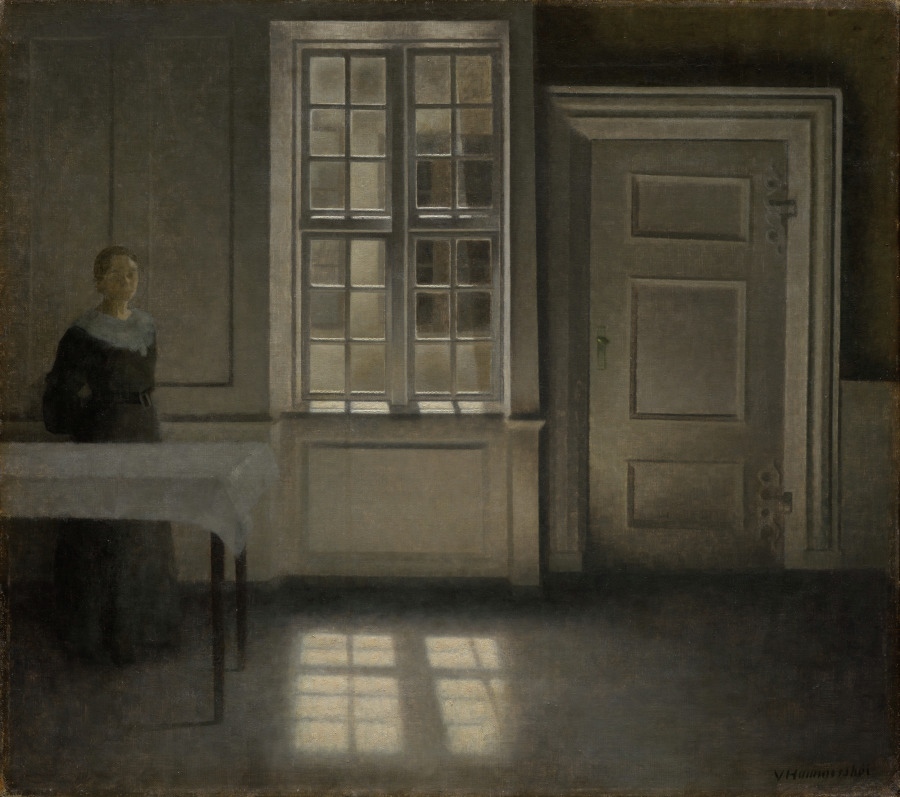


1864–1916 · Danish
Vilhelm Hammershøi

Notable Works
Tap to view larger.
Next stop
Browse the movements →
Every movement in the collection, from the Renaissance to Pop art.
Related Artists


Frequently Asked Questions
What is Vilhelm Hammershøi's most famous work?
Vilhelm Hammershøi, a Danish painter (1864-1916), is best known for his quiet interior scenes. One of his well-regarded works is *Interior with a Girl at the Clavier*. Painted in 1901, it depicts a girl seated at a piano, her back turned to the viewer. The composition employs cool, delicate pastel tones, creating a sense of peaceful serenity. The painting features a white tablecloth with crisp folds that draws the eye into the shallow depth of the room. The uncluttered composition recalls the spare, austere style of Japanese prints. The scene is flooded with clear, sharp Scandinavian light. Hammershøi's refined style has something mystical about it, reminiscent of seventeenth-century Dutch artists such as Jan Vermeer and Pieter de Hooch. His art possesses a timeless quality, offering a nostalgic escape into the past.What should I know about Vilhelm Hammershøi's prints?
Vilhelm Hammershøi (1864-1916) is best known for his paintings of quiet, sparsely furnished interiors. While he was primarily a painter, he also produced a number of prints, mainly etchings. An original print is an image conceived by the artist as a print. It is created solely as a print, usually in a numbered edition, and signed by the artist. Each print in the edition is an original, printed from a plate, stone, screen, block or other matrix created for that purpose. There is no single original print from which copies are made. Instead, each print is individually inked and pulled; it is a multi-original medium. The artist decides the number of prints in the edition. The numbering provides an accounting for the number of prints in the edition. Each print has a specific number; for example, 12/25 (the edition is 25, the particular print is number 12). Prints are sold in limited editions, so they command higher prices than posters, which are not numbered. The number of prints is limited by the number of impressions that can be made before the plate wears out. Some publishers impose their own limits on the number of impressions to increase a print’s value. These limits may be set as high as 700 to 1,000 impressions, but some prints are limited to just 250 to 500 impressions.What style or movement did Vilhelm Hammershøi belong to?
Vilhelm Hammershøi (born in Copenhagen, 1864; died there, 1916) was a Danish painter known for quiet interior scenes. His muted colours, chiefly grey, and refined style have a mystical quality. Some have compared his work to seventeenth-century Dutch artists such as Jan Vermeer and Pieter de Hooch. His paintings have a timeless quality. Scandinavian painters of the period put effort into capturing the effects of clear northern light. They often chose simple subjects, which took on fresh, pastel tones under the Arctic sun. They avoided strong colours and deep shadows. Hammershøi's uncluttered compositions recall the spare, austere style of Japanese prints. His paintings suggest peaceful serenity. One example is *Interior with a Girl at the Clavier* (1901).What techniques or materials did Vilhelm Hammershøi use?
Vilhelm Hammershøi is known for his muted colour palette, often using greys, browns, and creams to create a sense of quietude. He favoured oil paint, applying it in thin, smooth layers to achieve subtle gradations of tone. This technique contributed to the still, almost melancholic atmosphere of his paintings. Hammershøi's compositions are characterised by their simplicity and careful arrangement of space. He often depicted empty rooms or figures seen from the back, reducing details to essential forms. Light and shadow play a significant role in his work, with soft, diffused light enhancing the sense of stillness. Although he is not known as an experimental artist in terms of materials, his mastery lay in his restrained approach to painting. He used a limited range of colours and a controlled application of paint to create works that are both understated and evocative. His dedication to these techniques allowed him to explore the nuances of light, shadow, and spatial relationships within his chosen subject matter.What was Vilhelm Hammershøi known for?
Vilhelm Hammershøi (1864-1916) was a Danish painter known for his subdued, contemplative interior scenes. These paintings often feature sparse furnishings, muted colour palettes, and figures, typically women, seen from the back. Hammershøi's work frequently evokes a sense of quiet and melancholy. His paintings are characterised by their limited range of colours, often greys, whites, and blacks, which contribute to their distinctive atmosphere. The play of light and shadow is also a significant element in his compositions. Although Hammershøi painted portraits and architectural views, it is his interiors that have secured his place in art history. These spaces, often his own apartments in Copenhagen, are rendered with a meticulous attention to detail and a striking sense of stillness. His artistic style has been associated with Symbolism and a Nordic form of Realism, though his work resists easy categorisation. He remains admired for his unique vision and the evocative power of his understated imagery.When did Vilhelm Hammershøi live and work?
Vilhelm Hammershøi (1864-1916) was a Danish painter known for his quiet, contemplative interior scenes and portraits. He spent almost his entire life in Copenhagen, where he depicted the city's architecture and domestic spaces. Born in Copenhagen, Hammershøi received his artistic training at the Royal Danish Academy of Fine Arts. He exhibited his work regularly, including at the Charlottenborg Spring Exhibition and Den Frie Udstilling. His early paintings show the influence of Danish realist tradition; however, he soon developed his own distinctive style. Hammershøi's mature works often feature muted colour palettes, subtle light effects, and a sense of stillness. He frequently painted his own apartment, using his wife Ida as a model in many compositions. These paintings evoke a feeling of quiet isolation and introspection. Although his work was admired during his lifetime, his reputation grew significantly in the late 20th century. Today, he is considered one of Denmark's most important artists.Where can I see Vilhelm Hammershøi's work?
Vilhelm Hammershøi's paintings can be found in several museums, primarily in Denmark. The National Gallery of Denmark (Statens Museum for Kunst) in Copenhagen holds a significant collection of his works, offering a comprehensive view of his artistic development and recurring themes. Other Danish museums with Hammershøi paintings include the Hirschsprung Collection, also in Copenhagen, and the ARoS Aarhus Kunstmuseum. These collections often feature paintings that explore his signature style: muted colour palettes, architectural interiors, and contemplative figures. Outside Denmark, Hammershøi's art can be seen in a number of international museums. The Musée d'Orsay in Paris has examples of his interior scenes. The Metropolitan Museum of Art in New York also possesses paintings by Hammershøi, as does the Nationalmuseum in Stockholm. These international holdings allow a broader audience to engage with his distinctive aesthetic and quiet, introspective compositions. Museum websites and catalogues provide further details on specific works and their locations.Where was Vilhelm Hammershøi from?
Vilhelm Hammershøi was Danish. He was born in Copenhagen on 9 May 1864. Christened Vilhelm Hammershøj, he later altered the spelling of his surname. His parents were the merchant Christian Hammershøi and Frederikke (née Rentzmann). Hammershøi spent his life in Copenhagen, except for travels and short stays elsewhere. Many of his paintings depict the interiors of his successive Copenhagen apartments. He lived at Strandgade 30 (1893-1898), then Strandgade 25 (1898-1909), and finally, from 1909, at Bredgade 25. These buildings are all in central Copenhagen. Although associated with Danish art, Hammershøi maintained a distance from the artistic mainstream. He did not join the Grønningen artists' association until 1905, after several invitations. He remained somewhat isolated, even within the Danish art world. He died in Copenhagen on 20 March 1916 and is buried in the Vestre Cemetery.Who did Vilhelm Hammershøi influence?
Vilhelm Hammershøi's quiet, muted paintings have appealed to artists and audiences since their creation. However, it is difficult to trace direct influence. Some scholars suggest that Hammershøi's interiors anticipated certain minimalist approaches. His emphasis on atmosphere and light also connects, in some ways, to later Symbolist art. Others see a kinship with Edward Hopper's depictions of solitude. Hopper's urban scenes share a similar sense of stillness, though Hopper's colour palettes are brighter. More recently, Hammershøi's work has experienced a resurgence of interest. His paintings have appeared on album covers and in films. Authors have also referenced his atmospheric interiors. The appeal of his aesthetic continues to grow, even if specific artistic lineages are hard to define. His influence is perhaps more about a shared sensibility than direct imitation.Who influenced Vilhelm Hammershøi?
Vilhelm Hammershøi was influenced by several artists and artistic traditions. He travelled to the Netherlands in 1887 and to Paris in 1889, becoming familiar with Dutch and French art. He also knew Carl Holsoe from the Copenhagen Academy. Hammershøi's paintings of clean, simple interiors, filled with light, recall the work of Johannes Vermeer and Pieter de Hooch. Like those earlier Dutch artists, Hammershøi often depicted solitary figures, especially women reading, in quiet domestic settings. These scenes evoke a mood of reflection and repose. His work also shows the influence of Christoffer Wilhelm Eckersberg, a Danish interior painter from the first half of the 19th century, and James McNeill Whistler. While Hammershøi's interiors share some qualities with Biedermeier art, such as domesticity and simplicity, they also possess a sense of melancholy, asceticism, and isolation.Who was Vilhelm Hammershøi?
Vilhelm Hammershøi (1864-1916) was a Danish painter, known for his muted colour palette and contemplative interior scenes. He often depicted figures in quiet, sparsely furnished rooms. Born in Copenhagen, Hammershøi studied at the Royal Danish Academy of Fine Arts during the 1880s. He exhibited regularly at Charlottenborg, and he was a founding member of Den Frie Udstilling, an alternative exhibiting group. Hammershøi's work displays an interest in atmosphere and light. His paintings often feature a limited range of greys, browns, and whites. Certain motifs recur throughout his career: the artist's apartment at Strandgade 30 in Copenhagen, the isolated figure of his wife Ida, and the architecture of old buildings. His paintings evoke a sense of stillness and introspection. Although his work was admired during his lifetime, Hammershøi remained somewhat outside the mainstream of Danish art. Interest in his paintings increased significantly in later decades. Today, he is recognised for his unique contribution to European Symbolism and his distinctive vision.Why are Vilhelm Hammershøi's works important today?
Vilhelm Hammershøi's paintings offer a distinctive contribution to European art. Born in Copenhagen in 1864, he is best known for his subdued interior scenes and portraits. Hammershøi trained at the Royal Danish Academy of Fine Arts during the 1880s. He developed a muted, tonalist style, often using a limited colour palette of greys, browns, and creams. His paintings frequently depict the artist's own apartments, particularly those at Strandgade 30 in Copenhagen. These interiors are characterised by their sparse furnishings, quiet atmosphere, and the frequent presence of a lone figure, often a woman seen from the back. Hammershøi's wife, Ida Ilsted, was a frequent model. Although his work was exhibited during his lifetime, he remained somewhat outside the dominant artistic movements of his time. Interest in Hammershøi's art increased significantly in the late 20th century. This revival may be attributed to a renewed appreciation for his quiet, contemplative aesthetic and his unique treatment of light and space. His paintings provide a sense of stillness and introspection that continues to resonate with contemporary viewers.