



Antonio Jacobsen
- marine art
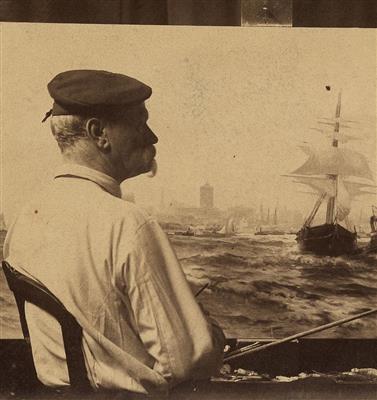
Antonio Jacobsen painted ships. Over five decades in New York, he produced an estimated six thousand portraits of individual vessels: steamships, sailing ships, yachts, and ferries, each identified by name and rendered with the accuracy of a marine architect.

Biography
Born in Copenhagen in 1850[1], Jacobsen studied at the Royal Danish[1] Academy before emigrating to the United States in 1873[1]. He settled in West Hoboken, New Jersey, overlooking New York harbour, and began painting the ships that passed through the world's busiest port.
His method was systematic: ship owners commissioned portraits of their vessels, providing rigging plans and specifications. Jacobsen painted each ship against a standard grey-green sea, the hull proportions exact, the pennants and flags correct. The paintings served as both business records and objects of pride for the companies that commissioned them.
Jacobsen's output was prodigious. He painted virtually every major vessel entering New York harbour between the 1870s and his death, making his body of work an unmatched visual archive of American maritime history. He died in Hoboken in 1921[1].
Timeline
- 1850Born in Copenhagen, Denmark
- 1870Began painting ships entering New York harbor
- 1873Emigrated to the United States
- 1873Settled in West Hoboken, New Jersey
- 1921Died in Hoboken, New Jersey
Notable Works
Tap to view larger.
Next stop
Browse the movements →
Every movement in the collection, from the Renaissance to Pop art.
Related Artists




Frequently Asked Questions
What is Antonio Jacobsen known for?
Antonio Jacobsen is known for his ship portraits. He painted virtually every major vessel entering New York harbour between the 1870s and his death, making his body of work an unmatched visual archive of American maritime history.What is Antonio Jacobsen's most famous work?
It is difficult to name one single work as Antonio Jacobsen's most famous, as he produced hundreds of ship portraits during his career. He is best known for his paintings of vessels, particularly those active in the late 19th and early 20th centuries. Jacobsen was a prolific artist, creating works for ship owners, captains, and maritime enthusiasts. His paintings are admired for their accuracy and detail, which makes them valuable historical records of specific ships. He often depicted ships in various weather conditions, and his skill in capturing the details of rigging, flags, and ship construction is notable. While no single painting has achieved universal recognition as his "most famous," his body of work as a whole has secured his place as one of the premier maritime artists of his time. Examples of his work can be found in many maritime museums and private collections.What should I know about Antonio Jacobsen's prints?
Antonio Jacobsen (1850[1]-1921[1]) was a maritime artist, known for his paintings of ships. He was born in Copenhagen, Denmark, but emigrated to the United States. Jacobsen was a prolific painter, producing thousands of ship portraits during his career. These paintings document a wide array of vessels, from commercial ships and naval vessels to private yachts. He is particularly known for his detailed and accurate depictions of these ships, often including their names, flags, and other identifying features. Prints of Jacobsen's work are popular among maritime history enthusiasts and collectors. They offer a glimpse into the ships of the late 19th and early 20th centuries. The prints vary in quality and value, depending on factors such as the rarity of the image, the condition of the print, and the reputation of the publisher. Some prints are reproductions of his original paintings, while others may be based on photographs or other sources.What style or movement did Antonio Jacobsen belong to?
Antonio Jacobsen (1850[1]-1921[1]) was an American maritime artist. He is best known for his paintings of ships, particularly steamships, and his work is often categorised as belonging to the maritime art tradition. He produced more than 6,000 paintings during his career, and his work is known for its accuracy and detail in depicting vessels of all kinds. While Jacobsen's style is representational, it does not neatly fit into movements such as Impressionism or Realism. His focus was primarily on the precise depiction of ships, and his work is therefore often considered within the more specialised category of maritime painting, rather than a broader artistic movement. Maritime painting is a genre in itself, focusing on the sea and ships as its primary subject matter.What techniques or materials did Antonio Jacobsen use?
Antonio Jacobsen primarily used oil paints on stretched canvas to create his ship portraits. He often worked on pre-primed canvas. While specific details about his personal studio practices are scarce, the techniques of his contemporaries and predecessors offer some insight. Artists of the time typically employed brushes of varying sizes and materials, including hog's hair, and painting knives. They used a range of mediums to adjust the consistency and drying time of their paints; linseed oil was a common choice. The preparation of the canvas was also an important step. This often involved applying a ground layer, consisting of materials like red ochre and gesso tempered with linseed oil, using a palette knife. Some artists also made preparatory sketches or oil studies before beginning a final work.What was Antonio Jacobsen known for?
Antonio Jacobsen (1850[1]-1921[1]) was a Danish[1]-American maritime artist. He is best known as a painter of ship portraits. Jacobsen was prolific; he produced more than 6,000 paintings during his career. He focused almost entirely on depictions of individual vessels. These were usually merchant ships, passenger liners, or naval ships. His work is characterised by a straightforward, literal style. He aimed to accurately represent the details of each ship, from its hull to its rigging. Born in Copenhagen, Jacobsen emigrated to the United States in 1871[1]. He settled in New York City and began painting ships for various shipping companies and private owners. His paintings became popular for their precision and clarity. They offer a detailed record of ships from the late 19th and early 20th centuries. His paintings are now valued by collectors and maritime history enthusiasts.When did Antonio Jacobsen live and work?
Antonio Jacobsen was born on 2 November 1850[1] in Copenhagen, Denmark. He emigrated to the United States in 1871[1]. Jacobsen died in 1921[1] in West Hoboken, New Jersey. Jacobsen is known as a painter of ships. He was prolific, creating more than 6,000 paintings during his career. He primarily worked in the New York City area. His paintings were typically portraits of individual vessels; he was regularly commissioned by ship owners. Jacobsen meticulously documented details of each ship, from hull design to the specific rigging. His paintings offer insight into maritime history during the late 19th and early 20th centuries. Jacobsen captured the transition from sail to steam power, as well as various types of vessels, including schooners, steamboats, and ocean liners.Where can I see Antonio Jacobsen's work?
Many museums hold examples of Antonio Jacobsen's maritime paintings. In the United States, these include the Metropolitan Museum of Art in New York; the Los Angeles County Museum of Art (LACMA); the Minneapolis Institute of Arts; the Charles Hosmer Morse Museum of American Art in Winter Park, Florida; the Virginia Museum of Fine Arts in Richmond; the Wolfsonian at Florida International University in Miami Beach; the San Antonio Museum of Art; the Santa Barbara Museum of Art; the University of Georgia, Lamar Dodd School of Art, in Athens; the University of Pennsylvania Museum of Archaeology and Anthropology, in Philadelphia; The Walters Art Museum, in Baltimore; and the Yale University Art Gallery, in New Haven, CT. Outside the United States, Jacobsen's work can be seen at the Royal Ontario Museum in Toronto, as well as at the National Museums of Scotland, Royal Museum, in Edinburgh.Who did Antonio Jacobsen influence?
It is difficult to identify specific artists who were directly influenced by Antonio Jacobsen. However, one can discuss the influence of earlier artists on later generations. Caravaggio, for example, influenced painters such as Hendrick ter Brugghen, Gerrit van Honthorst, Dirck van Baburen, Rembrandt van Rijn, Simon Vouet, Valentin de Boulogne, Georges de La Tour, Francisco Ribalta, Jusepe de Ribera, and Diego Velázquez. The rise of modern art in the twentieth century brought renewed interest in Caravaggio, with art historian Roberto Longhi playing a significant role in raising his critical profile. Titian was also an important influence. Annibale Carracci, along with Caravaggio, helped initiate the Baroque style in Rome, and Carracci's work shows the influence of Titian's atmospheric settings, figures, and use of light. Rubens copied Titian's paintings in the royal collection in Spain and was deeply admiring of his art. Anthony Van Dyck also studied Venetian art and Titian, learning to use oil paint to create scenes of material and atmospheric splendour.Who influenced Antonio Jacobsen?
It is difficult to identify specific artistic influences for Antonio Jacobsen. However, some general observations can be made regarding influences on artists of his period. Some artists find inspiration in the work of others, both contemporary and historical. They study the techniques and approaches of admired figures, such as Old Masters, Cubists, or more recent artists. This study can involve analysing the structure of paintings or even creating abstract responses to existing works. The goal is to understand the artistic choices made by others and to build upon them. Contact with other artists is also important. The exchange of ideas and the sense of community can be a source of inspiration and motivation. Artists may find themselves in unconscious collaboration, pushing each other to improve and innovate. This collaboration can take the form of discussions about painting techniques or simply observing how other artists approach their work and life.Why are Antonio Jacobsen's works important today?
Antonio Jacobsen (1850[1]-1921[1]) was a Danish[1]-American maritime artist. He is known for his paintings of ships, particularly those active in the late 19th and early 20th centuries. His importance today lies in his detailed documentation of a bygone era of maritime history. At the time Jacobsen was working, European styles of architecture were being adapted by the North American colonies of France, Spain and England. Various elements of the prevailing European styles were blended with regional materials and local considerations. Jacobsen's works offer valuable insights into ship design, maritime operations, and the merchant marine. His paintings are prized by collectors, museums, and historical societies for their accuracy and artistic merit. They provide a visual record of specific vessels, often including details of their rigging, flags, and deck arrangements. His art allows us to visualise the ships that shaped global trade and naval power during a period of significant technological change.What was Antonio Jacobsen's art style?
His method was systematic; ship owners commissioned portraits of their vessels, providing rigging plans and specifications. Jacobsen painted each ship against a standard grey-green sea, the hull proportions exact, the pennants and flags correct.
Sources
Editorial draws on the following primary and tertiary references for Antonio Jacobsen.
- [1] wikipedia Wikipedia: Antonio Jacobsen Used for: biography, birth dates, death dates, identifiers, movement attribution, nationality.
- [2] book Masterpieces of western art : a history of art in 900 individual studies from the Gothic to the present day Used for: biography.
- [3] book Beckett, Wendy, Sister Wendy's odyssey : a journey of artistic discovery Used for: biography.
- [4] book Landauer, Susan, The not-so-still life : a century of California painting and sculpture Used for: biography.
Editorial overseen by Solis Prints. Sources verified 2026-09-30. Click a source for details, or hover over [N] in the page above to preview.
Editorial standardsMethodologyCorrectionsAI disclosureAbout the editorial team